

For 25 years, Bellevue Literary Review has been publishing stories, essays, and poems that take readers into the shared space where art and medicine meet. Throughout our anniversary year, we’re marking this incredible milestone by inviting you on a journey through the BLR archive, from the beginning through the present.
Join us each week as we curate special highlights — stories, poems, photos, and more — from each of our issues.

About the Issue
Published one year after the attacks of September 11, BLR’s third issue features a special section about that devastating day and its aftermath. These writings serve as a type of freeze-frame, preserving details and emotions that might otherwise be lost to time.
The issue is also home to poems by Julia Alvarez, Cortney Davis, and Rick Moody; a debut story from Robert Oldshue; and more.
From the Foreword
“A call for manuscripts related to September 11th yielded hundreds of replies, so many of them heart-wrenching to read. They easily could have filled the entire issue, but it seemed—as in many other cases of literature—that less would be more, and we decided to make only one section of this issue devoted to September 11th. We received dozens of eye-witness accounts—people walking to work, people watching from their apartments, people out buying groceries. It seemed that it would be impossible to do justice to a recounting of the events, since there were thousands of individual lenses on that day and choosing two or three would seem to slight all the other, equally compelling, perspectives. Similarly, fiction that used the attacks as part of the story, as a dramatic canvas, felt too uncomfortable to use—not yet, or ever, at least for those of us living in New York.
It seemed that poetry, often thought of as the least linear genre of writing, felt the most appropriate. The tragedies of that day remain so illogical to us, so impossible to integrate, that poems, with their small but carefully wrought images, seemed most palatable. None of the five poems published herein attempts to amalgamate the whole event; they only dust off and illuminate one small speck. And perhaps that is all we can absorb at a given time. We do, also, present two prose pieces that each offer unique perspectives, without the hubris of ‘doing it all.'”
– Danielle Ofri, Editor-in-Chief
Read Highlights from Issue 3
Each week, we’ll be highlighting one outstanding story, poem, and essay from the featured issue. We encourage you to explore more from the issue on our website or, better yet, to pick up a copy!
Il Faut
by Stephanie Hammer
He has always liked a garden. He needs to plant the bulbs. They were sent to him from England, from a private botanical society that knew about how he’d transformed an old abandoned lot in Brooklyn into beautiful Schraff Park with the help of the local kids.
The gardener sighs, wipes his sunburned forehead with an old-fashioned cotton handkerchief. Squints up at the sky. A good day to plant.
The English people had also just heard about his son. They were, he supposed, trying to say something about renewal, about cultivating one’s garden (he had gone to college once and he remembers that line), about life in the very heart of obliteration.
Visual Anguish and Looking at Art
by Carol Zoref
Have you seen it?
‘It.’ The question comes easier this way, or perhaps with less difficulty than finding the words to name an absence instead of a presence. The question is tucked between the detailing of deadlines, news reports, and the practicalities of living in a city that has been bombed. My verb of choice: bombed. Neither ‘event’ nor ‘tragedy’ sounds right, though nouns will come soon enough. For now, here at the beginning, only verbs will do.
I understand these were commercial jetliners, not ICBMs, that split the steel and glass of the World Trade Center. But these were missiles none-the-less, guided to their targets by hand, by eye. Someone, a person, had a long-standing vision, intentions, imagined the explosions and death that would follow. The relationship of this action to seeing, including my seeing, is one of the things I cannot get out of my mind.
Rubies of Babylon
by Tim Suermondt
I lie back a little dreamlike,
let Mary Immaculate take the blood she needs.
The sun has found its way inside,
enveloping all of us in its light—
I swear I see my mother putting my brothers to bed,
“There aren’t any monsters. Be brave like Hoppy.”
Before I can say a word to her, she’s gone….
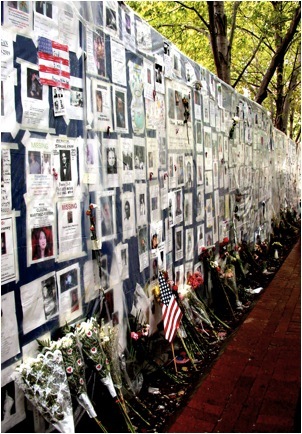
The “wall of prayers” outside of Bellevue Hospital became an impromptu memorial where people placed flyers, photos, and notes about loved ones missing in the aftermath of September 11.
(Photo credit: Troi Santos)