


For 25 years, Bellevue Literary Review has been publishing stories, essays, and poems that take readers into the shared space where art and medicine meet. Throughout our anniversary year, we’re marking this incredible milestone by inviting you on a journey through the BLR archive, from the beginning through the present.
Join us each week as we curate special highlights — stories, poems, photos, and more — from each of our issues.

About the Issue
What began as a theme issue about becoming old transformed into a collection of meditations on the ongoing process of aging. It also features a truly special cover that created a connection spanning more than 50 years. Read more about that below.
From the Foreword
“When we consider aging, most of us think of growing old. Indeed, that is how the editors of the Bellevue Literary Review conceived of it when we first called for manuscripts for a special issue on aging. However, the varied response from the writing community suggested a broader interpretation: aging, in fact, is a lifelong process, beginning from the moment we are born, extending—in fits and starts—until our last breath. This issue of the BLR reflects that continuum, each piece focusing on a particular nuance of aging.”
– Danielle Ofri, Editor-in-Chief
Read Highlights from Issue 13
Each week, we’ll be highlighting one outstanding story, poem, and essay from the featured issue. We encourage you to explore more from the issue on our website or, better yet, to pick up a copy!
The Father of Joan of Arc
by Ron Rindo
Two months after the loss of my only child, whose death—for which I am responsible—came in an unspeakable manner, I stand in line at the gas station, waiting to pay for my gas. Even now, such mundane activities feel obscene to me. I do them, yes. My body moves, my eyes see, I make small talk. I am mastering the clichés: I live one day at a time. I await the elusive silver lining. I nod at well-meaning comments ranging from the inane to the imbecilic: He’s in a better place now. Everything happens for a reason. God only takes the best. But inside I am far away, suffocating in a limpid pool of memory and self-loathing.
My son Paul died in a farming accident. This is what I’ve been told to say by a woman named Mary, a therapist, yes, who I am seeing—the only man in my family to need such a thing, ever. She is the sister of our priest, Father Bill, who likes to say that Mary heals troubled minds, while he ministers to wounded souls. An orthopedist tends to my damaged hand, lately fused and hardened into a claw. Pieces of me are under repair at different shops, the outcome far from certain.
Solitude
by Joan Kip
Black as a mahogany Madonna, my neighbor’s cat rests among the scarlet-flowered salvia bushes, several feet from the bird feeder. She invites no one. Should a neighborhood cat wander in, it is swiftly repulsed. From my window I admire—with a trace of envy—the independence and the undeviating sense of purpose of my uninvited guest as she settles into her instinctive nature. Motionless for hours, she has found her place of a defined aloneness.
I continue to battle for mine in the eleven years since the death of my husband, Art. I confront the unrelenting pull of conflicting desires: those that yearn for the comfort of friends, and those that ache to be alone in the silence of my room. Only in the silence do my thoughts and I hear each other, as the unquiet world outside rocks to its cacophonous beat, energizing the young and exhausting the elderly. At a restaurant yesterday, I was unable to hear my companion through the buzz of voices and the unceasing din of cutlery against plate. She suggested that I deactivate one of my digital hearing aids, and I was, once again, grateful for modern technology.
Love on Death’s Doorstep
by Alice Wirth Gray
Her lovely face captured the one
available male in the old folks’ home.
She’s found, at long last, Mr. Right,
absolutely faithful, endlessly attentive,
forgiving of all idiocy. Imagine if he
had been your grandfather.
The nicest man you’d hope to meet,
agrees our daughter;
he has such sweet manners.
On their walkers, constantly together
they stagger the rest-home halls,
play out their French farce
on adjoining balconies.
He calls her by his dead wife’s name;
and she, awakened from her frequent naps,
starts up in his bed and names him: Who?
Issue 13: The Cover

Michi Yasumura—pictured above left on the back cover of this issue—was hired by Bellevue in 1947 as part of the Children’s Recreation Department. She was assigned to the cardiac wards, where her job was to keep the kids “quietly occupied.” Boredom was a serious problem, and the Children’s Recreation Department was among the resources created to deal with it.
A volunteer named Mrs. Marshall created two chess clubs on the children’s ward—one for boys and one for girls. Once a week, Mrs. Marshall would bring the equipment to the wards and help the children play chess. She would leave the children with a problem to solve during the week. This photo was taken in the early 1950s.
“Like coming home…”
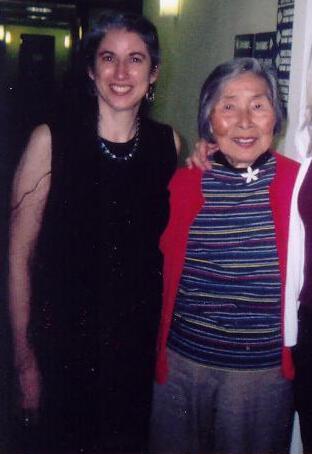
This cover photo was chosen because of its striking composition of two young girls playing chess, alongside two women of different generations, but we had no idea who the people were. Lorinda Klein, a former nurse at Bellevue and its unofficial historian, pointed to the person on the left. “That’s Michi Yasumura—what a wonderful woman!” Then she added, “When Michi left Bellevue, she moved down to North Carolina. She might still be alive, probably in her nineties.”
BLR editor Danielle Ofri got on the trail, and hunted down Michi’s phone number. Michi was thrilled to hear that she’d be on the cover of BLR and decided to make the trip north, despite her frail condition. On a Sunday afternoon in October 2007, Michi attended the BLR reading in Bellevue’s historic rotunda. She blushed when the audience of 100 applauded her, but was also beaming. She later told us that returning to Bellevue was like coming home.
Shown above: Danielle Ofri and Michi Yasumura at Bellevue Hospital, 2007