

For 25 years, Bellevue Literary Review has been publishing stories, essays, and poems that take readers into the shared space where art and medicine meet. Throughout our anniversary year, we’re marking this incredible milestone by inviting you on a journey through the BLR archive, from the beginning through the present.
Join us each week as we curate special highlights — stories, poems, photos, and more — from each of our issues.

About the Issue
This week the spotlight turns to one of BLR‘s early theme issues, about abilities and disabilities. Our bodies are unique in their strengths and their shortcomings, and we as unique beings often turn those shortcomings into strengths. The authors in this issue capture—as the issue’s subtitle notes—the range of human function.
From the Foreword
“‘Disability’ is a word that often polarizes. It is a concept that assumes classification: once a person is disabled, he or she is conveniently tucked into that slot, as though disability were one single thing. The assumption is that the various disabilities have sufficient overriding similarities to live comfortably and logically alongside each other in one single category. When that thinking is examined, it seems woefully naïve….”
– Danielle Ofri, Editor-in-Chief
Read Highlights from Issue 15
Each week, we’ll be highlighting one outstanding story, poem, and essay from the featured issue. We encourage you to explore more from the issue on our website or, better yet, to pick up a copy!
Plazoleta
by Eric Stener Carlson
The woman turned around to take a look at Macedonio and saw a long thread of spit running from his mouth to the rocks below. “That’s disgusting,” she muttered, and turned away. “Someone else is going to have to clean that up. I’m not lifting a finger.
The sparrows, interested by the ants and the thread of spit, drew closer. They gathered, attentive. Eyes bright, beaks opening. But, all of a sudden, they scattered. Rising together, they flew towards Santa Fe Avenue, over the plazoleta, over the trees, over the penthouses of the buildings—three black spots in a blue sky, as if guided by a magic wand.
Tethered to the Body
by Jane Kokernak
A $6,000 insulin pump with an on-board computer chip is not alluring. Neither is the white mesh adhesive patch on my naked abdomen or the length of nylon tubing that connects the patch to the pump. There is only illness, and there is no way to make that sexy. After several years as a medical device wearer, I know.
The Speed of Mice
by Hal Sirowitz
When the Parkinson’s medication
wears down, I turn into Cinderella.
My means of transportation
slows down to the speed of
a pumpkin pulled by mice.
My shoes still fit my feet.
But I take them off. They
make too much noise as
I drag them across the floor.
Issue 15: The Cover
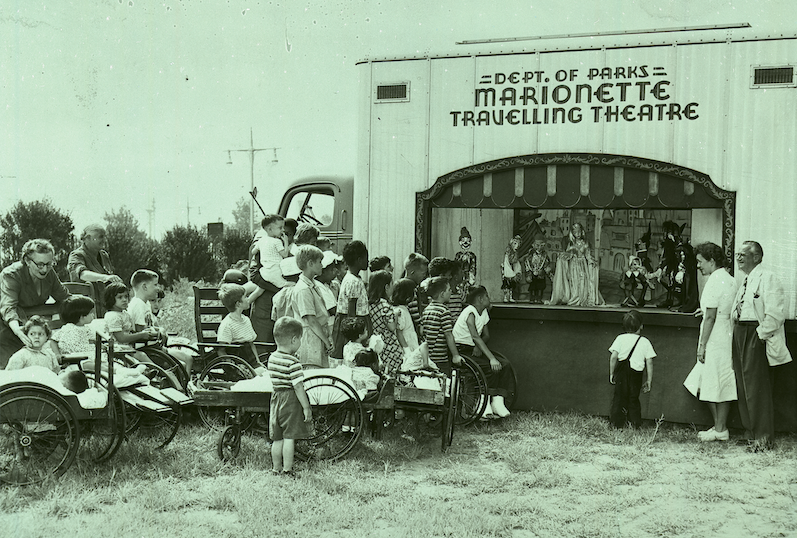
This photo, taken on one of the lawns of Bellevue Hospital on August 28, 1951, appeared in the New York Daily Mirror. Like most hospitals at the time, Bellevue strictly enforced visiting hours, including for parents of hospitalized children. To make up for this lack of parental contact, the Children of Bellevue program formed a Children’s Recreation Department. Hundreds of volunteers donated time and effort. The city of New York also sponsored programs for hospitalized children. The puppet show depicted in this photo is by the New York City Parks Department Traveling Marionette Theater, whose home base remains in the Swedish Cottage in Central Park. In attendance at this performance were Dr. Salvatore Cutolo, the medical director of Bellevue Hospital and Miss Alessandrini, the first director of Children of Bellevue.