

Our first BLR Book Club pick is FIRE EXIT, a novel by Morgan Talty. Named a Best Book of the Year by TIME, The New Yorker, ELLE, NPR, and Harper’s Bazaar, Fire Exit is available on BLR’s Bookshop page, where a portion of every purchase goes to supporting our programming.
About Fire Exit
From the award-winning author Morgan Talty, comes a masterful and unforgettable story of family, legacy, bloodlines, culture and inheritance, and what, if anything, we owe one another.
From the porch of his home, Charles Lamosway has watched the life he might have had unfold across the river on Maine’s Penobscot Reservation. He caught brief moments of his neighbor Elizabeth’s life―from the day she came home from the hospital to her early twenties. But there’s something deeper and more dangerous than the river that divides him from her and the rest of the tribal community. It’s the secret that Elizabeth is his daughter, a secret Charles is no longer willing to keep.
Every week, we will be discussing a section of the book; follow along and learn more by visiting our BLR Book Club page, where weekly posts will live.
To be a part of the discussion, don’t forget to sign up for the BLR Book Club Facebook Group.
For weekly reminders, sign up for BLR’s newsletter.
Note: All pagination is based on the paperback version.
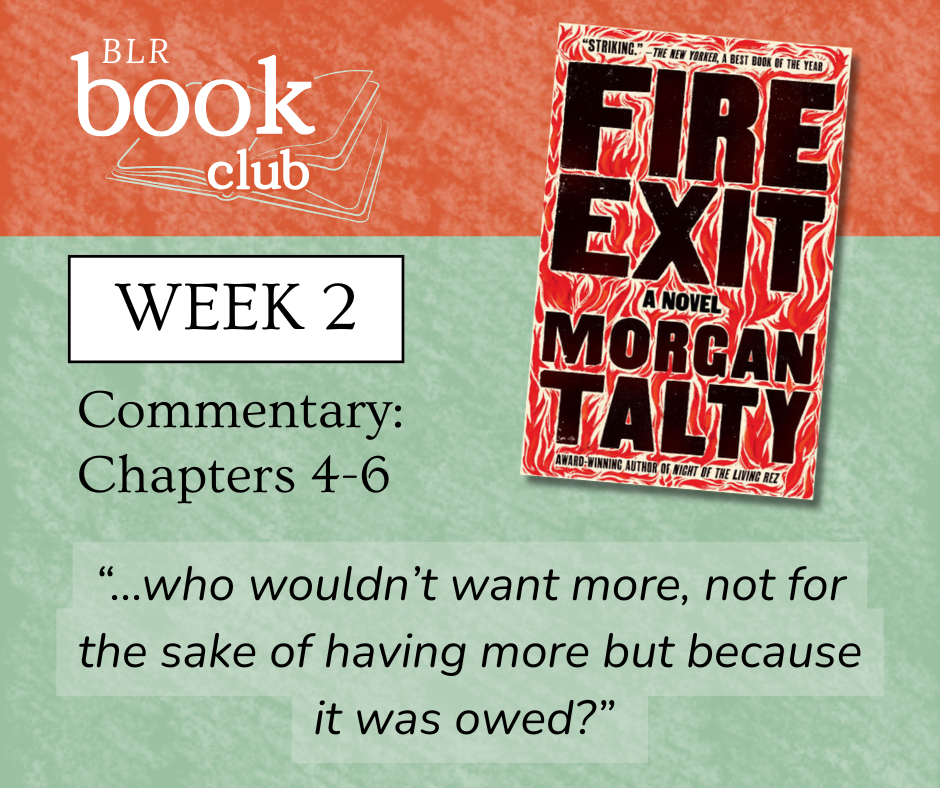
Week 2: Chapters 4-6
We learn more about Charles’ past, including a pivotal event in his youth. Louise’s dementia worsens. The theme of body vs. mind deepens: “It’s sharp, like cold air…that your body knows something about your past that you don’t.”
- Charles’s identity and place in the world is precarious. “I guess what I mean is that my situation on the reservation was already precarious, and this—this story—could snap what little thin line had held me in this place” (42).
- An offhand remark from Bobby causes Charles to observe, “There’s nothing strange about a white person wishing to be Indian. It’s comical, if anything. And white people saying they’re Indian happens all the time…” (56). Do you think he’s right?
- What does it mean, for Charles, to be Indian? How is one’s identity defined or erased? “To think that the reservation is what makes an Indian an Indian is to massacre all over again the Natives who do not populate it” (56).
- The concept of “blood quantum” is used by the federal government to regulate Native populations and land. According to Wikipedia, “Native American tribes did not formally use blood quantum law until the government introduced the Indian Reorganization Act of 1934, instead determining tribal status on the basis of kinship, lineage, and family ties.”
Read more from Talty on this topic here.
- During the era of slavery and Jim Crow, hypodescent, or the “one drop” rule, was a system of racial classification applied to African Americans. What are the governmental goals of legal classification systems like blood quantum and hypodescent?
Find a useful summary here. - A great line: “Maybe all we are is creation’s translators, putting things like granite or oak or elephant or corn in a language they want to be put in, to give them bodies made of sound so they’re measurable” (32).
Join us on the BLR Book Club Facebook Group to discuss Fire Exit, and visit our BLR Book Club page to read all the commentary.