

For 25 years, Bellevue Literary Review has been publishing stories, essays, and poems that take readers into the shared space where art and medicine meet. Throughout our anniversary year, we’re marking this incredible milestone by inviting you on a journey through the BLR archive, from the beginning through the present.
Join us each week as we curate special highlights — stories, poems, photos, and more — from each of our issues.

About the Issue
This week’s theme focuses on the immense emotional landscape of illness. Each piece in the issue imbues a particular feeling that balances the heavy and somber qualities of illness with the curiosity, humor, and imagination of the human spirit.
Issue 16 also features entries for our annual contest. (Fun fact: the poetry winner in this issue—Celeste Lipkes—was our youngest prizewinner. Today, she is an accomplished psychiatrist!)
From the Foreword
“‘Considering how common illness is, how tremendous the spiritual change that it brings, how astonishing, when the lights of health go down, the undiscovered countries that are then disclosed…it becomes strange indeed that illness has not taken its place with love and battle and jealousy among the prime themes of literature.’ So wrote Virginia Woolf in her essay ‘On Being Ill.’
The number of submissions to the Bellevue Literary Review validates Woolf’s notion. They have quadrupled from our onset… We have enjoyed working on this issue, and have found ourselves, at times, unusually at odds in our responses, which served to remind us of how singular the acts of writing and of reading are, and therefore how valuable in validating our individual souls.”
– Suzanne McConnell, past Fiction Editor
Read Highlights from Issue 16
Each week, we’ll be highlighting one outstanding story, poem, and essay from the featured issue. We encourage you to explore more from the issue on our website or, better yet, to pick up a copy!
SUTHY Syndrome
by Hollis Seamon
I shit you not. Hey, I’m a totally reliable source, eyewitness, in fact. I, Richard Casey—aka the Incredible Dying Boy—actually do live, temporarily, in the very hospice unit I’m telling you about. Third floor, Columbia Memorial Hospital, in the city of Hudson, the great state of New York. And right in front of the elevator that spits you into our hospice, there is—get ready for this—a harpist. This old lady with white hair and a weird long skirt sits by a honking huge wooden harp and strums. Or plucks, whatever. The harp makes all these sappy-sweet notes that glom themselves right onto your chest, no matter how hard you try to keep them off.
Given
by Nancy Devine
In the last 48 hours, I’ve squatted 500 times and can no longer stand up completely straight. Instead, I curve like a human comma, my shoulders threatening to collapse onto my hips. Each time I rise takes concentration on how knees work, imagining them as a hydraulic jack lifting me up. Just as it seems like they’ll give, one heartbeat from upright, I will myself that last bit to vertical by picturing my heels pushing into the ground; quite literally, they are my footings. Lingering, now, near a grow tube, listening to this unexpected music, is both respite and pleasure.
Moon-face
by Celeste Lipkes
The side effects of Prednisone include mood swings, rounding of the face, sensation of spinning, thin, shiny skin, and poor wound healing. — about.com
The doctor clicks his pen and says it’s just a phase.
My fat moon-face comes second to the x-rays
he pulls from a folder labeled with my room number.
I’m taking 75mgs of Prednisone a day. It’s summer,
and I’m paler than I’ve ever been. Lookin’ good,
the doctor says, by which I think he means: you could
look worse.
Issue 16: The Cover
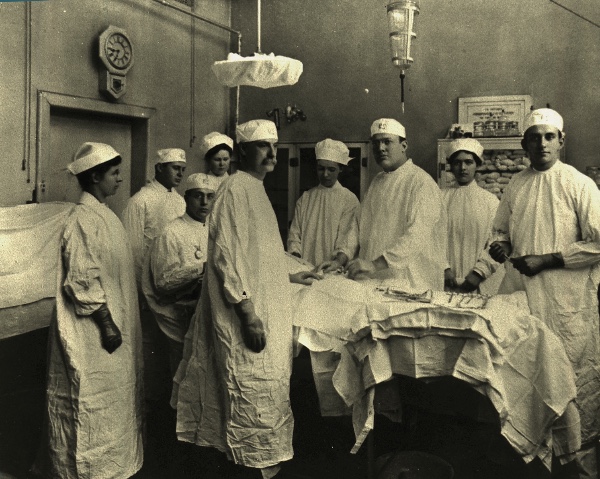
Surgical operating suite, circa 1920
By World War I, the concept of antisepsis had taken root. Surgeons in this photo are wearing gloves, caps, and white gowns. Tools are set on a clean field. Prior to this, surgery took place in open amphitheaters and surgeons did not wear gloves. Dr. Robert Hawthorne Wylie (with moustache) was the supervising surgeon in the Crane operating room. Both he and his brother, Walker Gil Wylie, were OB /GYNs at Bellevue. In 1872, Walker Wylie—then an intern—took the Charities Aid Association on a tour of the hospital, pointing out the appalling conditions. This visit led to Bellevue’s creation of the first American school of nursing: the New York Training School for Nurses, based on Florence Nightingale’s philosophy.