


For 25 years, Bellevue Literary Review has been publishing stories, essays, and poems that take readers into the shared space where art and medicine meet. Throughout our anniversary year, we’re marking this incredible milestone by inviting you on a journey through the BLR archive, from the beginning through the present.
Join us each week as we curate special highlights — stories, poems, photos, and more — from each of our issues.

About the Issue
The theme of intimate storytelling takes center stage this week. Moments of illness, healing, and even good health, can call for us to reveal the reality of our experiences to others.
There is both a freedom and risk to vulnerability and self-disclosure, but the reward of shared understanding is too great to squander.
Issue 17 showcases the deep layers to writing—for both the writer and the audience. The writer creates while the audience takes in. Both digging deeper for the benefit of art — and one another.
From the Foreword
“’You opened this door…’
So begins Melissa Stein’s poem, ‘Hinges,’ appearing in this issue of the Bellevue Literary Review. It is an apt description for much of the writing we receive. Our themes seem to inspire writers to dig a bit deeper, to enter the realms that are slivered open when illness invades. The ways in which we are broken and healed press these doors even further ajar, allowing us to consider the fragility of the human experience.
When asked to describe our themes, we often say that we are looking for writing on ‘illness, health, and healing.’ However, this is a deceptively simple phrase. Yes, on the surface these are stories, essays, and poems about disease and healing, about the mind and body. But they are more than that. They take the reader into intimate spaces and help us find that common place—that human place—where we can slip into another person’s experience.’”
– Stacy Bodziak, Managing Editor
Read Highlights from Issue 17
Each week, we’ll be highlighting one outstanding story, poem, and essay from the featured issue. We encourage you to explore more from the issue on our website or, better yet, to pick up a copy!
The Hand You’re Dealt
by Jerry M. Burger
I say I’ll keep taking the lithium, but the doubt I see on Dr. Pederson’s face as he hands me the pills tells me I probably won’t. And then it’s time to go. Only the real nutcases stay at the VA more than a couple of days anymore. Better for you on the outside, they say. Institutionalization can be worse than the disease. But we all know it’s the budget cuts. They don’t have half the staff they did the first time I was here. I’m released after breakfast. Pederson insists that all psychiatric patients wear their own clothes, so there’s not even anything to change into before I find myself standing at the bus stop in front of the hospital. I’ve got a brown paper bag in my right hand that contains some toiletries. In my left, a 30-day supply of the miracle drug that lowers the highs and raises the lows. Good old lithium. Safest medication we hand out, Pederson says. Consider yourself lucky to be bipolar. Look at the facial tics and memory loss the schizos have to put up with.
The Consolation of Anatomy
by Kurt Magsamen
Cadavers don’t look much like anatomy drawings. They don’t smell much like anatomy books. The
drawings are clean, ordered, the striations of muscle cells combed out tight and smooth, like the strings of a harp. The nets of veins, nerves, and lymph nodes have been lifted out and colored blue, red, pale yellow, and black. Some drawings are of skinless athletes posing on posters in the gym reaching up one hand and tipping back a toe to make visible the Brachialis, Brachioradialis, and Extensor carpi radialis longus muscles. Their muscles are a beautiful red, more like the red of lipstick than the blackened red of blood on a floor or the purple of blood puddled beneath the skin. The models of anatomy have wide eyes staring out that cannot follow strangers walking past. They are calm in their exposing repose. Cadavers too are calm but much more muddled, and everything is obscured by fat. Press a blade through the skin and fat will emerge, not the clean white fat of cattle, but the jaundiced globules that fall away and stick to the steel slab, and if the slab is warm enough, melt there.
Describe a morning you woke without fear.
by Jacqueline Jones LaMon
It is four in the darkness and you cannot breathe.
You cannot will your chest to expand, and suddenly,
this is all right. You grope for the language of internal
surrender. Everyday, you have a choice, this choice.
Your left hand memorizes the grooves and nicks
in your mother’s headboard. The textured flaws
keep you holding on and sane. You are used to living
on the memories of breath in your body, savoring
history. And so, your routine—two handfuls
of hospital visits each month—trips for breath in Brooklyn
when you are close to the unconscious edge….
Issue 17: The Cover
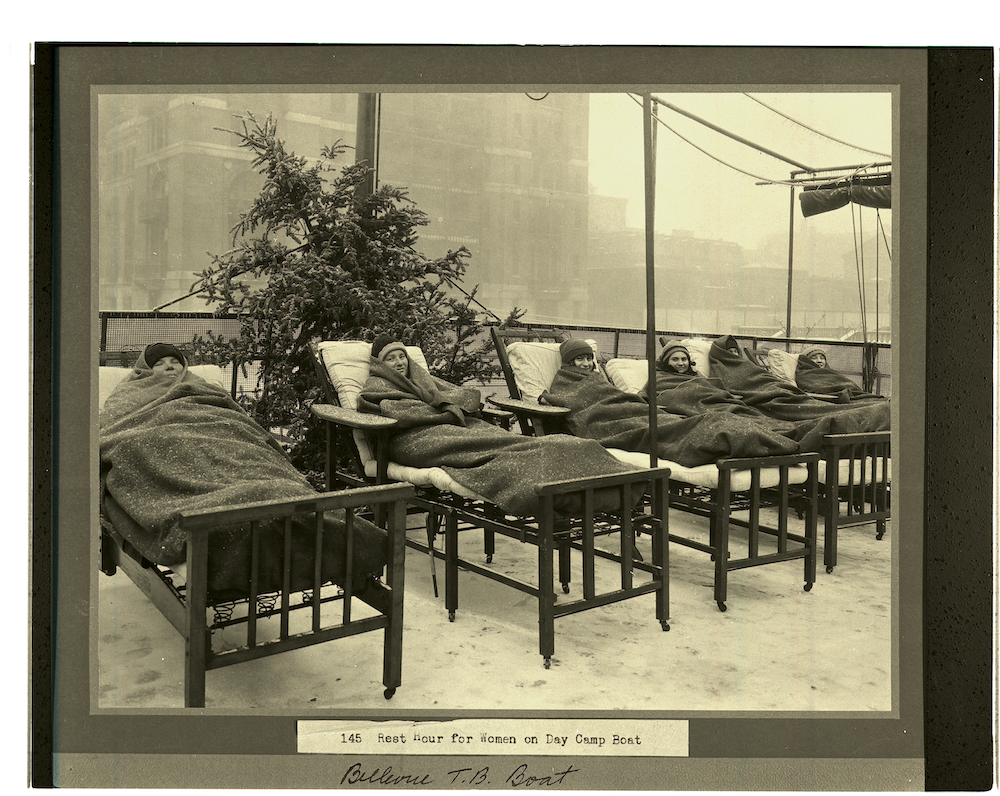
The Southfield Ferry was a retired Staten Island Ferry purchased by the Bellevue Auxiliary in 1908 to serve as a floating sanatorium. It was moored in the East River at E. 26th Street and served as a day treatment facility for tuberculosis patients. Inhaling fresh air—no matter what the weather—was considered the best treatment for TB, and indeed was the only treatment available until the antibiotic isoniazid became available in the early 1950s. Dr. Walsh McDermott, a Bellevue physician, was quoted as saying that the best cure for TB was “to stand on a windy corner.” The Southfield Ferry treated patients in two shifts: female patients during the day, male patients—who presumably had jobs—during the night. Rules on the boat were very strict and patients were required to lie completely still during their al fresco treatment.
The Southfield Ferry served Bellevue Hospital until it exploded in 1918 from a boiler accident. It was replaced by the Day-Camp Boat (a retired barge) until 1938 when the FDR Drive was built along the waterfront as part of a massive WPA project. Bellevue had just built its own TB building (the “C&D” building), so the boats were no longer needed.