

For 25 years, Bellevue Literary Review has been publishing stories, essays, and poems that take readers into the shared space where art and medicine meet. Throughout our anniversary year, we’re marking this incredible milestone by inviting you on a journey through the BLR archive, from the beginning through the present.
Join us each week as we curate special highlights — stories, poems, photos, and more — from each of our issues.

About the Issue
Issue 18 features winners of our annual contest, plus much more. (Fun fact: the poetry winner in this issue—Amanda Auchter — is the only person to ever win both first-place and honorable mention in our contest in the same year!)
One of Amanda’s poems is highlighted in this newsletter, along with a story and essay that touch on education from two very different perspectives.
A Poem with Lasting Impact

Ever read a story or poem that has lingered in your mind for days…even years?
If yes, poet and nurse Stacy Nigliazzo can relate. Stacy has always felt soul-stirring emotions when reading the poem “Saint Elizabeth,” which appears in this issue. (She even shares it with medical students and residents in her teaching!)
At BLR’s last “Narrative Arc” event, Stacy finally got her chance to interview the poem’s author, Rachel Contreni Flynn. The conversation is a must-see!
Read Highlights from Issue 18
Each week, we’ll be highlighting one outstanding story, poem, and essay from the featured issue. We encourage you to explore more from the issue on our website or, better yet, to pick up a copy!
Ghosts of Doubt
by Gregg Cusick
He stands before the class, the lectern his wheelhouse, the teen- or twenty-something-aged students his sea, the sky in the back windows his horizon. The worn paperback before him lays open to a page. If he were to brush it to the floor, the spine would strike first and the leaves would fall three-quarters right, a quarter left. The book would lay open on page 63, just as it does on the podium. Like a hymnal from which only one song has been chosen, again and again. Today is October 11, exactly fifty years since the day he’d shipped out, in 1944. He always notes this grim anniversary, but it’s never felt so heavy.
Hunter is not, and never was, a captain. More like the one the natives call Tuan Jim—Lord Jim, the title character in the novel open on his podium—he is something like a first mate. In 1944 he is twenty, the age many of his students will be, when he teaches in the decades to follow. Headed to England in October, he’s a private assigned as Chaplain’s Assistant. And two months later, he’s leaving from Southampton aboard a Belgian troopship chartered by the British Admiralty, the Leopoldville, crossing the English Channel on Christmas Eve, 1944. Private Hunter and 2,234 others from the 66th Infantry Division, U.S. Army, are reinforcements for the rapidly escalating Battle of the Bulge.
The Wills of Twenty Strangers
by Anna Mirer
It is eleven o’clock at night, and I am stomping around with half a skull in my hand. “Where are all the goddamn pipe cleaners?” I ask the room. The situation is not really urgent enough to require profanity, but I am tired and miserable, and I am resorting to overstatement in the hope of making my tired and miserable colleagues laugh. My study partner and I are getting confused about the difference between two holes in the skull, called the inferior orbital fissure and the infraorbital foramen. They have similar names, but different functions. The characters, if you will, of the foramen and the fissure are quite distinct, and to demonstrate that, I need to push a pipe cleaner through each of them to represent the paths of different nerves.
There are five days left in the spring semester, and the anatomy lab is getting squalid. Printed lab guides and anatomy atlases with broken spines are strewn everywhere. The pipe cleaners have all disappeared; there is a shortage of forceps and probes; the dispensers are out of soap. The good model of the inner ear is missing, and is rumored to have been hidden by a crazed medical student. Skulls with the tops sawn off have been jumbled with the tops of different skulls. There is a Snickers wrapper on the floor, which means that someone first ate a candy bar in here, then littered. We have been stepping around the wrapper for two days.
The Bottom Drawer
by Amanda Auchter
Tucked beneath my mother’s shirts
and camisoles, a paper bag
of prayer cards, I find
my brother’s pajamas. I want
to take them out, understand
how she can spend an afternoon
in an empty house with them. Her
at the table with a cup of tea,
raising the sleeve to her cheek,
her nose, thinking of him….
Issue 18: The Cover
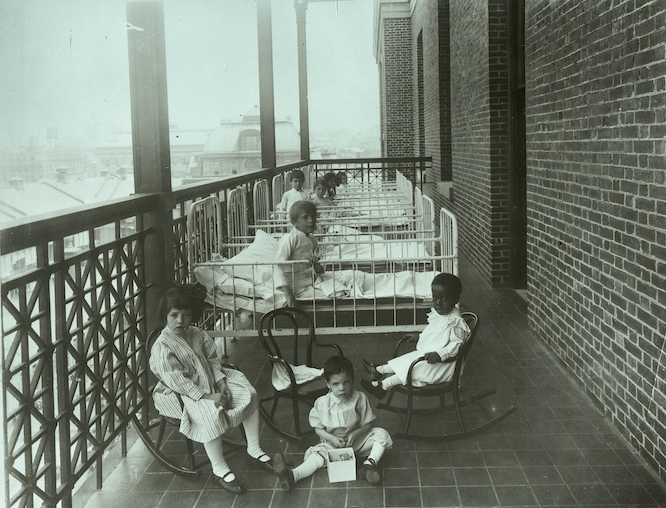
Children on loggia, 1908
The “A&B” building was the first of the McKim, Meade and White buildings on the Bellevue campus. This photo, circa 1908, was taken just a few years after the building opened. Loggia were included in the new building, so that patients could take in the sun and the air. Partly because of this modern design, pediatric and cardiac patients were the first to be moved to the “A&B” building.
Children often spent months in the hospital, and visiting hours for parents were limited to once per week. The beds shown in the photo do not have mattresses—only sheets pinned tightly to the bedframes.
In the subsequent two decades, cardiac patients in the A&B building gained access to the latest medical technology—the early EKG machine. Unfortunately, the motor to run the machine was located in the old Almshouse hospital building, seen in the background of the photo. After attaching the electrodes to their patient, the doctors in the A&B building would have to step out onto a loggia and wave a handkerchief to their colleagues in the Almshouse building. This second group of doctors would start the motor, signal back to the first group via handkerchief, and then the EKG could run.