

For 25 years, Bellevue Literary Review has been publishing stories, essays, and poems that take readers into the shared space where art and medicine meet. Throughout our anniversary year, we’re marking this incredible milestone by inviting you on a journey through the BLR archive, from the beginning through the present.
Join us each week as we curate special highlights — stories, poems, photos, and more — from each of our issues.
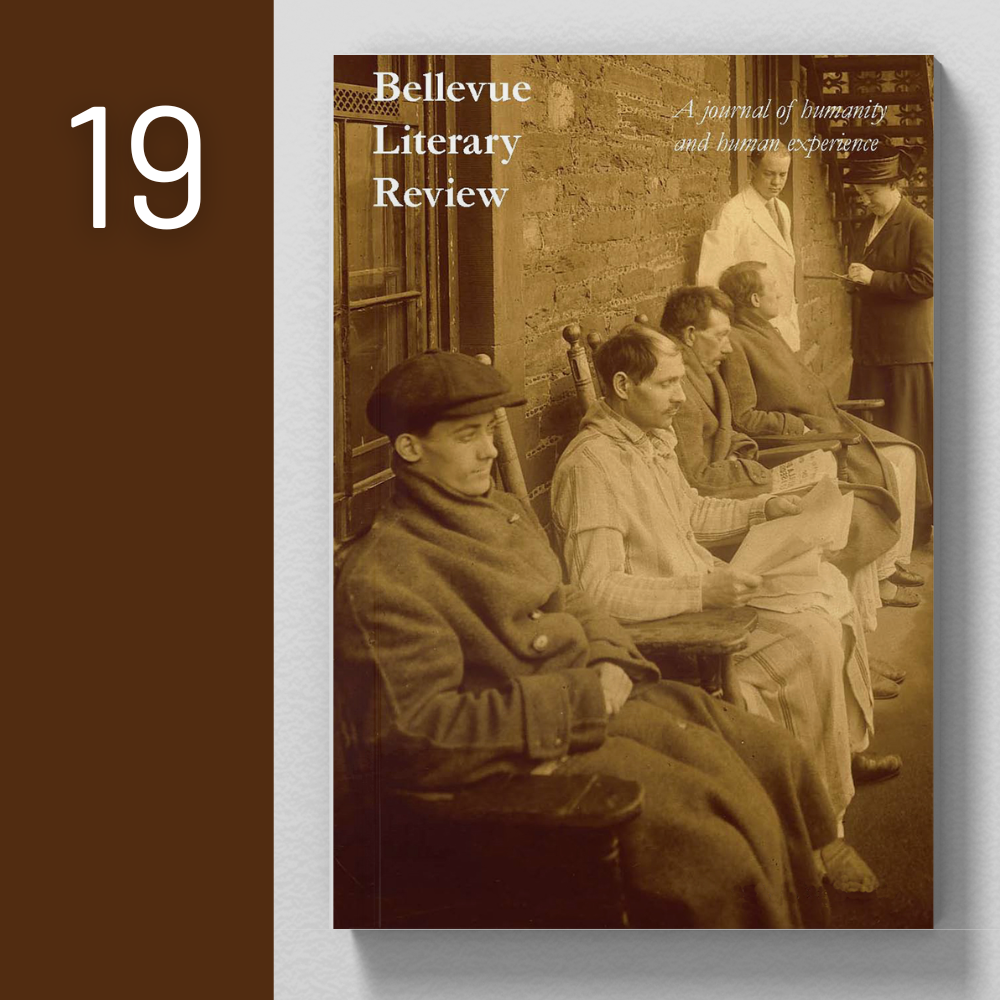
About the Issue
Issue 19 captures a variety of worlds, some familiar, some not. From the cliques of junior high school girls to the mind of an unhappy podiatrist, each world places the reader closer to the truth of its characters. That is the beauty of the literary experience—the opportunity to see beyond one’s own perspective.
Literary journals help nurture writers’ careers. In Issue 19, BLR published early writing from authors who went on to become national bestsellers: Celeste Ng (author of Everything I Never Told You, Little Fires Everywhere, and Our Missing Hearts) and Kali Fajardo-Anstine (author of Sabrina and Corina and Woman of Light).
The Transformative Nature of Story
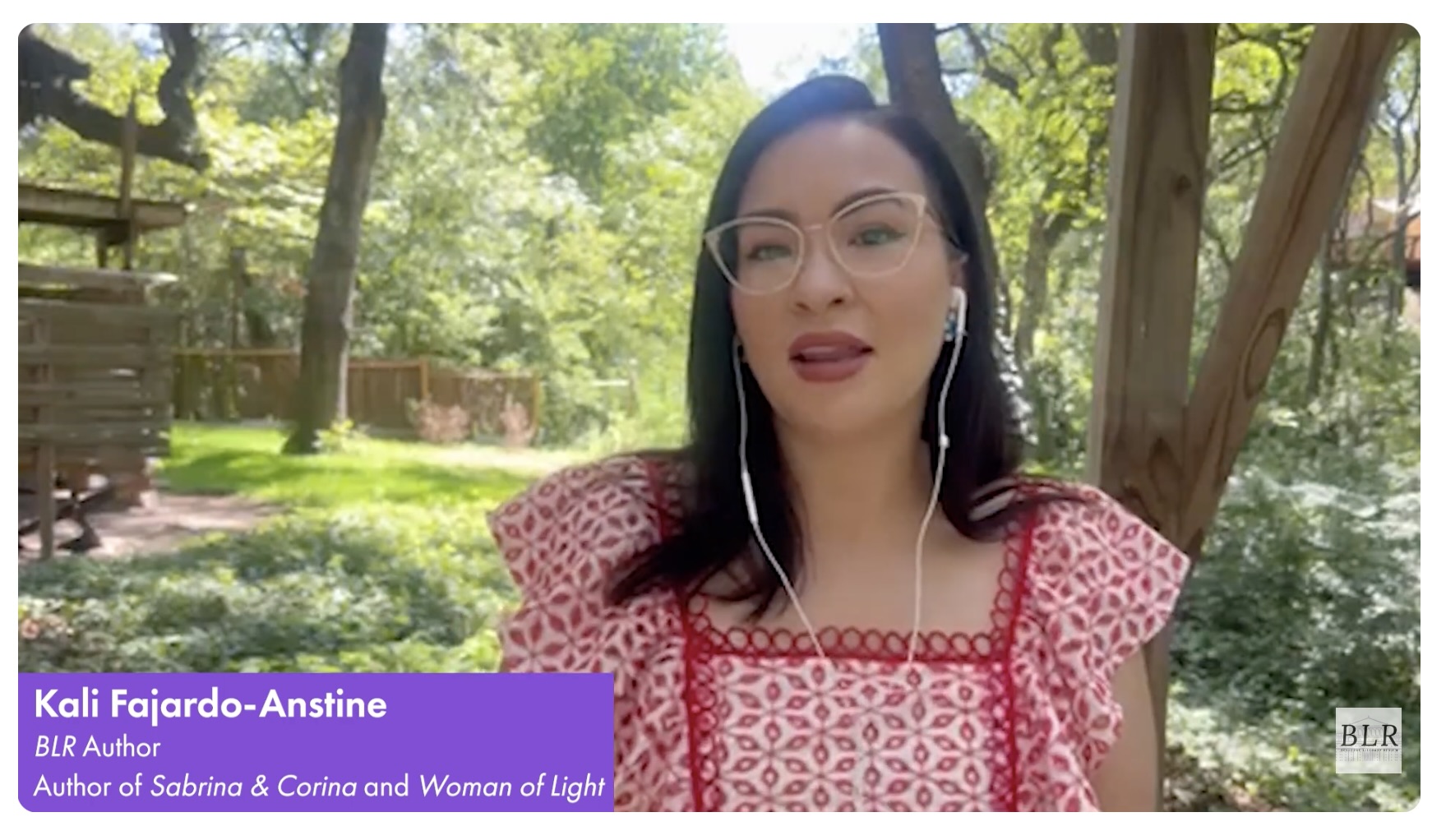
In this special video, Kali Fajardo-Anstine discusses the healing power of writing, plus reads an excerpt from her story, “Remedies.”
From the Foreword
Recently, a reader wrote us a letter and objected to a story we had published. She felt one of the characters in the story was unfairly dismissive of nurses. Her letter caused us to think about the BLR’s goals. What can a reader expect from creative work about health, healing, and illness published in a literary journal?
Literary work about these themes differs from scholarly work, of course. Articles in medical journals must be fair, based on fact or rigorous research. A personal essay that appears in the BLR is grounded in fact as well, although the writer often expresses an opinion. But a short story and sometimes a poem create a fictional world. What does fiction promise us? How does the world of a story differ from a creative essay or scholarly article?
– Ronna Wineberg, Contributing Fiction Editor
Read Highlights from Issue 19
Each week, we’ll be highlighting one outstanding story, poem, and essay from the featured issue. We encourage you to explore more from the issue on our website or, better yet, to pick up a copy!
Girls, At Play
by Celeste Ng
This is how we play the game: pink means kissing; red means tongue. Green means up your shirt; blue means down his pants. Purple means in your mouth. Black means all the way.
We play the game at recess, and the teachers don’t notice. We stand on the playground by the flagpole, arms ringed with colored bracelets from the drugstore, waiting. The boys come past us, in a bunch, all elbows, laughing. They pretend not to look. We pretend not to see them. One of them reaches out and snaps a bracelet off one of us, breaking it like a rubber band, fast and sharp as plucking a guitar string. He won’t look back. He’ll walk back the way he came, along the edge of the football field. And whoever he picked, Angie or Carrie or Mandy, will watch him go. After a minute she’ll follow him and meet him under the bleachers, far down the field, where the teachers can’t see.

In a profile in the New York Times, Celeste Ng noted that winning a Pushcart Prize for her BLR story, “Girls, At Play,” was a “huge boost of confidence” after a bout of postpartum depression. (Photo from a profile of Celeste in the New York Times, December 20, 2018)
A Figment of Your Imagination
by Cynthia-Marie O’Brien
I am a figment of your imagination. You may laugh skeptically, and I admit there is much that would seem to prove I am anything but the product of an imagination. I am, of course, the result of a physical act between two human beings. But what I humbly suggest to you is that, while we are all flesh and blood, bruises and bones, hair and scalp, scars and scrapes, none of this can convey the essence of our being.
This essence—if it can be physically located—is hidden somewhere in the connections between the neurons in our minds, somewhere few of us have seen, and somewhere that, unless we are neurosurgeons, few of us can hope to ever physically access. Unlike the outer layer of ourselves which we see in the mirror all too often, and the outer layers of each other, which we see with our retinas, it is commonly agreed upon that the inner workings of our mind are found inside the cerebral cortex. Here is where the imagination works, in ways still mysterious.
The Shed
by Elana Bell
Each time something went missing—
the photo album of my first
year, postcard from a forgotten
friend—my mother blamed
the shed, rusting in the center
of our yard. I imagined
some insatiable monster
stored there, feeding
on all our dark clutter.
Issue 19: The Cover
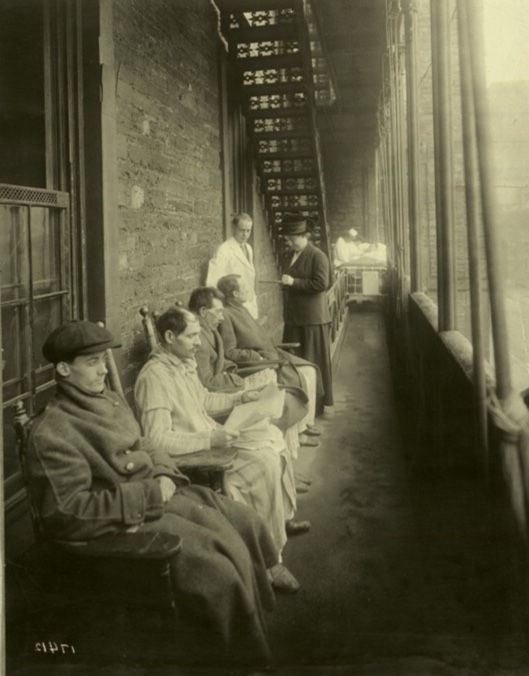
Awaiting Transfer, circa 1918
Patients on the Bellevue Chest Service awaiting transfer to sanitarium
Dr. James Alexander Miller is conferring in the background with Mary Wadler, Bellevue’s first Nurse Social Worker. Miller founded the Chest Service in 1903, just four years after his graduation from medical school. He remained associated with the Bellevue Chest Service until his death in 1948. When Dr. Miller arrived at Bellevue, patients with tuberculosis were housed with the alcoholics and other “undesirables.”
Miller created a designated ward and clinic for TB patients, and he commissioned a retired Staten Island ferry to dock in the East River for “day treatment” with sun and fresh air. Miller had worked at the Trudeau Clinic, a sanitarium at Saranac Lake in the Adirondacks, before coming to Bellevue, and he sent some of the patients to sanitaria for extended care. Traditionally, patients were given a quarter-grain of morphine and a shot of whiskey prior to transfer. The Chest Service—the first in New York City and only the second in the nation—remains active at Bellevue today, although now antibiotics are the mainstay of treatment.