


For 25 years, Bellevue Literary Review has been publishing stories, essays, and poems that take readers into the shared space where art and medicine meet. Throughout our anniversary year, we’re marking this incredible milestone by inviting you on a journey through the BLR archive, from the beginning through the present.
Join us each week as we curate special highlights — stories, poems, photos, and more — from each of our issues.

About the Issue
Issue 26 features winners of our annual contest, including a story that went on to win a prestigious Pushcart Prize (and that might also take the prize for most unique title!): “Death Defiant Bomba or What to Wear When Your Boo Gets Cancer” by Lilliam Rivera. Read that story, and more, in this week’s highlight.
From the Foreword
A number of years ago, I attended the wedding of a surgeon and a poet. The guests were almost evenly divided between doctors and writers, and the conversations between the groom’s side and the bride’s side quickly became strained. Questions about work did not open up onto interesting conversations. One doctor, in response to “I teach poetry,” looked at me with a touch of disdain, and in slightly accented English, asked, “You can do that for a living?” By the end of the evening, the poets and doctors had stopped trying to mingle.
Literature and Medicine should be the easiest of bedfellows. Anton Chekov invented the modern short story and William Carlos Williams undertook one of the twentieth century’s most compelling investigations of the line between poetry and prose. In contemporary letters, C. Dale Young and Rafael Campo loom large in poetry. But perhaps this already reflects a certain prejudice on my own part. Should I be looking for the poetry of Jonas Salk? The short stories of Marie Curie? Except for rare figures like Oliver Sacks and our own Danielle Ofri, when we speak of people at the intersection of literature and medicine, one is usually the achievement, the other a footnote…
Which brings me to why I value the Bellevue Literary Review so much, and why the staff works so hard to get each issue into your hands. Whether you come to the BLR as a doctor, patient, poet, nurse, novelist, phlebotomist, or insurance claim adjustor, these pages offer you the rare ability to see something from all sides. There’s no small talk here. Without the sensationalism, sentimentalism, or hysteria that attends most reporting on the experience of receiving or giving medical care, the BLR focuses on both writing and literature as humanisms.
– Jason Schneiderman, past Poetry Editor
Read Highlights from Issue 26
Each week, we’ll be highlighting one outstanding story, poem, and essay from the featured issue. We encourage you to explore more from the issue on our website or, better yet, to pick up a copy!
Death Defiant Bomba or What To Wear When Your Boo Gets Cancer
2014 Honorable Mention, Goldenberg Prize for Fiction
by Lilliam Rivera
Paseo Basico/Basic Step
His snoring will wake you. You’ll be pissed off at first but then you’ll welcome the snoring over the clock set to go off in an hour. It’s still dark outside and although it’s warm next to him, you’ll get up, your bare feet searching for your slippers. You’ll say a short prayer and move the bed a bit to get him back into regular breathing. It won’t work.
If the doctor’s appointment is early, at 9 A.M., pull out the red sheath dress, the one that you bought on sale at Nordstrom with the famous but unpronounceable designer label. The red will wake the receptionist up like a motherfucker and cause her to send you hate for daring to outshine her that morning. The receptionist will think you’re tacky, loud, too much. In the bloodshot color, the doctor will notice that you wore the equivalent of a flag and think you’re stately and in charge. You’ll wear red, definitely red.
In 2022, BLR reconnected with Lilliam Rivera for a discussion and reading of “Death Defiant Bomba or What to Wear When Your Boo Gets Cancer.” Watch it here.
Forty-One Months
2014 Winner, BLR Prize for Nonfiction
by Will McGrath
Thato is a small sad boy who has come to stay at the safe home in Lesotho, up in the cloudvoid in the eastern mountains of Mokhotlong district. His mother is dead and his father is off working somewhere, possibly South Africa. His grandmother has struggled to care for him but is unable. Thato is severely malnourished and HIV-positive, three-and-a-half years old, with a tiny skeleton’s body and mournful eyes that swivel in their sockets as they silently scan the room, taking in foreign surroundings, trying to interpret this newest confusion, this latest question-with-no-answer.
Thato makes ten now at the safe home. But what separates Thato from the other children is that, on some level, he knows what has happened. Most of the babies—weeks old, months old—are too young to process their current circumstances. They don’t understand that their mother is dead, or their father by necessity works in another country. They don’t realize that their uncle the drunk won’t take them in, or their aunt doesn’t have enough money for food, or their cousin is in jail, or their sister is nine and doesn’t know how to treat abdominal tuberculosis. All they know is that suddenly they are being fed five times a day. Perhaps for the first time in their lives they feel healthy—getting meds exact to the minute—or at least the absence of pain.
Chronic Care: “Broken Leg” by Keith Carter, Photograph (Toned Gelatin Silver Print 1998)
2014 Winner, BLR Prize for Poetry
by Laurie Clements Lambeth
The girl in black dress and tights stands behind the fawn,
hands clasped, their white blur forming almost
a heart. Her head’s nothing more than faceless smudge,
but she wants something. Her non-eyes plead through glass.
Before her lies the fawn in focus, head lifted
and tending to its right knee, the other foreleg tucked
beneath the shoulder. The right hind hock twists all askew—
unfolded to near arc, dragged long from the flank.
The leg’s twin toes have been scraping in dirt, splayed
wide. The fawn has attempted to rise and cannot. Tufts
erupt above the eyes, antlers in bud. The girl is close
enough to kick or stroke the animal; still she stands.
I’ll be the girl and you be the fawn, says the girl
to me. Okay, I’m the fawn. Now draw your leg in
so you look normal. I can’t lift it, I tell her. Let me
whisper you a secret in your giant ear, she says.
Issue 26: The Cover
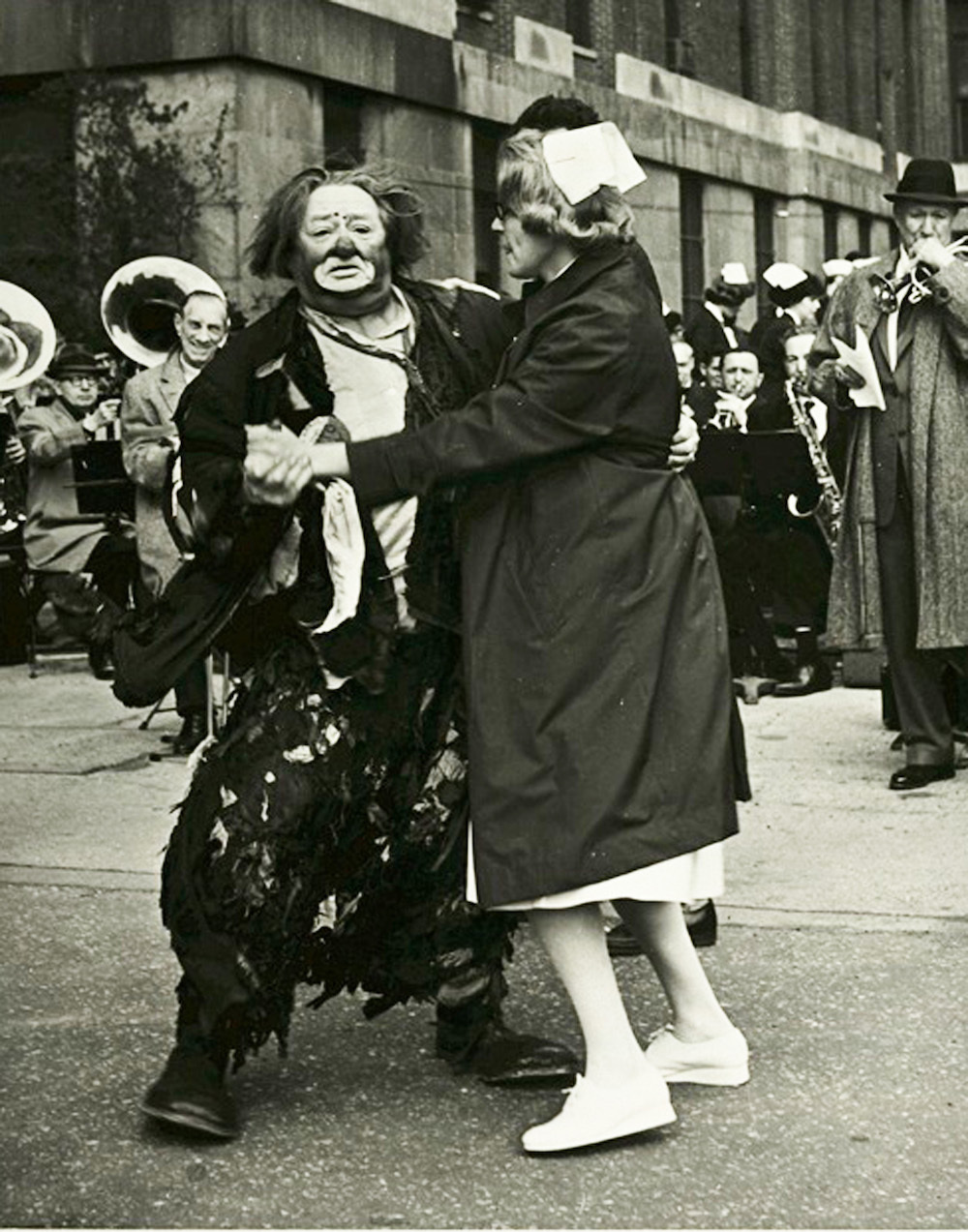
The Circus Comes to Bellevue, late 1940s
The Barnum & Bailey Circus visited New York frequently in the 1890s and its injured performers were almost always treated at Bellevue Hospital. Mary Wadley—Bellevue’s director of social work—invited the circus to perform at the hospital itself, and in 1906 the circus began a 60-year tradition of annual performances at Bellevue. Every year, the entire circus—elephants, trained penguins, dancing bears, bareback riders, and all—trooped through the streets of Manhattan to perform in the courtyard of Bellevue Hospital.
Other entertainers who performed at the hospital included Bill Cody’s Wild West Show and Roy Rogers. This photo from the late 1940s shows a Barnum clown dancing with a Bellevue nurse.
Photo courtesy of Bellevue Hospital Center Archives