

For 25 years, Bellevue Literary Review has been publishing stories, essays, and poems that take readers into the shared space where art and medicine meet. Throughout our anniversary year, we’re marking this incredible milestone by inviting you on a journey through the BLR archive, from the beginning through the present.
Join us each week as we curate special highlights — stories, poems, photos, and more — from each of our issues.

About the Issue
Issue 27 is a special issue that explores the fragile nature of our environment, with essays, stories, and poems that convey the power of our surroundings and their impact on our lives and health. As our featured essay below notes, “What if our evolution as humans was measured by how graciously and profoundly we related to the living world around us?”
We hope the pieces in this issue compel you to ask deeper questions and to find inspiration in the natural world we dwell in.
Check out this BLR reading guide for the issue, plus a special roundtable interview on writing and the environment with three authors from Issue 27:
Ben Goldfarb, Jeanine Pfeiffer, and Martha Serpas.
From the Foreword
I have spent the last thirty summers within Cape Cod National Seashore, a mile’s walk on a sandy one-lane road, past freshwater ponds, to the ocean. Cape Cod is a fragile, shifting, glacier-made place. Three feet a year of beach, on average, are swept away. From the air, the 365 kettle ponds the glacier left resemble puddles, and Cape Cod itself, a slender, curling spit, the glacier’s thin drool. Due to the foresight and effort of a grassroots movement to make it into a national park, signed into law by President Kennedy in 1961, the outer Cape is pristine. So I am instructed daily each summer in the value of conservation. It’s from this place that I am writing.
A theme on the environment was proposed some years ago at an editorial meeting. The threat to it is our greatest global health issue, we nominally concurred. But it was not until Hurricane Sandy devastated New York and our hospitals that everyone readily agreed to the theme. I am reminded of Ben Franklin’s warning: “Eternal vigilance is the price of freedom.”
– Suzanne McConnell, past Fiction Editor
Read Highlights from Issue 27
Each week, we’ll be highlighting one outstanding story, poem, and essay from the featured issue. We encourage you to explore more from the issue on our website or, better yet, to pick up a copy!
A Big Empty
by Rhonda Browning White
We hadn’t talked since we left our West Virginia homeplace over two hours ago, both of us teary-eyed, too afraid to put words into the space already overfull of emotion. Every now and then, I’d hear Romie sniffle in the seat beside me, and she’d squeeze my knee, or I’d squeeze hers. It was the only way to say what we felt. It surprises me then that she speaks when we’re partway through East River Mountain Tunnel.
“Look at them cracks,” she says. “You think it’s even safe to drive through here?”
I register her words and peer out the Jeep window at the long, zigzagged cracks between the bricks that hold the land away from us. “I feel safe,” I say. And I almost do. Five years of underground mining taught me to seek a measure of calm in the disquiet of trespassing the belly of the earth. There’s always danger, sure — men get crushed in roof-falls, die in fires and explosions, breathe silica and coal dust that seizes up their lungs — but surely everybody knows tearing apart a mountain can kill you. Violence done to the land can never come to a good end.
All Our Relations
by Jeanine Pfeiffer
It is midsummer and the hummingbird feeder is sucked dry.
I take it down, scrub out the crystallized sugar at the base with a toothbrush, and refill it with fresh sugar water, something I sardonically refer to as “hummingbird crack.” As nectarivores, hummingbirds’ diets are high in sugars, yes, but those sugars are usually nutritionally balanced with plenty of protein from tiny insects and spiders. Hummingbird feathers are built from protein, and feather iridescence is biochemically linked to protein content. More protein, more brilliantly colorful feathers. This is why, if we truly adore our hummingbirds, we create insect-friendly habitat in our gardens, along with plenty of pollinator-friendly plants.
Standing on the porch, I call out to the hummingbirds, inviting them back. The morning is still cool, and a breeze wafts the outstretched leafy arms of my purple- and red-flowered sage, hibiscus, and buddleia (the “butterfly plant”). Moments later I’m rewarded with the sound of delicate helicopter wings whirring, as a tiny male perches and feeds. He’s an Anna’s hummingbird with a flashy, iridescent red skullcap, sparkling throat dickey, shimmering green jacket, and a few tiny feathers sticking out incongruously from one side of his neck, making him look like a tiny, aerodynamic ruffian. This is how I recognize him, and why I’ve fallen in love with him.
Irrigation
by Martha Serpas
we steal water when we make rain, the way
everything I have is from somewhere else,
from someone else, what I am
the riverbed looks scalded
but the wound is full thickness
and elsewhere
in a variegated field or on a lawn
of grass named for a saint
or a saint once removed
Issue 27: The Cover
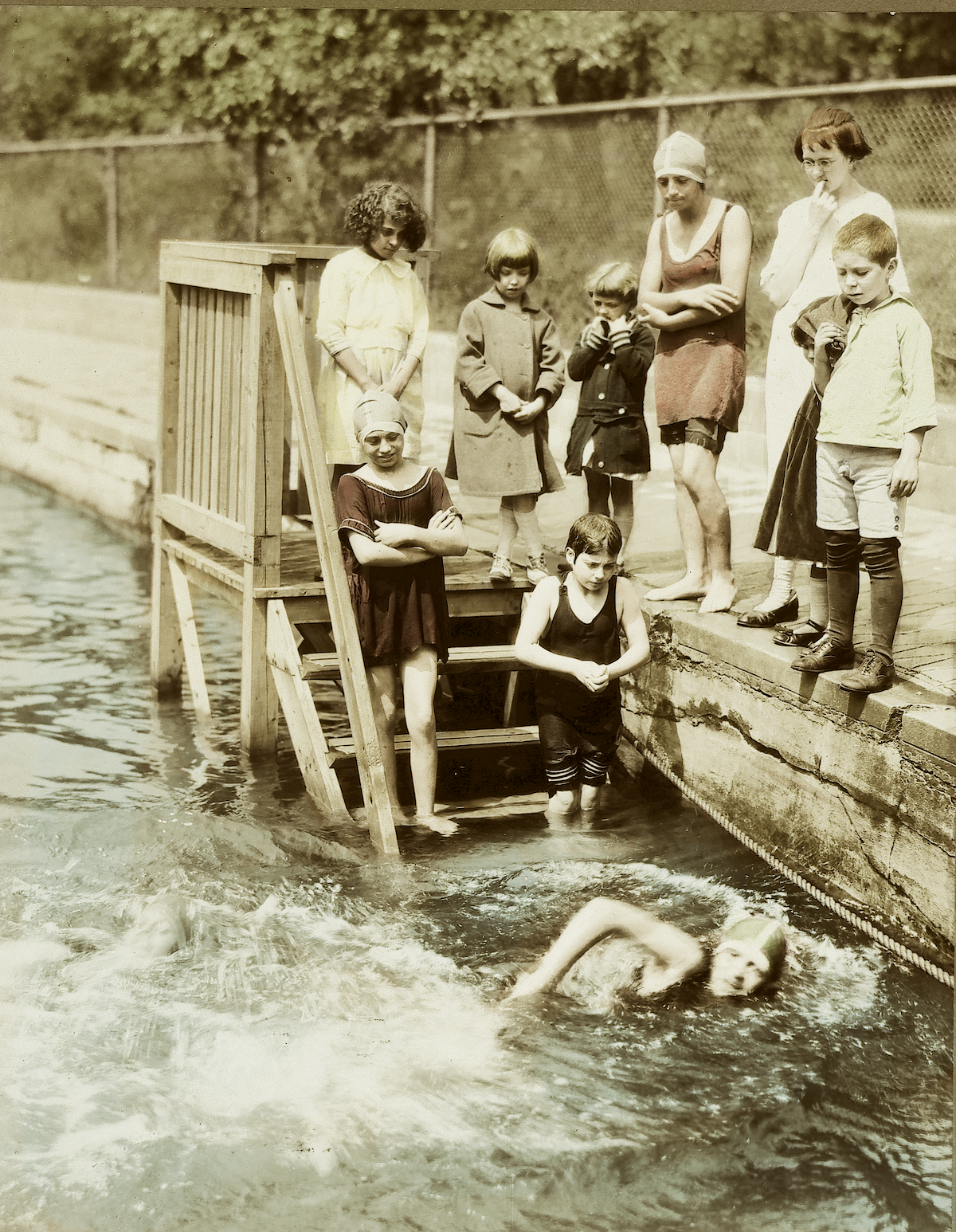
Swimming Pool at Goodhue Center, Staten Island, circa 1920s
In 1912, Sarah Parker Goodhue donated her country estate on Staten Island to the Children’s Aid Society of New York. The Woodbrook estate had been built in 1840 by her father-in-law, Jonathan Goodhue, who planted 1,100 trees on the site. Even before the 1912 bequest, the estate had always been open to city youth whenever the Goodhues were not present, but now it would be a full-time center for children (though the bequest stipulated that the Goodhues could still stable their horses there).
The Children’s Aid Society immediately established a summer camp and then an agricultural school. “Orphan trains” plucked street kids from Manhattan and brought them to Staten Island for medical care and school. They would be released to their families or to adoption agencies once they had gained the prescribed number of pounds. Bellevue Hospital sent children to Goodhue who were at risk for tuberculosis, so that they could get the requisite fresh air and sunshine.
Based on the clothing of the children in the cover photo, this photo was likely taken in the 1920s. A new swimming pool was built in the 1930s as part of the Public Works Administration.
The Goodhue Center continues to function today, with mental health services, foster care services, summer camps, after-school programs, swim programs, and gardening classes. It celebrated its centennial in 2012.
Photo courtesy of Bellevue Hospital Center Archives