

For 25 years, Bellevue Literary Review has been publishing stories, essays, and poems that take readers into the shared space where art and medicine meet. Throughout our anniversary year, we’re marking this incredible milestone by inviting you on a journey through the BLR archive, from the beginning through the present.
Join us each week as we curate special highlights — stories, poems, photos, and more — from each of our issues.

About the Issue
Issue 28 features winners of our annual contest, in addition to showcasing one of the most important literary tools of any story: the setting. The time and place. The when and where.
This issue features a variety of unique backdrops. From Australia to Tel Aviv, the stories absorb the texture of their settings, and in turn, so too does the reader who is taken on a journey of feeling.
From the Foreword
When I read the slush pile of submissions to the Bellevue Literary Review, one of the things that most catches my eye is the set-up: where the characters find themselves, what personality quirks undercut them, how they are pressed up against each other by circumstance, and what sort of challenges from left field will wreak havoc. The Spring 2015 issue of the BLR offers a literary jaunt through unusual locales and intriguing set-ups.
– Danielle Ofri, Editor-in-Chief
Read Highlights from Issue 28
Each week, we’ll be highlighting one outstanding story, poem, and essay from the featured issue. We encourage you to explore more from the issue on our website or, better yet, to pick up a copy!
Assisted Living
by Louise Aronson
Mary’s not at dinner and no one knows why. Roy is limping but at least he’s up walking again after last month when he fell by the mailboxes and dislocated his new knee. He says it hurts all the time now which is a shame because the whole point of getting the new knee was to stop the pain, and it was better that first week he was back after all those weeks away for the knee surgery and then the heart attack—a small one, thank God—and then the rehab.
No, no—don’t sit there. Sit here, beside me. You can see better from here, a simple fact that you’d know if you came to see me more often. Oh dear, there’s Bessie. We usually eat together but she knew you were coming and now she’s stuck with Sadie Mangiello. Have I mentioned that Jack and Viv’s daughter comes to dinner every week? Not always on the same day, but still. Every single week. Imagine that. All right, all right, I won’t start. I know you’re busy. I remember what that’s like. I used to have a life myself you know.
Oh boy, here come Lee and Nancy. It’s nice she’s coming down again these days, though I used to really like to talk to Lee when Nancy didn’t come down and Lee sat around chatting while the girls put food onto trays for him to take upstairs. He can talk about anything, reads the Times and the Post cover to cover every day with CNN on the television and NPR on the radio, all at the same time!
I Must Have Been That Man
2015 Winner, Felice Buckvar Prize for Nonfiction
by Adina Talve-Goodman
In the morning, I hid his cigarettes and made him toast and everything was funny again. We had headaches, we smelled like whiskey, and it was a Tuesday. He left for class and I stayed home because I didn’t have classes that day, just rehearsal for a play in the evening. He told me I should come find him later, before my rehearsal, he’d be at the library and he’d be happy to help me learn my lines.
After he left, I showered, got dressed, gathered my books, and walked outside. It was October in St. Louis and not quite cold. There was a slight drizzle and even though I was wearing a raincoat, I could hear my mother’s voice saying, You’re immunosuppressed, please take an umbrella. That’s when I realized I was locked out.
The walk to campus wasn’t long, fifteen minutes, and even though I had a car, I walked it almost every day. I liked to walk it alone. Before the transplant, fifteen minutes was impossible. The doctors explained it to me like this: for you, in heart failure, a fifteen-minute walk is like a marathon and that’s why sometimes you throw up at the end. Doctors often explained my illness to me using sports metaphors—as if, as a kid born with a single-ventricle heart, sports was a language I ever learned to speak.
Adina Talve-Goodman passed away, far too young, in 2018. Her posthumous essay collection, Your Hearts, Your Scars, was published by our friends at Bellevue Literary Press. Her legacy lives on in One Story‘s Adina Talve-Goodman Fellowship, a year-long mentorship on the craft of fiction writing.
Because You Are Dead You Think You Can Have Anything You Want
by Dannye Romine Powell
You come back,
bent over my things
like a collector, hunched,
touching, wanting to lay claim
to everything. No, not everything.
Only what I cleaved to after you died.
My Moon Book, its midnight cover
and parchment pages, its luminous drawings
steeped in liquid gold.
Issue 28: The Cover
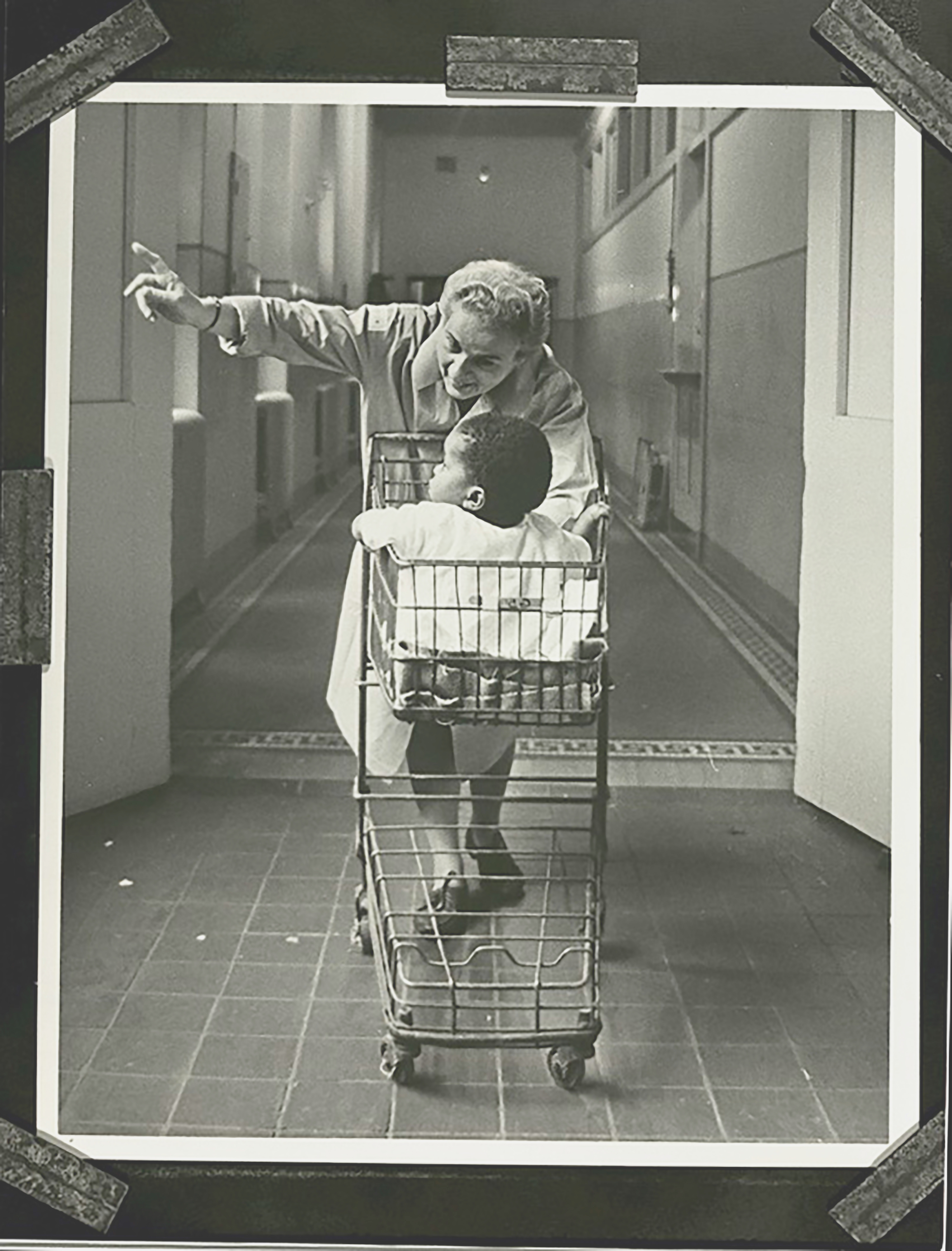
A volunteer from Children of Bellevue transporting a pediatric patient in the old F and G Pavilions of Bellevue Hospital. c. 1972
The F&G pavilions—all the pavilions of Bellevue were designated by letters—were the last of the McKim, Meade and White structures, which first broke ground in 1900. The bulkhead of the hospital grounds had to be extended into the East River to accommodate the grand architectural plans. The F and G pavilions were delayed by the Depression but finally opened in 1935 and were highlighted that year in Modern Hospitals Magazine in an article entitled “Bellevue Still Builds.”
The floor in the foreground of the photo was composed of red terracotta tiles. Such terracotta floors, along with mosaic tile decoration, expansive windows, and even arched Guastavino-tiled ceilings were common throughout the pavilions as part of the grand elegance of turn-of-the-century hospitals.
“The hospital always seemed to have a shortage of wheelchairs,” noted Lorinda Klein, a former Bellevue nurse and the BLR’s local Bellevue historian, “but for some reason there was always an abundant supply of shopping carts. Small children being wheeled in shopping carts, either for a medical reason or simply for a stroll, were a common sight at Bellevue in the 1950s and 1960s.”