

For 25 years, Bellevue Literary Review has been publishing stories, essays, and poems that take readers into the shared space where art and medicine meet. Throughout our anniversary year, we’re marking this incredible milestone by inviting you on a journey through the BLR archive, from the beginning through the present.
Join us each week as we curate special highlights — stories, poems, photos, and more — from each of our issues.

About the Issue
Issue 29 is a special theme issue entitled “Embattled: The Ramifications of War.” These poems, stories, and essays trace war’s reach far beyond the battlefield, revealing how conflict reshapes lives, communities, health, and the world we share.
From the Foreword
War stories are not only the stories of soldiers and combat, although these are plentiful. Our intention in this issue of the Bellevue Literary Review is to encompass work about a broad spectrum of people affected by wars in a myriad of ways, in many places and times. Together, we hope they afford some sense of overview and invite thoughtful consideration of war, and especially—as the title of our theme suggests—its ramifications…
The history of war may be largely written by the victors, but the ramifications of war know no such bounds.
– Suzanne McConnell, past Fiction Editor
Read Highlights from Issue 29
Each week, we’ll be highlighting one outstanding story, poem, and essay from the featured issue. We encourage you to explore more from the issue on our website or, better yet, to pick up a copy!
Failed Treaties
by Sahar Mustafah
Danny used to open the door and let me into his apartment downstairs at seven a.m. every Saturday. My mother would already be up, stooped over the kitchen table in our upstairs apartment, wearing her pale-blue nightdress, spreading tangy lebanah on a plate for my father before he left to open his grocery store. My baby sister Leena sucked on her chubby fist and squirmed in her highchair when I tickled her face. My mother blocked my way to the back door, holding a spoonful of yogurt in one hand and my chin in the other, sniffing my breath for traces of Colgate.
“Tayib,” she’d say, and I’d rush past her and swoop down the stairs.
Danny and his mother rented our first floor in the summer of 1980. She was a bartender, sleeping until noon in a room adjacent to Danny’s. When Danny and I triumphantly freed Lady from Donkey Kong, she’d yell at us in a scratchy voice to keep it down. Sometimes, there’d be a man with her, and he’d loom in the doorframe in his plaid boxers and bare chest, telling us to knock it off.
Obligation
by Leopold Szor
Did you ever yearn to be a tree? Or a cat, or even a rat? True, a cat lives no more then twenty years, a rat much less. And yet, how I envied them all, on the eerily silent streets of Lvov in June 1941. I was eighteen then and all around me were these other creatures I envied intensely.
Lvov was a charming city on the eastern edge of Poland, bordering the Ukraine. It was the gateway to the East, rich in history, rich with people whose faces bore witness to past invaders—Tartars, Mongols, Russians, Austrians. It was a Polish city with a large Ukrainian minority. There were Jews, too, who’d been invited here by the Polish king centuries ago to enhance the local commerce. The Jews stuck to their shtetls and ghettos, their ancient ways in total contrast to modern Polish life. Through nearly eight centuries, this “coexistence” produced endless years of persecution, pogroms, suffering, and death.
The Call
by Terry M. Dugan
I could tell from his voice
something was horribly wrong.
I’m okay he said over and over
in a tone that told me he was anything but.
Insurgents had blown up the school,
driving into the group of small children
he gave lunch and candy to the day before.
I’m the reason the kids are dead.
Weeks later he called again.
Me and my buddies are getting tattooed.
Every rec period he chooses a new tat.
I’m coming home when I run out of skin.
WATCH: When this issue was published, BLR held an Off the Page event in which actors Chris Henry Coffey and Jane Bradley brought some of the works to life through dramatic readings. Watch here.
Issue 29: The Cover
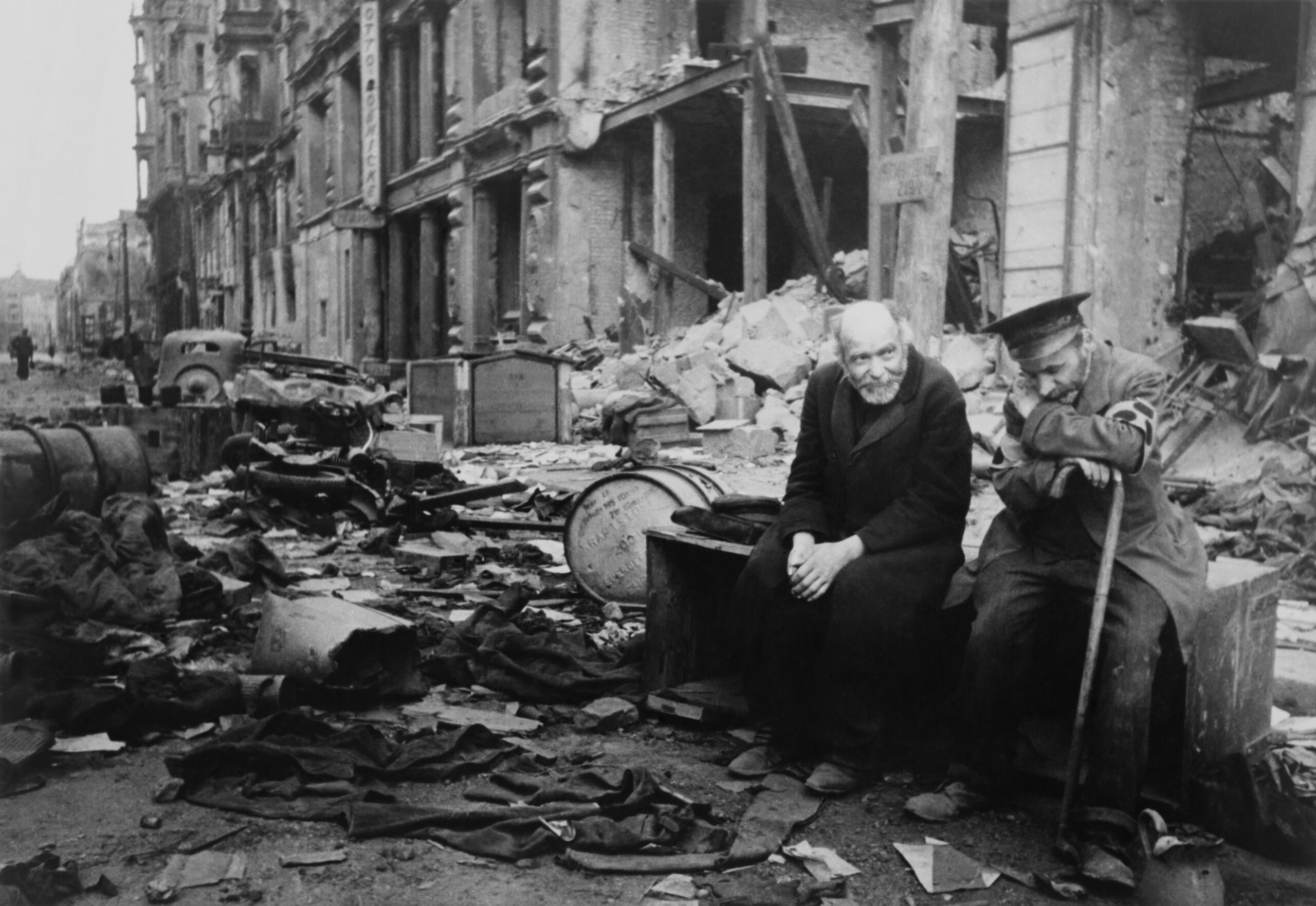
Battle of Berlin, 1945. Photo by Yevgeny Khaldei.
In April 1945, the Soviets attacked Berlin from the north, the south, and the east. The ensuing Battle of Berlin lasted thirteen days until the German forces defending their city surrendered. During this crucial battle, Nazi leader Adolf Hitler committed suicide. One week later Germany surrendered to the Western Allies and World War II finally came to an end.
The photograph on the cover of the Fall 2015 issue of the Bellevue Literary Review was taken by Yevgeny Khaldei in May of 1945, shortly after the battle’s conclusion. Khaldei was a Jewish Ukrainian-born photographer best known for another photograph taken at the Battle of Berlin: “Raising a flag over the Reichstag.” In order to produce the iconic image, Khaldei himself brought a Soviet flag to the Reichstag, a central target for Soviet forces, and reportedly asked a passing solder to hold it up.
In the Khaldei photograph on the cover of this issue, two elderly men sit on a crate surrounded by the remnants of war-torn Berlin. One man is blind and wears a yellow armband bearing three black dots, a marker of physical impairment “used during the war. The other has been identified as his aide.
Such classification was common practice in Nazi Germany. While all Jews were required to wear armbands bearing yellow Stars of David, those Jews with disabilities relocated to concentration camps wore armbands with plain black triangles. This group was referred to as asoziale or “antisocials.” Outside the camps, there was significant controversy around whether or not to allow disabled Jews the “right” to wear the yellow armbands used to signify disability, though it was ultimately decided that they would bear the same markers as their non-Jewish counterparts. This act of inclusion, however, was performed only for the convenience of the public, rather than the protection of Jews with disabilities.
Image courtesy of Shutterstock