

For 25 years, Bellevue Literary Review has been publishing stories, essays, and poems that take readers into the shared space where art and medicine meet. Throughout our anniversary year, we’re marking this incredible milestone by inviting you on a journey through the BLR archive, from the beginning through the present.
Join us each week as we curate special highlights — stories, poems, photos, and more — from each of our issues.

About the Issue
Issue 30 features the annual BLR Prizewinners — highlighted below — and includes writings that take readers from a visit to a canine cardiologist all the way to an outing at an Istanbul cinema. Plus a farewell to Oliver Sacks, the noted author and physician (and longtime BLR friend).
From the Foreword
Welcome to the thirtieth issue of the Bellevue Literary Review. In 2000, when we sat in Bellevue Hospital, creating this literary journal, the world seemed like a stable place. The third millennium had begun. Life felt relatively peaceful; violence and war occurred in countries far from us. We assumed this stability would extend for decades. The first batch of BLR submissions explored illness, death, the practice of medicine, and families, and were set mostly in the United States.
The world is fluid, though, and just as our first issue was going to press, the attacks of 9/11 took place. We now live in an era in which terrorism has, unfortunately, become part of our daily vocabulary. The Internet and the ease of travel of people and ideas have made us—for better or for worse—citizens of one global community. Medicine, too, has been transformed; we can sit at the computer and search for cures, or choose 5-star hospitals and the best doctors based on the ratings of strangers. The themes of the stories, poems, and essays that come to the BLR reflect the concerns of our changing world.
– Ronna Wineberg, Contributing Fiction Editor
Read Highlights from Issue 30
Each week, we’ll be highlighting one outstanding story, poem, and essay from the featured issue. We encourage you to explore more from the issue on our website or, better yet, to pick up a copy!
The Foreign Cinema
2016 Winner, Goldenberg Prize for Fiction
by Lauren Alwan
One day in those first months after her mother’s death, Cenem resolved to finally see Los Angeles. She’d spent the afternoon at one of the cheap matinees, seeing Casablanca yet again, and after, went directly to the used bookstore off Taksim Square in search of a copy of Baedecker’s California. The shop on Istiklal Street was known as much for its sizable collection of travel literature as its front window, which for decades had been filled with a welter of jackknifed, yellowing books. Inside, the air was heavy with mildew and the toasted scent of wood pulp. Surfaces were cluttered with stray memoranda and windblown sheets of newspaper. On hearing her request, the owner, Osman was his name, led her to the furthermost shelves, where he located a well-used copy wedged between volumes of a treatise on North American geology. “Ah, California,” he said, admiring the frontispiece of mountains and orange trees. “Such a distant, intriguing locale.” When he inquired of her interest, Cenem told him she had a sister there, her eldest, whom she had not seen in decades. “An admirable aim,” he observed, passing her the book. “Two sisters, apart all those years. A journey of time more than distance it would seem.”
Askew
2016 Winner, Felice Buckvar Prize for Nonfiction
by Esther K. Willison
It gets hold of me, I wrote less than a year after her death. Somehow it creeps up. It comes over me like a wave, seeping into my eyes first, then like a sheath slips over my head and takes over my body and fits so tightly I can’t breathe. It lies waiting for me in my car—I know it’s there the minute I open the door but I get in anyway and as soon as I begin to steer it comes over my shoulders, into my eyes and down my back. I can feel it beginning to fold itself around my forehead, on the sides, then into my eyes.
I had reasons, excuses, justifications—she was immature, she was taking a long time to grow up, she was a sensitive soul, needed more support. I was sure. As the years went by and her rage grew and she needed more help, I gave it gladly, although my own anger and disappointment began to seep into our relationship. But when I spoke up, her answers were as though she disappeared and someone else spoke, “Oh, I should have known I couldn’t count on you, you’ve never been there for me.” Could it be me? Unsure of myself, I too was vulnerable. So I remained silent and waited for the change, waited for my daughter to return. “There’s something wrong with Andrea,” my partner said. “You don’t have kids,” I snapped. “How would you know?”
The Problem with Anatomical Thinking—
2016 Winner, BLR Prize for Poetry
by Meridian Johnson
The corpse is invented and now
little birds sit pecking at it. What they lift
from the shadows is not a body in bits. Look again,
feel the birds balling up the body-thread with their beaks, disregarding
the smell, unwrapping it into a thing of this world…
Issue 30: The Cover
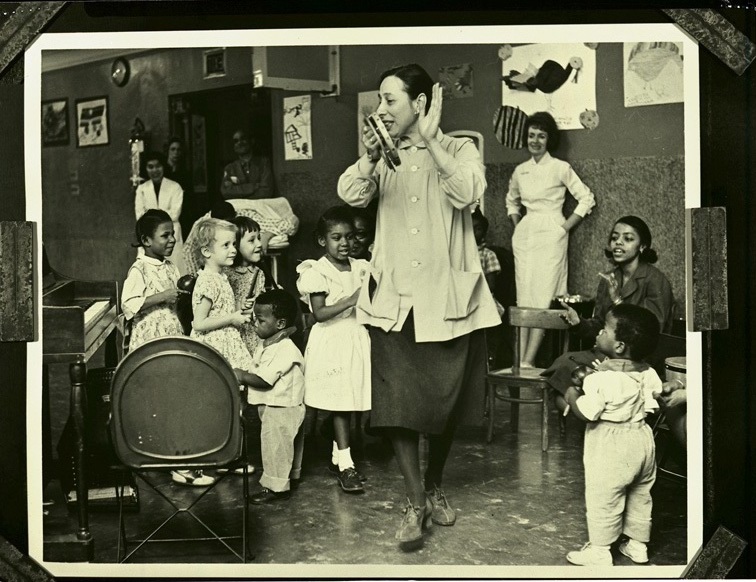
Pediatrics ward at Bellevue Hospital, circa 1957
Sophie Rogers was the music therapist for the Children of Bellevue program. She was full of energy, roving the hallways of Bellevue with a shopping cart filled with tambourines, bells, drums, maracas, even an auto-harp. She could walk into the locked pediatric psychiatry ward, and immediately the din would cease and attention would focus on her. She was known as a Pied Piper; kids would follow her wherever she went. Music therapy was one of the most popular programs at Bellevue, enlisting both local and visiting talent.
Lorinda Klein—a longtime BLR friend—started working at Bellevue as a recreation director when she was eighteen years old. She met Sophie Rogers on her very first day on the job. Sophie took her on a ‘short-cut’ to the psychiatry ward via Bellevue’s infamous basement. “It was a warren of machine shops plus the laundry and the kitchen,” Lorinda recalled. “It was always dim and wet. Bare lightbulbs swung from wires overhead and steam rose from the vents on the floor.” The basement was teeming with people going to and from the many buildings of Bellevue, including the morgue. And somehow there were always cats underfoot. After twisting and turning in the elaborate maze, they finally arrived at the ward. Sophie had to zip off somewhere else, so pointed Lorinda back toward the subterranean labyrinth. “When you’re done—just go back the way you came!”
BLR Trivia: Although we did not know it at the time Issue 30 was published, this would be the last issue of BLR to feature archival Bellevue Hospital photographs on the cover. We loved showcasing these snapshots from history on our earlier issues, but but there was only a limited supply of photos with sufficient resolution to be used for a cover.
The cover of the following issue—Issue 31—marks a shift to modern photography and art (with our complete redesign just a few issues down the road!)