

For 25 years, Bellevue Literary Review has been publishing stories, essays, and poems that take readers into the shared space where art and medicine meet. Throughout our anniversary year, we’re marking this incredible milestone by inviting you on a journey through the BLR archive, from the beginning through the present.
Join us each week as we curate special highlights — stories, poems, photos, and more — from each of our issues.

About the Issue
From Marcel Proust to Oliver Sacks, memory has been both a muse and a source of endless literary and scientific inquiry. Memory serves to define who we are and how we fit ourselves in our world, yet it is plagued by emotional biases, biological limitations, societal expectations, and personal ego.
Issue 31 of BLR is a special issue — “Reconstructions: The Art of Memory” — that dives into these timeless themes, featuring poetry and prose on how memory entwines in our lives and how it affects the body, mind, and relationships.
From the Foreword
“Memory takes a lot of poetic license,” wrote Tennessee Williams in the stage directions to The Glass Menagerie. “It omits some details; others are exaggerated, according to the emotional value of the articles it touches, for memory is seated predominantly in the heart.”
This issue of the Bellevue Literary Review is devoted to the theme of memory. It is entitled “Reconstructions: The Art of Memory” because, as Williams points out, memory is based in the heart. Our brains—and our pens—take poetic license freely as the stories of our lives are reconstructed by our hearts into the “facts” by which we define ourselves.
These memories, however poetically refashioned, create our identity. Without them, we would wake up each day in the Eternal Sunshine of the Spotless Mind—the movie in which a medical procedure can erase unwanted memories. Luckily, our memories remain far from spotless. Their very messiness is the fodder from which many a harrowing novel or poem have arisen.
– Danielle Ofri, Editor-in-Chief
Read Highlights from Issue 31
Each week, we’ll be highlighting one outstanding story, poem, and essay from the featured issue. We encourage you to explore more from the issue on our website or, better yet, to pick up a copy!
Song of Memory
by Ellen Collins
We have forgotten how to tie our shoes, how to button our sweaters, how to hold a fork. We have lost the ability to add a column of numbers, to trace a route on a map, to color inside of the lines, to sip through a straw. We no longer know the word for paper clip, toothbrush, Kleenex, pancake turner, eyelash, wrench, or tablecloth. We cannot laugh at your jokes. We cannot remember how to spread mustard on a hot dog, how to seal an envelope, how to tell time, how to light a candle, how to use toilet paper, how to walk without tripping.
We were Federal Reserve bankers, farmers plowing furrows for corn, mothers rocking feverish babies, chefs at four-star restaurants, and hash-slingers at diners. We sketched blueprints for houses and theme parks, pounded out the notes for symphonies and rock songs, handed out Kennedy Center programs and free car wash tickets. We marched silently over the bridge to Selma, picked lettuce and grapes in heat-baked California fields, smeared our fingers with late-night ink in newspaper offices, wore our smiling faces at the brass-handled doors of New York hotels, computed your taxes every April, diagnosed your diabetes and asthma and clogged arteries. We huddled in subway stations with all our possessions in broken down grocery carts, worked three jobs or no jobs, embezzled, invested, played the lottery, debated issues, signed petitions, shouted out the Jeopardy answers, shoveled sidewalks, cleaned carburetors, organized the PTA.
Good Measure
by Pamela Schmid
In the summer of ’76, my little sister and I were shipped off to Camp Rim Rock, set beside the leech-infested Capacon River in the woods of West Virginia. I joined the other ten- and eleven-year-olds in the Cherokee camp, a jumble of rickety cabins at the top of a steep hill, while Patti—at nine a lowly Shawnee—was stationed closer to the lodge.
I remember the overpowering outhouse smell and the way the berries in my strawberry shortcake bled into the tiny dollop of cream. I remember the gnat that flew into my ear, buzzing there for hours until it finally died. I remember horseback riding and camping and playing tetherball for the first times in my life. But what stands out most from that summer is the song my sister and I learned there, “Obalaba Koobalaba”—one of those nonsensical chants of youth that burns into your brain and never leaves.
Baptism
by Michele Bombardier
His hand a fist as he pulls the catheter
from his crotch to above his head,
an arc of movement and mustard yellow urine
dousing me, my clipboard and my intern name-tag,
his head lolls to one side, his eyes closed.
I pull up a chair, lower the bedrails.
He bats at my hand. When he finds it, he quiets,
his hand a vice on mine. We sit like this,
in his wet, a tableau, for maybe ten minutes
before I go to get the nurse.
WATCH: When this issue was published, BLR held an Off the Page event in which actors Lily Balsen and Jinn S. Kim brought some of the works to life through dramatic readings. Watch here.
Issue 31: The Cover
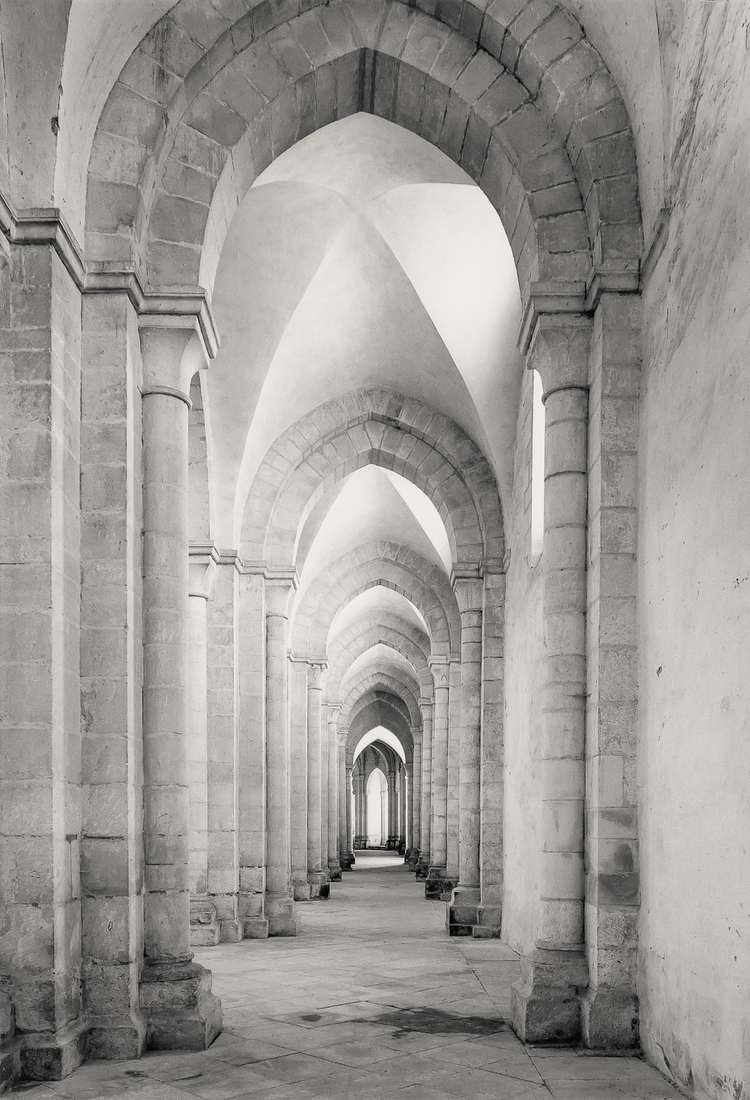
“South Aisle looking East, Pontigny, 1986” © David Heald
The Pontigny Abbey is a Cistercian monastery in Burgundy, France, built in 1114. Writing about David Heald’s photographs in Architecture of Silence, art historian Roger Lipsey commented: “Cistercian architecture draws together the fundamentals of masonry and geometry to create a harmony of stone and light, of uncluttered interior volumes and modest external masses…. Upon entering [these buildings] one is deeply touched by the quality of the silence and the light. Free by design of distracting details, these are places of recollection, of concentration, of serenity.”
David Heald has been photographing art, architecture, and the natural landscape for over 35 years. His work is represented in many private and public collections, including the Cleveland Museum of Art, the Mount Holyoke College Art Museum, and the Bibliotheque Nationale de France. Heald is currently Director of Photography at the Guggenheim Museum.
www.davidhealdstudio.com
Photo used by permission of artist