


For 25 years, Bellevue Literary Review has been publishing stories, essays, and poems that take readers into the shared space where art and medicine meet. Throughout our anniversary year, we’re marking this incredible milestone by inviting you on a journey through the BLR archive, from the beginning through the present.
Join us each week as we curate special highlights — stories, poems, photos, and more — from each of our issues.

About the Issue
Issue 32 features the annual BLR Prizewinners — highlighted below — and includes writings that showcase the nuances of relationships as they are impacted by illness, from a couple’s physical intimacy during cancer treatment to a young researcher trying to care for her primate subjects and her ailing mother at the same time.
From the Foreword
Greetings from the 32nd issue of the Bellevue Literary Review, my first issue as assistant poetry editor… I am grateful to join a journal that has explored the stories of medicine and literature as it has been intersecting the lives of medical professionals and patients alike for almost two decades. When I began reading submissions for the BLR I felt like I was a student again. This time, Leila Chatti invited me to question the presence of blood in the violent, peaceful, and intimate scenes she rendered in her poem “Blood HX.” And through the poem “Back in the World: Commuter Student,” JoLee Passerini taught me what it is like to return to school after a military tour overseas. From a couple’s bedroom to a bed in the ICU, these works of literature teach us that writing is not done solely to share oneself with others, or to commemorate a moment. Rather, great literature is meant to help us understand how it is to be another human.
– Jen Hyde, former Assistant Poetry Editor
Read Highlights from Issue 32
Each week, we’ll be highlighting one outstanding story, poem, and essay from the featured issue. We encourage you to explore more from the issue on our website or, better yet, to pick up a copy!
Do I Look Sick To You?
2017 Winner, Goldenberg Prize for Fiction
Pushcart Prize Winner
by C.J. Hribal
At first you don’t. You hold back, stroking the small of her back. You kiss her ear. You nestle in behind her. Finally she says, “What, you’re afraid I’ll break? You’re afraid it’s contagious? Trust me, the cancer will not stick to your dick. It’s not gonna rush up your urethra, pummeling your little spermies on the way, and explode like an IED in your insides. It’s only trying to do that to me.”
This is how it’s going to be—she is going to kick cancer in the ass. Everyone says this, “She is going to kick cancer in the ass,” until it becomes a mantra. Everything is going to be as it was before, only now you are “living with cancer.”
“‘Living with cancer?’” she says when her oncologist uses this phrase. “What, I’ve lent out rooms? I’m just supposed to think it’s a particularly sloppy roommate? It leaves its clothes everywhere, its dishes mound up in the sink, it leaves its towels on the bathroom floor and clots of hair in the drain, and when I say, ‘This is not working out,’ my cancer roommate gets to say, ‘Screw you, I’m staying’? That is so not right.” Her oncologist and her nurses love her. So do you. She is going to kick cancer in the ass.
Of Mothers and Monkeys
2017 Winner, Felice Buckvar Prize for Nonfiction
by Caitlin Kuehn
In the morning I rush past the early shift nurses and the acrid chemical scent of burnt coffee in Styrofoam cups, towards the locked doors near the cafeteria of our city’s largest teaching hospital. There are other student research assistants, but I have been here the longest, nearly three years, so I am the most trusted to self-manage the hustle and flow of laboratory life. By the time I layer on the second pair of gray plastic booties over the first set, and steal a look at the clock perched above another layer of locked doors, my mother is already halfway through surgery at the other end of the hospital. I pinch the metal at the bridge of my facemask onto my nose, take a hard breath in, and enter the lab in search of Domingo.
The trick with Domingo is outwitting his speed. He is small enough and jittery enough—and clever enough—that even with the back of the cage slid forward, pressing him with his flank against mesh, he manages to spin himself around until he is spread-eagled facing me. From this position it is impossible to safely administer the ketamine into his quadriceps. Intramuscular injections are a delicate process, a quick and confident plunge through the skin into the muscle tissue before the leg is instinctively jerked away. If the aim is off or I am too self-conscious in my movements, too tenuous, shaky, sluggish, or scared, I risk hitting major arteries or the sciatic nerve that runs deceptively close to the surface in primate thighs. Acute neuropathy, localized necrosis, lameness, and atrophy can all be the permanent fallout of a poorly aimed injection.
Poem For A Friend Growing Lighter and Lighter
2017 Winner, Marica and Jan Vilcek Prize for Poetry
by Abe Louise Young
How are you?
I’m on the barbs of stars
How are you?
A bug eating through the shirt someone draped on a stone saint
How are you?
Soft moldy orange with a white-to-green halo
How are you?
Sexual hopes redeem my fears
How are you?
Lamotrigine, Clonazepam, friendship and gliding
How are you?
Just like you–a septic tank covered in honeysuckle vines, leaking time
Issue 32: The Cover
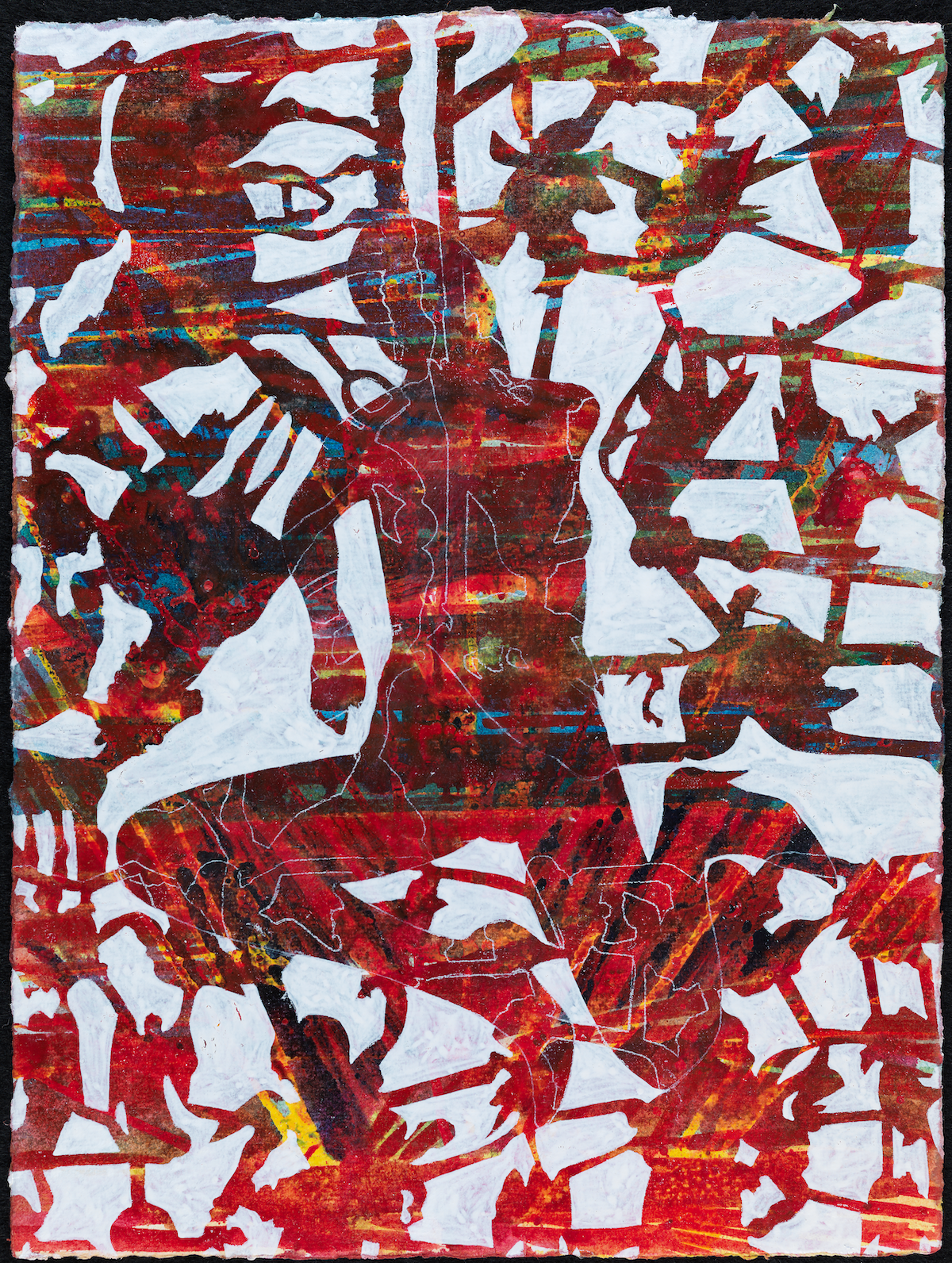
A Lexicon of Persistent Absence: Erotic Fantasy by Bo Joseph
Bo Joseph is a New York-based artist, originally from California. His abstract artwork is based on powerful images culled from books, magazines, or auction catalogues. “I scavenge images of objects that transcend cultural boundaries,” says Joseph. He often layers the images and repeats silhouettes using stencils. He then uses “chancy techniques” such as sanding, masking, and rinsing to alter the images from their original forms and upend their original contexts. The result is a “mingling of iconic forms from disparate cultures and historic periods.”
(Quotes are from an artist statement by Bo Joseph. More insight into Bo’s creative process can be found in an interview by Matthew Weinstein, published in BLR Issue 32.)