

For 25 years, Bellevue Literary Review has been publishing stories, essays, and poems that take readers into the shared space where art and medicine meet. Throughout our anniversary year, we’re marking this incredible milestone by inviting you on a journey through the BLR archive, from the beginning through the present.
Join us each week as we curate special highlights — stories, poems, photos, and more — from each of our issues.

About the Issue
Issue 33 of BLR is a special issue — “Finding Home: Family and Connections” — that looks deeper into a universal theme, featuring poetry and prose on how home can be the people in our lives and how those relationships affect every aspect of our health and wellbeing.
From the Foreword
The trope of rugged individualism is intimately knitted into the fabric of Americana. Dig a bit deeper, though, and this ideal is often revealed as a convenient fantasy to prop up a sense of self. The reality is that nearly everything we do is caught up in a tight web of connections that begins—and usually ends—with family.
The Fall 2017 issue of the Bellevue Literary Review is devoted to the theme of family, to the idea of finding home. For better or for worse, family is the original social network. Many of us spend our years trying to escape the tendrils of family, and just as many of us are racing to knit them together as fast as we can. In this issue of the BLR, we explore families of all types—ones we’re born with, ones we create, ones we destroy, ones that are thrust upon us, and ones we can only dream of. Woven through these stories, essays, and poems is the idea of “finding home,” through the connections we make and break over the years.
– Danielle Ofri, Editor-in-Chief
Read Highlights from Issue 33
Each week, we’ll be highlighting one outstanding story, poem, and essay from the featured issue. We encourage you to explore more from the issue on our website or, better yet, to pick up a copy!
Numbers
by Marcia Calhoun Forecki
The best years are even years and the square is the perfect shape. Some people say the circle is the perfect shape but that’s ridiculous because a circle only has one side. Only two odd numbers are lucky—three and seven—but the rest are just sharp and awkward like scissor blades or pocket knives, the two sharpest instruments I have yet to come in contact with in this, the spring of my fifth-grade year. Even numbers are smooth and sweet, and can all be divided by two, which is the most perfect number of all because two means love: husband and wife, mother and child, man and dog. That should be obvious to anyone.
Another reason I love even numbers is that my grandparents, specifically my father’s parents, visit us from California every other year, in the even years as this one, 1960, and bring shells from the beach, real paper leis like in Hawaii, and five dollars cash for each of us, my brother, sister, and me. They come in the late spring before it is too hot to cross the desert but after the mountain passes open. Grandpa follows Route 66, which divided by two is 33, a double lucky number.
The Funeral
by Alexander Schuhr
Tonton Charles was not a great man. He had not led an inspirational life. In fact, he had spent little of it sober. This he had in common with my father, though my father was lucky enough not to see death coming. He just collapsed one day, fell into a coma, and never woke up. My father was only forty-five, but his body had been aged by years of excessive drinking.
Such merciful ignorance was not granted to Tonton Charles. He watched his death approaching and had to bear the full burden of those wasted years.
He reacted with spite. Spite towards his wife, Mama Yvette, who stayed by his side during his final hours, no more appreciated than during the years of their marriage. Spite towards his sister, Mama Fabienne, who had offered him shelter and care, forgiving past ingratitude, disrespect, and insults. Even after his voice had left him, he would stare at them hatefully, angry about the life he had led, malevolently envious of those who would continue living. His death would not be greater than his life had been.
Migrations
by Ines P. Rivera Prosdocimi
San Nicolas fluctuated between mentor, master.
The more I travelled the stairs, he levitated. The more
I slid my finger along his goldstone frame, he’d say,
‘Ciónnn. Father said he was the heart of an old wooden
triptych, flanked by the ups and downs of the Atlantic.
Once, I kissed this saint for Father, placed him facing
the sky on the stairs, listening to Mother play a waltz.
See, I was too small to return him to that spot faded
under his weight. See, I learned to move among men,
the way I moved around this saint. See, when Father’s
god-voice broke, it broke like the sea and made me
wet myself. I had to wear a silky bombacha up
to my chest, baby-blue bloomers belonging to queen-
nanny Reina, Reina rocked me in her boat-like arms,
Reina with hair like dune grass.
Watch Readings from the “Finding Home” Theme Issue
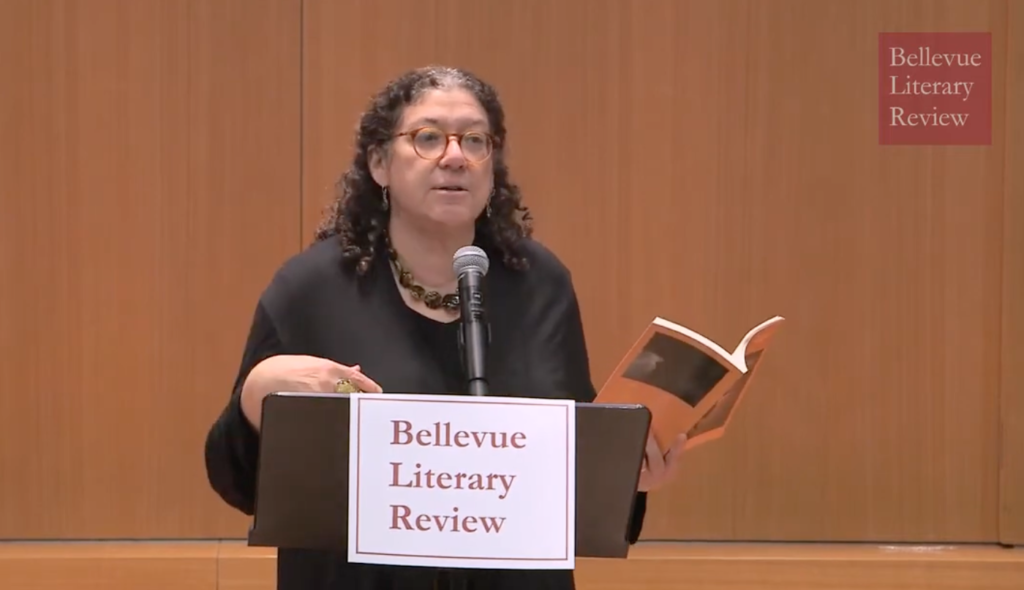
WATCH: When this issue was published, BLR held an event in which some of the works were brought to life through dramatic readings. Perri Klass (photo) read her essay “I’m Not Talking to Anybody,” which explores the role reversals that doctors experience when they become a patient, or (worse!) the hovering family member of a patient. Watch here.
Issue 33: The Cover

This issue of BLR extended the family theme by featuring artwork by father and son Paul Caponigro and John Paul Caponigro. John Paul’s stunning “Alignment XXXIII” graced the front cover, and the issue featured an insert of additional work by both artists.
The quotes that follow were featured in an artist statement in Issue 33 of BLR.
“Often I see the materials of photography as being a type of terrain. Emulsions, liquid developers, silver salts, and fixers interact and make up a landscape which I need to explore in my mind’s eye if I am to manifest an artful image in silver. Light strikes silvered emulsions and lenses reshape the forms riding on the rays which affect film. This work of transformation etches and shapes a landscape in the surface of the emulsion. Herein can be a place of conceiving, where mind and imagination might combine with the world of feeling to bring a new object into being. It is here also that overtones from the symbolic language of the medieval alchemist might be apprehended…. I encourage the viewer to allow the art to flow and take on a meaning needing no explanatory notes.”
Paul Caponigro, 1978
“The process of creating these images is like dreaming while I’m awake… I am not encouraging people to reshape or make the land that surrounds and shelters us. I am encouraging people to make land a part of themselves physically, mentally, emotionally and spiritually. And I am encouraging people to take an active hand in reshaping the landscapes within themselves.” The series called “Alignment” explores the process of finding our place in the universe, one could say finding home.
John Paul Caponigro, 2017
Images used by permission of the artist