

For 25 years, Bellevue Literary Review has been publishing stories, essays, and poems that take readers into the shared space where art and medicine meet. Throughout our anniversary year, we’re marking this incredible milestone by inviting you on a journey through the BLR archive, from the beginning through the present.
Join us each week as we curate special highlights — stories, poems, photos, and more — from each of our issues.

About the Issue
Issue 35 is a theme issue on displacement, with poetry and prose that allows readers to grapple with the upending of the familiar, the shifting of lives, the transference of emotion, the journey away from home, and the geographical and emotional sense of belonging elsewhere.
Notably, this was also the first issue to showcase BLR‘s new look, a wonderfully inspired “mid-life refresh” that was born from a remarkable collaboration with students at the Parsons School of Design. Under the direction of their teacher, the incomparable Minda Gralnek, the students were given free creative rein to present their ideas to the BLR team, who then chose the final design and worked with the students to refine it. This refreshed look is what our readers still hold in their hands (whether in print or by digital device!) today.
From the Foreword
When I was six, my family moved from England to California, where I was cast as Paul Revere in the school play about the American Revolution. I had a strong British accent, and after riding my hobby horse down the aisle shouting “The British are coming! The British are coming!” I found myself on stage delivering a speech to an audience of parents who were practically falling out of their chairs with laughter. I wasn’t quite sure what was funny. I laughed too, not wanting to be left out of the joke, but ruining the delivery of my speech in the process. On one hand, I was thrilled; apparently, I was quite funny. On the other hand, I was confused; what was funny about Paul Revere? And why was no one upset that I had messed up my lines?
I didn’t get the joke until almost twenty years later, when my father told the story, assuming that I had understood all along. A six-year-old with a heavy British accent playing Paul Revere in the early 1980s might as well have been a Monty Python sketch. By the time I was in on the joke, my British accent was long gone, and I even had a slight Baltimore twang from years of living in Maryland. Of course, no one’s accent is ever funny to themselves, so it was impossible for me to get the joke until I was so unequivocally American that I could look back and see myself as the adults in the room had seen me. I can still see the auditorium where I rode down the center aisle, but I can’t see myself, because I was looking out. To get what was funny, I have to imagine myself into the audience, and make a stranger of that little no-longer-English boy whose voice would have been more at home in a production of “Oliver Twist.”
All of us have stories of displacement. Some of those stories are as simple as being yanked from the comforts of home on the first day of school, and some of those stories are harrowing tales of catastrophic upheaval and radical reinvention. Displacement felt like a pressing theme to us at the Bellevue Literary Review because, like illness and healing, displacement is a universal experience that is unevenly distributed.
– Jason Schneiderman, past Poetry Editor
Read Highlights from Issue 35
Each week, we’ll be highlighting one outstanding story, poem, and essay from the featured issue. We encourage you to explore more from the issue on our website or, better yet, to pick up a copy!
This Be Madness
by Carter Sickels
Antoinette poured two well whiskeys, neat, and slid the tumblers toward us. We tried to sip like we were drinking hot tea instead of liquor, wanting them to last. The whiskey blazed in my mouth, a fiery, sweet, temporary medicine. I looked past Antoinette, toward the bottles of liquor, and a man with a shockingly pale face and greasy hair and a rat-like mouth stared at me from across the bar. Then I realized I was looking into a mirror, looking at myself.
I turned away from my reflection, quickly, and eyed KC, whose face lit up. He’d forgotten I was sitting next to him. He was happy to see me.
“Did you know I used to be a teacher?” he asked. KC always had a story about his life in the Before. Basketball star. Singer. Teacher. That was the one he spoke of most often. He constantly searched for breadcrumbs of his past, like somehow he would find the trail that would lead him back to a fairytale.
Displacement: Illness & Health
by Barron Lerner
In medicine, mental health has traditionally been “displaced” from physical health, cordoned off into its own, often devalued, category. Working as an internist in a mental health clinic, however, I often sense the reverse—the physical health displaced from the mental. Patients are there primarily for their psychiatric issues, and other medical concerns seem secondary.
Of course, displacement is almost always a defining feature of the patients here. Many have lost their jobs because of their illnesses and are now unemployed or on disability. Others have needed to move away from their families—or been kicked out—and live alone. Many of the medications used to treat the psychiatric disorders have major side effects that change how patients’ bodies feel—adding weight, depleting energy, causing tremors. In other instances, the displacement is more subtle…
In one sense, my job with psychiatric patients is little different from the “regular” patients I take care of in the medical clinic: I treat their asthma, hypertension and diabetes; try to get them to stop smoking and drinking; and push for screening tests like mammograms and colonoscopies.
But there are times when displacement renders screening almost ridiculous. How important is a Pap test for someone who is actively hallucinating? Who can think about their cholesterol level when they’ve just lost their housing?
A Sestina of Bad News
by Alex Johansson
“There are more important things I should be doing at the age of forty-two,” you say, showing me photos of your daughter in a pink, fluffy tutu and I list potential risks of self discharge including the possibility of death, make follow-up plans and try to listen and make an effort to write it all down for you so you can read it at home and make notes of any questions you have that you hadn’t thought to ask at the time.
I see your pale eyes glaze over when we meet the next time,
and I answer questions you don’t really want the answer to,
the box of tissues conveniently placed just within reach of
the tremulous hand that wipes your wet, drowning eye.
Your other hand tightly grips a pen as you try to write
it all in a journal you carry. We don’t mention death.
Issue 35: The Cover
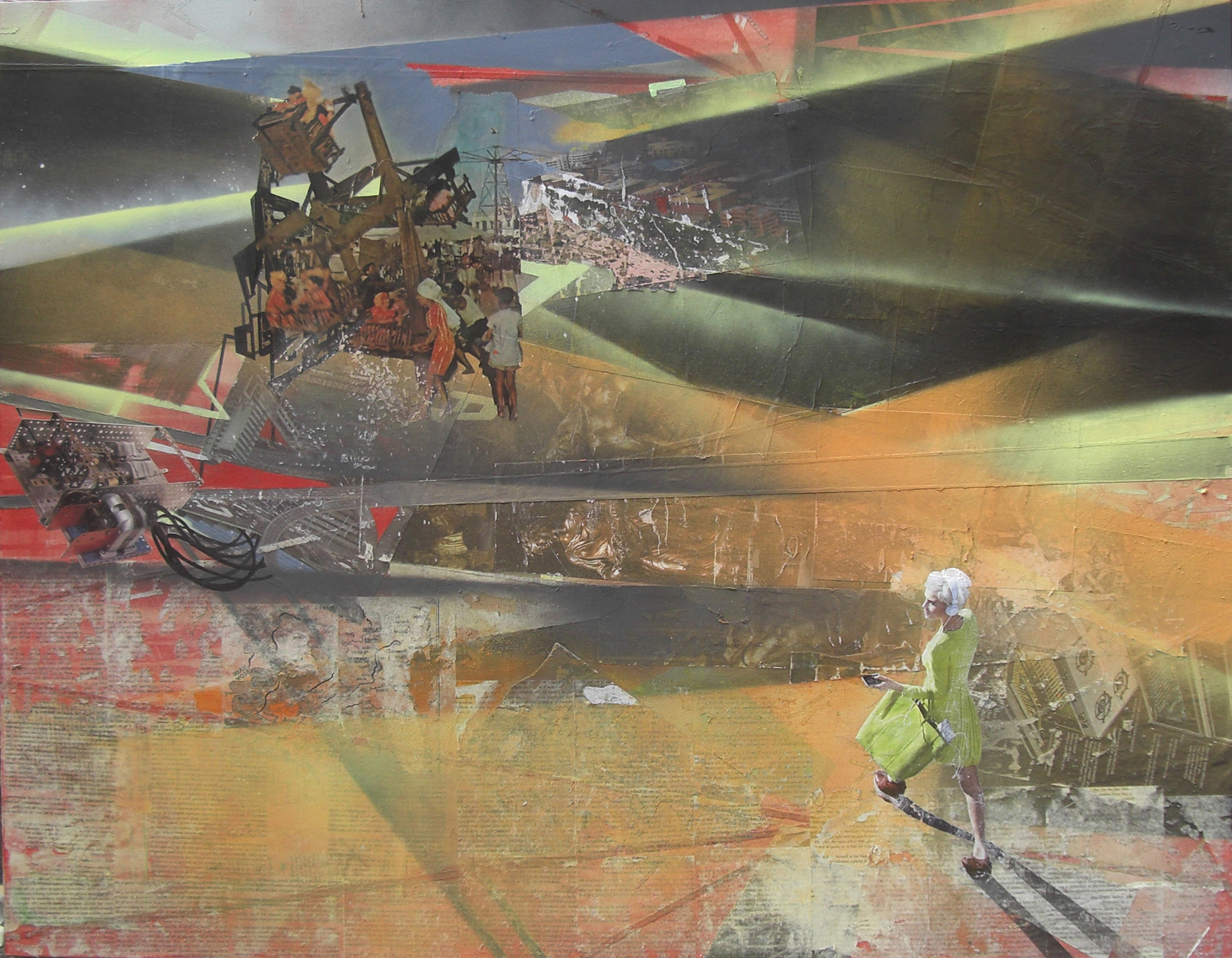
This issue of BLR featured artist Jonathan Allen’s “Round and Round” on the front cover.
“Round and Round” evokes the circularity of globalization, and the interconnectedness
of seemingly disparate communities within our digital era. It includes imagery of Bengali children playing on a ferris wheel, and a privileged white woman striding along with her smartphone. The work is composed using layers of newsprint, paint, appliance catalogues, and advertising imagery. www.jonathanallen.org
Used with permission of the artist