


For 25 years, Bellevue Literary Review has been publishing stories, essays, and poems that take readers into the shared space where art and medicine meet. Throughout our anniversary year, we’re marking this incredible milestone by inviting you on a journey through the BLR archive, from the beginning through the present.
Join us each week as we curate special highlights — stories, poems, photos, and more — from each of our issues.

About the Issue
Issue 38 featured the 2020 BLR Prizewinners, selected by judges Bryan Washington, Sheri Fink, and DéLana R.A. Dameron. It also included a Book Review Roundup, highlighting poetry collections that focused on the consolations of mortality.
From the Foreword
A writing contest is an ocular hybrid of sorts, a combining of the eye of the reviewer and the eye of the editor with the eye of the judge. Nearly 700 writers submitted their work for the contest this year, far more than we can ask our judges to read. Our reviewers do the initial read of the submissions, which are submitted “blindly”—without name or cover letter.
Submissions with promising reviews are then passed on to the editors. We read these thoroughly and debate them, usually quite passionately. This process of honing the final pile is one of the most time-intensive and invigorating parts of the editorial calendar. The spirited tussle of opinions about style, character, plot, perspective, voice, setting, and metaphor ends up ensuring that there is a wide variety of pieces in the final pile.
That raucous debate screeches into silence as we pass the final pile—10 stories, 10 essays, 10 poems—off to the judges. And then we wait. The judges read these stories without any knowledge of who the author is, what the reviews were, how vociferous or unanimous the editorial debate was. While the judges take their time to deliberate, we editors sink back to our regular work—the next round of manuscripts is waiting to be reviewed —but it’s hard to fully focus. There’s always that thought percolating in the back of our heads, “Hmm, I wonder who they’ll pick?”
– Danielle Ofri, Editor-in-Chief
Read Highlights from Issue 38
Each week, we’ll be highlighting one outstanding story, poem, and essay from the featured issue. We encourage you to explore more from the issue on our website or, better yet, to pick up a copy!
Rivers
2020 Winner, Goldenberg Prize for Fiction
by Yalitza Ferreras
Aunt #1’s plastic toilet lid shifts under Manolo’s weight as he balances his left ankle on his right knee, careful so his leg doesn’t slide off his sweatpants. He presses the pad of his thumb into a clear spot on his ankle, watching the indentation fill up with fluid, like water seeping back into a fresh muddy footprint. He calls this checking his water levels, which could be a cool party trick, but Manolo is not at a party.
There is no time to waste, so he places his leg down to get started. He closes his eyes to avoid seeing himself limp in his own hand. There is a clear image of Dinora’s breasts bouncing in front of his face in time with the merengue music thumping from the upstairs neighbor despite it being morning, but the chatter and the clanging of plates and utensils coming from the other side of the door is difficult to ignore. The steady beat fragments. Aunt #1 says, “It’s been at least fifteen minutes,” and his mother asks, “Did he take anything with him?” Aunt #4 says, “I don’t know how you put up with this.” The sisters are gathered together in Aunt #1’s apartment in Queens to shut down his broken, horny, male body. He is forty-five years old and knows he is going to die soon, either where he is now—at Aunt #1’s apartment in Queens, or back at his mother’s house in Santo Domingo.
READ: BLR interviewed Yalitza on a variety of themes including how her bi-cultural heritage impacts how she perceives and interprets the world. Read here.
Refugere
2020 Winner, Felice Buckvar Prize for Nonfiction
by Nina Adel
Beneath your soft blanket. Beneath twigs and dirt. On the hardest ground. Just under the skin of a life you are living. Under pine needles fallen in the pines. On the rooftop. With the animals inside your house. Beneath the stage makeup on your skin. Enmeshed in the lining straw of new bird’s nests—you can send yourself there, seeking softness. In the corn. Under clouds of fragrance. Under sweat.
Any place a place of refuge.
Any place, as long as it’s not the place you’ve left.
Live anywhere, but always leave the back door open.
Live hidden in the open. Live being open.
Leave. Leave yourself open so you can leave yourself.
READ: BLR interviewed Nina on a range of topics including the influence of songwriting on her creative writing process. Read here.
Ordinary Psalm with Near Blindness
2020 Winner, Marica and Jan Vilcek Prize for Poetry
by Julia B. Levine
i.
The world mostly gone, I make it what I want:
from the balcony, the morning is a silver robe of mist,
I make a reckless blessing of it— the flaming,
flowering spurge of the world, the wind
the invisible birds make as they flock and sing.
Edges yes, the green lift and fall of live oaks,
something metal wheeling past,
and yet for every detail alive and embodied—
the horses with their tails switching back and forth,
daylilies parting their lobes to heat,
the pond splintered into rain—
I cannot stop asking sparrow or wren?
READ: BLR interviewed Julia on a range of topics including her relationship to nature as a poet. Read here.
Issue 38: The Cover
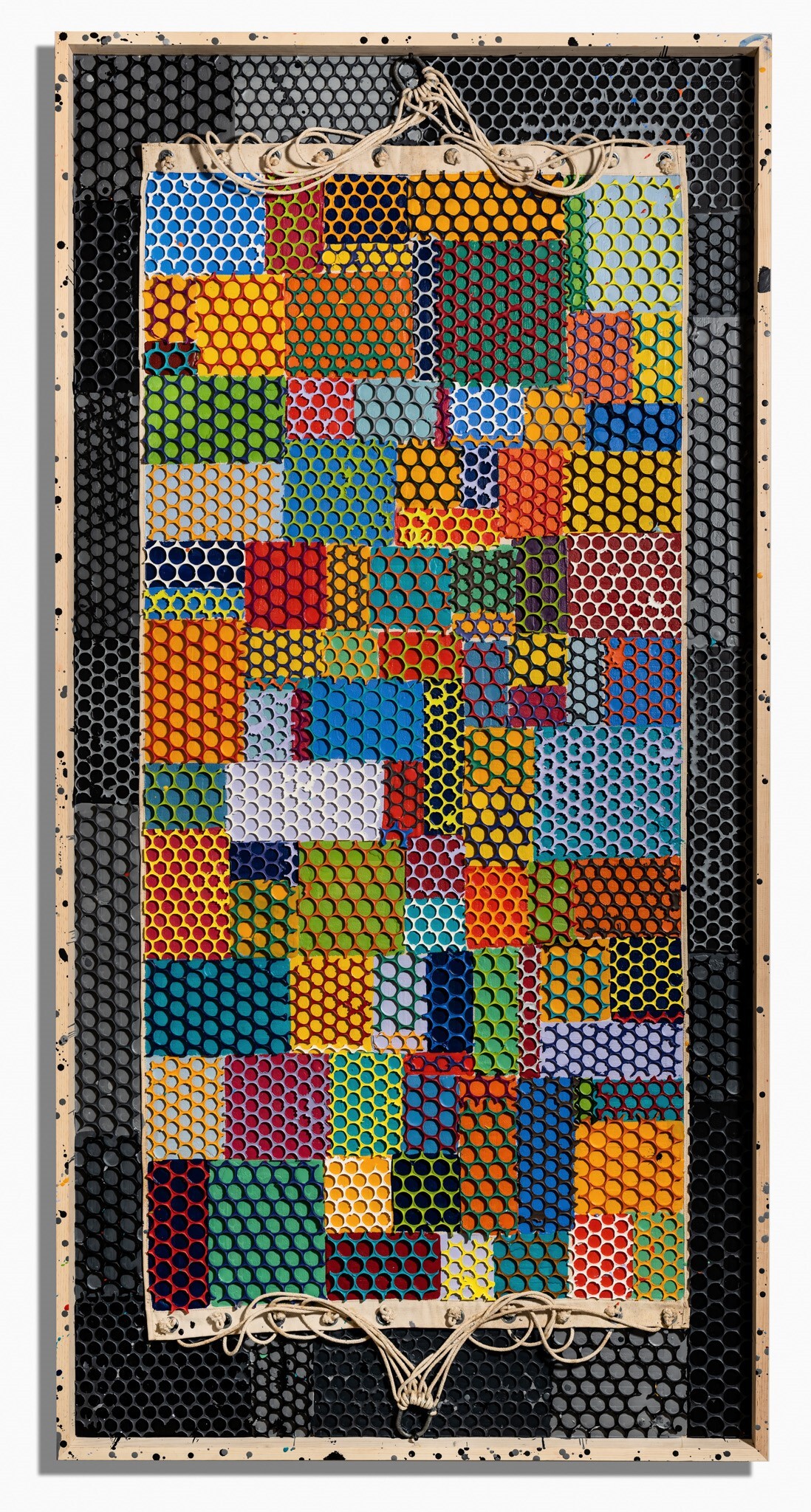
The cover of this issue of BLR featured “Patchwork” by Martin Kline, which is from his “Hammocks” series. These vintage WWII Navy hammocks served as a blank canvas for Kline, a form of tabula rasa on which to project.
In an artist statement, Kline noted:
“In the Hammocks series, vintage World War II Navy hammocks are employed. These particular hammocks belonged to sailors and were used in stressful times, during war. But a hammock itself is a symbol of leisure and relaxation. The hammocks served as beds and thereby communicate the activities associated with them: rest, sleep, dreams, sex. In the studio, the hammock is a readymade object and the blank white canvas is a form of tabula rasa on which to project. Through the last six years, the series evince a wide range of subjects: work versus relaxation, anxiety, fear and isolation. Military themes, nautical and seafaring references abound. There are chapters of joy and serenity as well.”
Image used by permission of the artist