

For 25 years, Bellevue Literary Review has been publishing stories, essays, and poems that take readers into the shared space where art and medicine meet. Throughout our anniversary year, we’re marking this incredible milestone by inviting you on a journey through the BLR archive, from the beginning through the present.
Join us each week as we curate special highlights — stories, poems, photos, and more — from each of our issues.

About the Issue
Issue 40 featured the 2021 BLR Prizewinners, selected by judges Dan Chaon, Sandeep Jauhar, and Jen Bervin. (BLR Trivia: The prizewinning poetry selection was written by Saleem Hue Penny, who is now an Associate Poetry Editor at BLR.)
From the Foreword
For much of the world, turning the page from 2020 to 2021 couldn’t have come soon enough. The Covid pandemic has exhausted the collective populace—psychologically, physically, economically, politically, and spiritually. The grief and pain seem endless. There are days in the hospital when I’m just staggered by the amount of tragedy that life deems permissible.
So it hasn’t been surprising that the many of the submissions to BLR have reflected this reality. We read scores of poems, essays, and stories that probed the various contours of the pandemic. Two essays, in particular, stood out to us and are published in this issue of BLR. They bring the perspectives of a Chinese high school student and a Black family physician caught in the myths, fears, and prejudices that characterized the earliest stages of the U.S. pandemic.
– Danielle Ofri, Editor-in-Chief
Read Highlights from Issue 40
Each week, we’ll be highlighting one outstanding story, poem, and essay from the featured issue. We encourage you to explore more from the issue on our website or, better yet, to pick up a copy!
Tattoos
2021 Winner, Goldenberg Prize for Fiction
by Galen Schram
You notice the weathered scar first, the wrinkled tilde pinching brown to pink skin where her pierced nipple once shocked her late husband. The cut beneath your collarbone twinges.
The rim of the N-95 mask burrows deeper into your cheeks and the bridge of your nose as you cover her chest with the blanket. The team assembles around her bed. Another pair of navy scrubs beneath a transparent plastic isolation gown is beside you at Mrs. Mattie’s hips, two more on her right side mirroring you, green scrubs at her feet on IV catheter duty, and the light blue ones monitoring the ventilator are to your right.
You allow the three other physical therapists to process the scene. You remember your first time in the intensive care unit, that rush of exhilaration speckled with terror. (Or was it the other way around?) Under normal circumstances your junior coworkers would shadow an experienced therapist for a week before touching a patient, but desperate times and all. There’s safety in numbers, you assured them during the training session. And besides, any serious clinical decision wouldn’t be in your collective hands, but rather the anesthesiologist’s. For once you’re grateful to be understood as the muscles of the treatment team.
WATCH: When this issue was published, BLR interviewed Galen, who also read an excerpt from “Tattoos.” Watch here.
The Tapeworm
2021 Winner, Felice Buckvar Prize for Nonfiction
by Amy V. Blakemore
My father drove me to the appointment where we would determine what to do with the tapeworm in my stomach, the one that, in all likelihood, was not real. I’d be lying if I told you I remember what we talked about on the way there; I don’t. I didn’t talk much during high school, unless “talking” was staying up late on instant messenger flirting with boys with acne who said: sup. In the car, I pressed my face to the window, let the sun warm my skin. I was always trying, in those little ways, to feel pretty. It was spring and I wanted to sprawl on the grass beside our house.
Besides, I didn’t think I was sick, or “anorexic,” or not eating enough—I thought I was dieting, like everyone else. And after a while, eating less felt comfortable, normal, safe. The less I ate, the less I wanted, until my body became … less. There was nothing bold or bright or celebrity about my eating disorder. I hardly noticed it myself, until my thinness migrated from admirable to somewhat concerning to red alert: waste of a girl. These shifts occurred quickly, seemingly overnight.
And I could explain none of it. I couldn’t explain any of my desires or behaviors in a way that made sense. I was starving myself and I didn’t know why.
WATCH: When this issue was published, BLR interviewed Amy, who also read an excerpt from “The Tapeworm.” Watch here.
Never the Less
2021 Winner, Marica and Jan Vilcek Prize for Poetry
by Saleem Hue Penny
we still great. again, restrictive / covenants hit like bricks. / we Great Migrate. again, // redlined, we wait. we congregate / like food pantries & funeral wakes. breaths held like / sentencing dates. hoping for change, like ’08.
Note: The excerpt above does not do justice to Saleem’s unique poem format. Please be sure to check out the full poem at the link below.
WATCH: When this issue was published, BLR interviewed Saleem, who also read “Never the Less.” Watch here.
Issue 40: The Cover
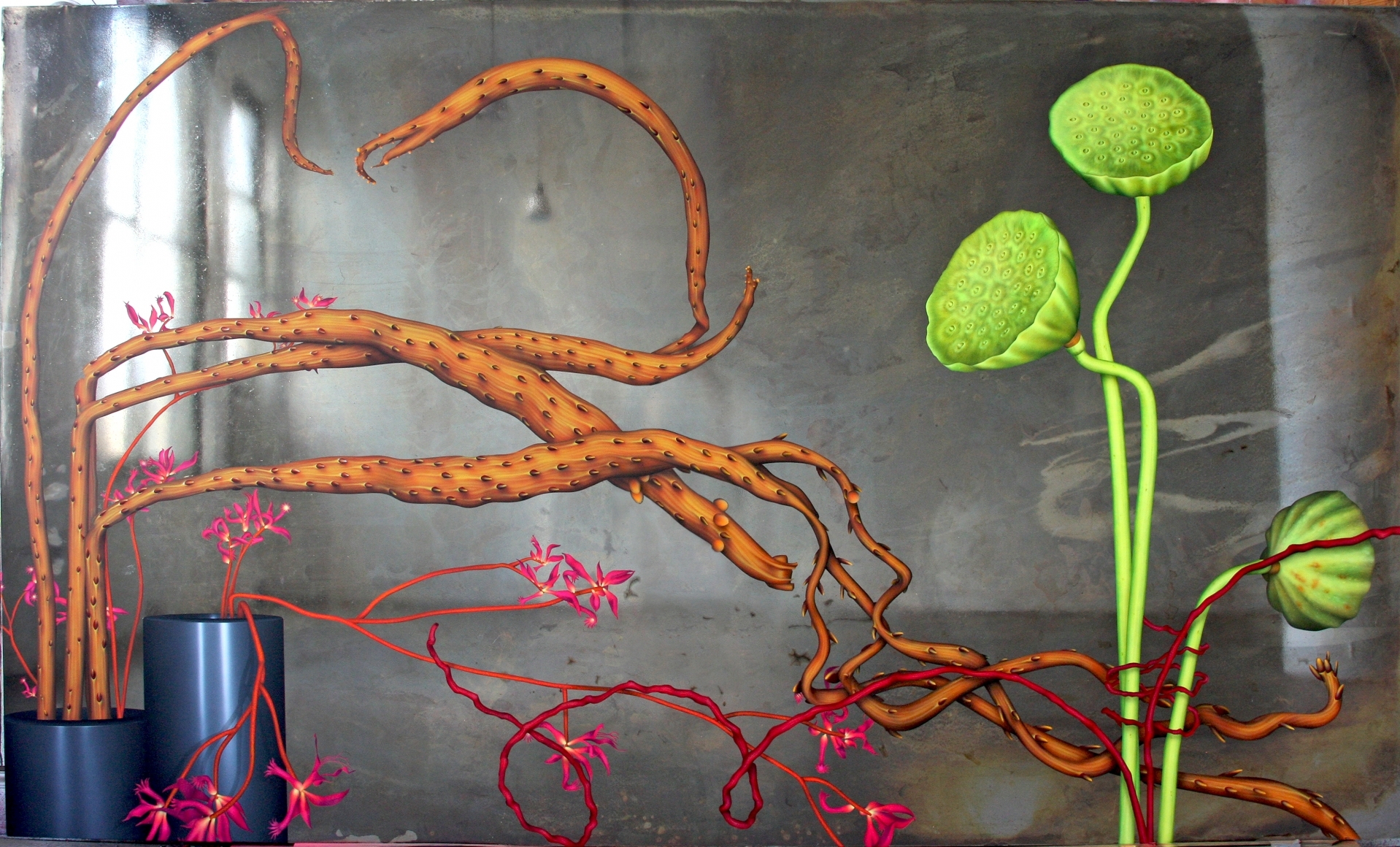
The cover of this issue of BLR featured “The Conversation” by Matthew Weinstein.
In an artist statement, Weinstein noted:
“The Conversation comes out of a continuing series of works featuring ikebana arrangements. I was first exposed to ikebana when I was a student in Japan. I was inspired by the way ikebana practitioners look at the natural world so closely, and use the bare minimum of plant elements. Ikebana signifies a more ecological relationship to the natural world—bringing nature closer to us—than the Western attachment to excess and waste. Ikebana arrangements anthropomorphize plant life, bringing out the uniqueness of each element to the point where they acquire personality. They are us, and we are them.“
Image used by permission of the artist