

For 25 years, Bellevue Literary Review has been publishing stories, essays, and poems that take readers into the shared space where art and medicine meet. Throughout our anniversary year, we’re marking this incredible milestone by inviting you on a journey through the BLR archive, from the beginning through the present.
Join us each week as we curate special highlights — stories, poems, photos, and more — from each of our issues.

About the Issue
Issue 43 is a theme issue on recovery, with poetry and prose that approach recovery from all angles: long-term illness, addiction, mental health struggles, piecing together a sense of self. It also marked the first of BLR‘s Studio Visits series of short videos with our cover artists.
From the Foreword
When we initially considered recovery as a theme for BLR, Covid-19 wasn’t yet a twinkle in any epidemiologist’s eye. By the time the call for submissions swung into action we were knee deep in a global pandemic and the term recovery took on urgent medical tones above and beyond the metaphorical ones we’d been debating. Recovery seems to feel more dimensional than ever as we try to navigate this perfect storm of medical disasters, environmental catastrophe, political discord, economic stress, and social upheaval.
It can be exhausting to contemplate all that is happening, much less consider how we might ever recover. Literature can never offer a “how-to” manual for recovery—that we’ll leave to the strategists of the world. Rather, it offers an opportunity to grapple with the individual strands of our lives, teasing out one tiny aspect to ripple slowly through our fingers. Literature won’t necessarily give us the answers, but it will help us wrestle with the questions…
Recovery is rarely a final destination. Usually it is an ongoing journey, often an avidly detoured one. While we could never presume to offer a roadmap to recovery, we hope that the stories, poems, essays, and artwork in this 43rd issue of BLR provide insights into how we grapple with the journey. Enjoy the ride.
– Danielle Ofri, Editor-in-Chief
Read Highlights from Issue 43
Each week, we’ll be highlighting one outstanding story, poem, and essay from the featured issue. We encourage you to explore more from the issue on our website or, better yet, to pick up a copy!
Beenie at Fourteen
by Margaret Buckhanon
We are in the emergency room, Grandma, Jamal, and me. Jamal won’t stop crying, eyes are invisible, drowned by tears, snot keeps running out of his nose. “Rubena, get him back here.”
“His nose still runny, Grandma!”
I can’t find enough tissues; Grandma is yelling at me not to bother the nurses. Her sugar is high and Jamal is crying because he thinks his electricity caused “Grandma’s sugar to run out.” I tell him to stop crying but he won’t. I tell him Grandma is old, old people get diabetes. He does not believe me even though he can tell when I’m lying or telling the truth.
The people in Grandma’s building say Jamal is psychic. Grandma’s friends always bothering Jamal to pencil in winning numbers, give them the first six numbers that pops in his head. Those old people so happy a seven-year-old won them thirty, forty dollars. Grandma stopped him because it’s a sin to gamble, she’s stingy, wants Jamal’s powers for herself. Jamal says Grandma pulls him close to her whispering, “Baby, what’s your favorite numbers today?”
But this morning, Jamal’s magical power is not working. He still crying, despite Grandma telling him to hush. The doctor, an African with every letter of the alphabet in his last name, cannot control Grandma’s blood sugar. He tries to cheer Jamal up, placing the stethoscope around Jamal’s neck letting him hear Grandma’s heart is working. This works far better than Grandma telling him to hush as his crying is now a whimper.
1:00 a.m. Refill
by Rebecca Grossman-Kahn
It’s 1:00 a.m. and the emergency department is cold. The bright overhead lights illuminate the rows of empty desk chairs. I hear the tap-tap of rubber clogs shuffling in a far corner. There are only two patients here— the man in Room 18 with abdominal pain, and you.
From outside Room 11, I peer in through the glass walls. The privacy curtain is pulled halfway, exposing only a computer on wheels. I briefly struggle to open the door until it gives way with a click. A toddler is sleeping on the hospital bed, limbs and hair scattered, somehow taking up the entire single bed. You’re sitting next to her on the edge of a chair, wearing jeans, a T-shirt, and work boots with flecks of grayish mud. You haven’t shaved in days. I look back to the girl, and you must see my surprise at seeing a child in an adult emergency-department bed.
“It’s me,” you say. “I’m the patient. Just here for a refill.”
Love, We Never Get Too Far
by Nicholas Yingling
You take my arm
and remind me which way to walk the fire
road home. How strange to be this soft, to look down
an ammonite circling into concrete and return
to this question of one’s final shape.
The final shape will be shale, a metacarpal or two
to point the way to fossil reefs, the mollusks
I imagine as ossicles listening in the rock
for some hand to bridge the shores
on our canyon wall.
Watch
Writers on Recovery: Watch BLR’s event featuring interviews and readings with authors from the issue.
Issue 43: The Cover
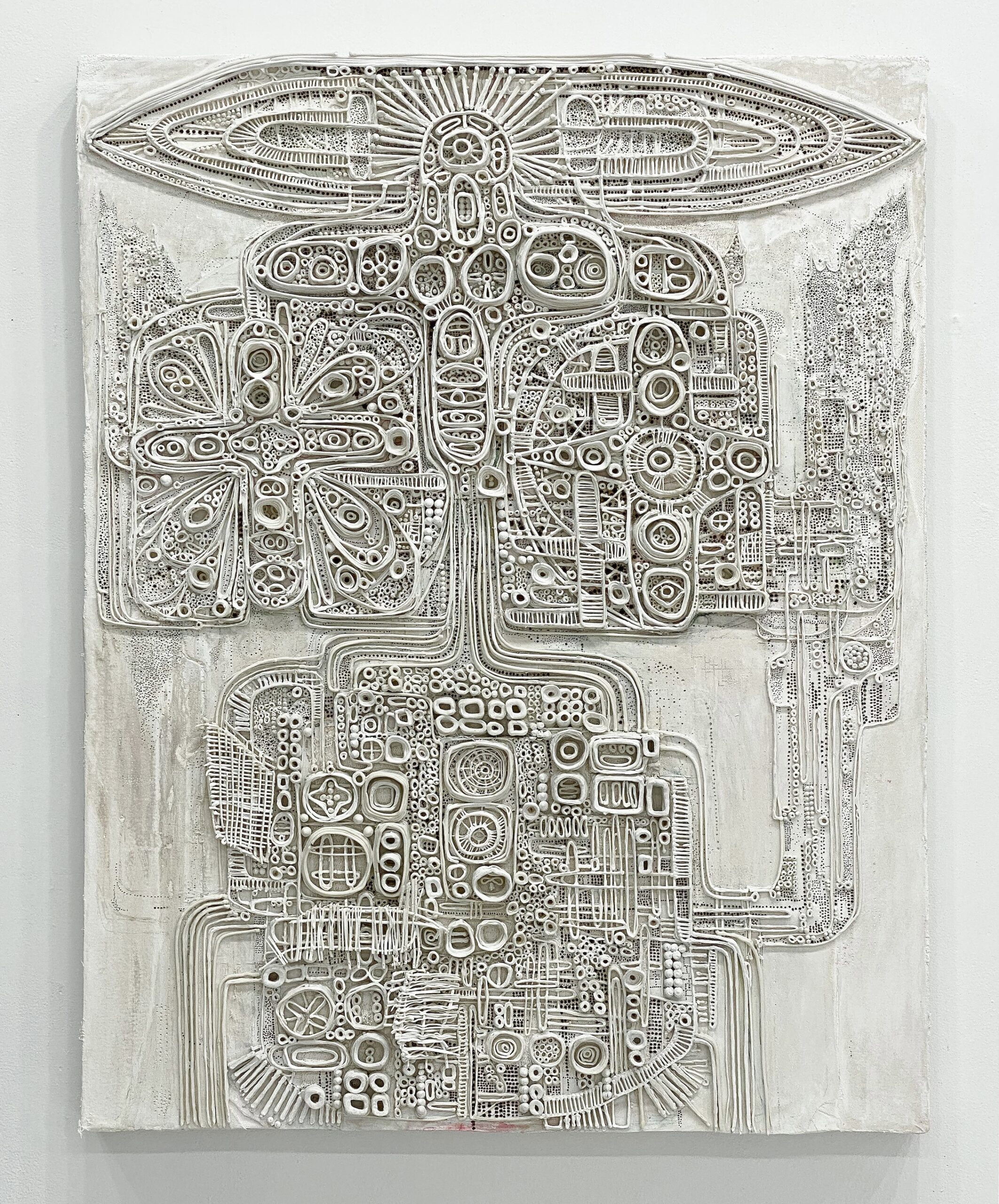
Image used by permission of the artist
The artwork on the cover of this issue of BLR is “Alien Robot Ghost” by Lauriston Avery. From the issue’s artist statement:
“The cover art for this issue of BLR was created in response to my recovery from addiction. In the disorienting early days, very little made sense to me, especially in the studio where I struggled to find a connection to my art.
Whether it was defiance or desperation, I turned to what was immediately on hand—construction adhesive—something that seemed oddly fated to this unsettled moment. I played first with a caulk gun, squeezing out the adhesive into simple forms. This led to obsessively populating the surface of stretched canvas with multitudes of squares and circles in all kinds of configurations. Intermittently I would apply washes of white acrylic paint. Then came the power tools—drills, sanders, grinders, scrapers—to carve away and further manipulate the material.”
BLR Studio Visit
In this video, BLR editor Danielle Ofri visits cover artist Lauriston Avery’s studio in Bushwick, Brooklyn, to discuss his creative process and get an inside look at his artwork.