


For 25 years, Bellevue Literary Review has been publishing stories, essays, and poems that take readers into the shared space where art and medicine meet. Throughout our anniversary year, we’re marking this incredible milestone by inviting you on a journey through the BLR archive, from the beginning through the present.
Join us each week as we curate special highlights — stories, poems, photos, and more — from each of our issues.

About the Issue
Several of BLR‘s issues have been home to early writing by authors who went on to great acclaim. Issue 14 features a prizewinning story by Leslie Jamison, who later wrote the bestselling books The Empathy Exams; The Recovering; and Make It Scream, Make It Burn. Other notables in the issue include stories by Maud Casey and Maureen Brady, essays by Emily Rapp and Cheryl Pearl Sucher, and poems by Amanda Auchter and Jessica Greenbaum.
From the Foreword
“As the journal has developed, coincidentally, so has the public’s interest in literature, medicine, and the importance of empathy in a medical exchange. The Science Section of the New York Times regularly publishes articles about the experiences of doctors and patients. Medicine has become increasingly technical, and now many medical schools include humanities in their curriculum. Our view at the BLR is that literature enriches our lives. It enhances the practice of medicine, as well as the experience of being a patient or being a friend or family member of one. At some point, all of us will become patients or will have to cope with the illness or death of someone we love.”
– Ronna Wineberg, Contributing (and Founding) Fiction Editor
Read Highlights from Issue 14
Each week, we’ll be highlighting one outstanding story, poem, and essay from the featured issue. We encourage you to explore more from the issue on our website or, better yet, to pick up a copy!
Letters to Michiko
by Leslie Jamison
God knows my father did his share of speed, but it was the smoking that finally got him. Cancer filled his lungs with little tumors like blueberries, clotted between his ribs. A social worker called me up to tell me he wasn’t going to live much longer. Her name was Vedra.
I hadn’t seen my father since another social worker—a woman whose name I couldn’t remember—moved me into foster care when I was eleven years old. Now I was living in sin and scandal with my foster sister Tammy, a woman I no longer loved. I’d worshiped her as a sister, felt the burden of our foster blood between us like a taunting: If only. And now: this. We lived as lovers and I just wanted a sister again. She worked afternoon shifts at a frozen yogurt parlor—and this, “parlor,” always said with something like pride—and nights at a hospital. She wanted to help, she said, but after a month she was just disgusted by their bodily functions and their monologues, the secretions of their dying.
Okahandja Lessons
by Emily Rapp
I tugged my skirt over the hydraulic knee of my prosthetic limb to keep out the flying gravel. The inside of the leg’s silicone socket was stinking and sticky from the long plane ride. I could feel an itchy rash forming on my stump, and I was anxious to get to Okahandja, to the cabin where I’d be sleeping, so that I could apply my anti-fungal cream. I’d packed all the necessary leg provisions: an extra socket in case the strap on this one broke; antibacterial soap to clean the socket; extra cosmetic hose to cover the outside of the leg when the one I wore became dirty from wearing sandals on the dusty roads.
Anatomy Lessons
by Nellie Hill
To understand the heart
you’ve got to memorize arteries, vessels,
and which goes where, which is red
and which is blue, what’s likely to pop open–
is it in your head or behind your wings
or the one down low in the snake path
of food that winds around the tangle
of bladder, liver, spleen.
Issue 14: The Cover
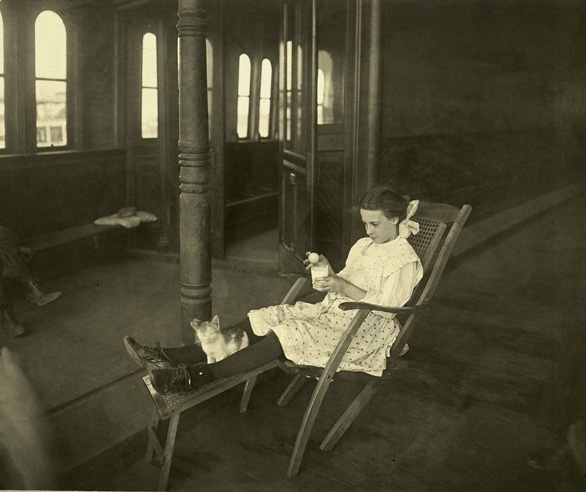
This young girl either had tuberculosis or was “suspicious for TB.” She is sitting on the Southfield Ferry, a retired Staten Island Ferry purchased by the Bellevue Auxiliary in 1908 for the day treatment of TB. The ferry was moored in the East River, in front of Bellevue Hospital, and patients came every day for treatment, which included rest, fresh air, sunshine, and “corrective exercises.” Part of the treatment was drinking milk and eating eggs to provide proper nourishment. The Auxiliary also provided outdoor school and art classes on the deck of the ferry, no matter how cold or how hot. In the summertime, many children were sent to the New York City Farm Colony in Staten Island to get extra sun. The ferry exploded in 1918 from a boiler accident and was replaced by another ferry, the Day Camp Boat. Fresh air treatment of tuberculosis was replaced by antibiotics in the early 1950s, when isoniazid became available.

We were thrilled to have Leslie read from “Letters to Michiko” as part of our 20th anniversary celebration in 2021. Now we’re at 25—where does the time go?!