


For 25 years, Bellevue Literary Review has been publishing stories, essays, and poems that take readers into the shared space where art and medicine meet. Throughout our anniversary year, we’re marking this incredible milestone by inviting you on a journey through the BLR archive, from the beginning through the present.
Join us each week as we curate special highlights — stories, poems, photos, and more — from each of our issues.

About the Issue
Issue 20 features winners of our annual contest, plus a very special dedication.
A theme that looms large over this issue is the ultimate story told by life itself. You do not have to look too far to find the artistry, humanity, tragedy, and even comedy. Together, they add character to one’s life. And from there, the story begins to tell itself.
From the Foreword
Much of the writing in the Bellevue Literary Review touches upon mortality and vulnerability. Writers often use fiction and poetry—“the great lies that tell the truth”—to mine the emotional depths of these issues. But sometimes the brutal facts of real life jolt us, and can make literature feel rather paltry.
In the waning weeks of August, through September and October, the story “Winston Speaks” by Jill Caputo was being passed from hand to hand, as reviewers and editors read, discussed, and debated this story, unaware that the author had been killed in a car accident just five weeks after submitting it. The story was very much alive for all of us, eddying in our minds as it survived cut after cut of the hundreds of contest submissions. By the time we called to congratulate Jill, all her listed phone numbers and email addresses were inactive. When we finally pieced together what had happened, and then tracked her family in Kansas, it felt as though we had lost a close friend.
It is with these thoughts that we dedicate this issue of the Bellevue Literary Review to Jill Caputo, and offer our thanks to her for graciously sharing her wisdom with us.
– Danielle Ofri, Editor-in-Chief
Read Highlights from Issue 20
Each week, we’ll be highlighting one outstanding story, poem, and essay from the featured issue. We encourage you to explore more from the issue on our website or, better yet, to pick up a copy!
Winston Speaks
by Jill Caputo
(Honorable Mention in BLR’s Goldenberg Prize for Fiction)
Winston sold candy at the bus station on Wednesdays because that was the only day Georgia could give him a ride there. He kept the goods in the pack on the back of his chair: Snickers, Milky Ways, Reeses Peanut Butter Cups, M&Ms, both peanut and plain. The sign mounted on the back of his chair told his customers what Winston could not: ALL CANDY IN KING SIZE PACKS FOR $1. He was an entrepreneur.
Winston loved the bus plaza. The chipped blue benches, the mock-sparkle concrete floor, the bird-screeching sound of the buses. Even the unrefrigerated water fountain by the stairs. This Wednesday Georgia parked Winston by the center bench, the circular one, where he could watch the people go by. Impatient mothers holding the hands of their children, fat ladies walking with canes, old people carrying groceries, even bums. Winston knew he would stand out to all of them.
The Tag
by Elizabeth Crowell
(Winner of BLR’s Prize for Nonfiction)
The bleeding, black letters sprayed on the silver utility box at the corner of Brattle Street and Mt. Auburn Street in Cambridge spelled Grief. The G was a hunch-backed giant on which the other, spindly letters leaned. It was a perfect road sign for the place we were going—the Neonatal Care Unit of Children’s Hospital, Boston. Someone heavy with sorrow had waltzed through the dark night to find a place to plant that word. Like all grief, it could only say itself. The event that had caused it was already gone, but its mark in the world seemed to be everywhere.
Looking Back
by Floyd Skloot
That morning my wife and I felt
summer lose its grip. Nothing more
than a waning of the scents that dwelt
all season near the hilltop, or
softer light, an edge to the breeze
we were not even sure was there….
Issue 20: The Cover
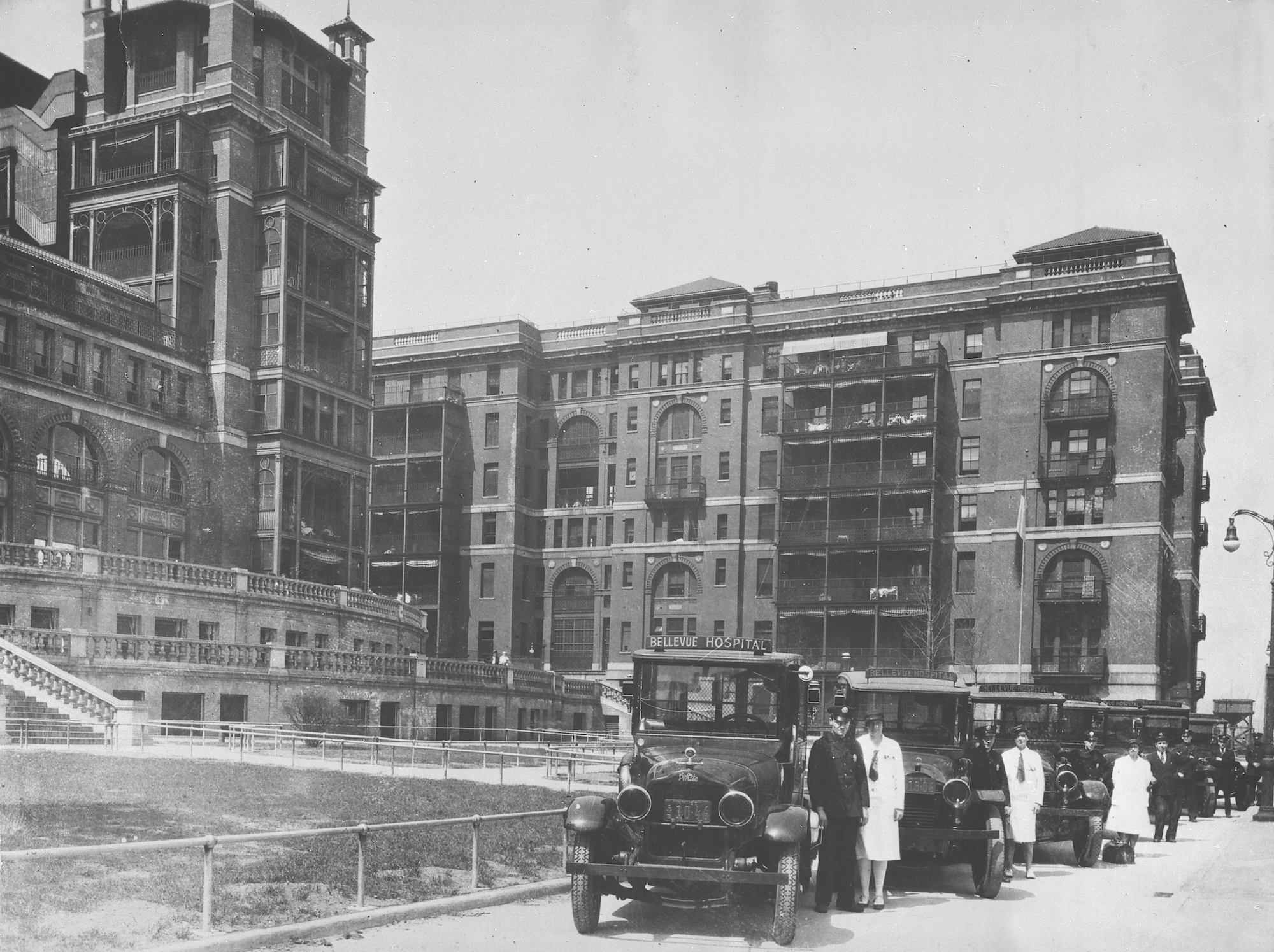
Motorized ambulances staffed by Bellevue surgeons, circa 1935-1939
Bellevue Hospital was one of the pioneers of ambulance services. In 1869, Dr. Edward Dalton, the Sanitary Superintendent of New York City, submitted a plan for an ambulance corps based on his experiences in the Civil War.
Shortly thereafter, the famous horse-drawn Bellevue ambulances debuted. In 1924, the fleet was fully motorized, and the cover photo was taken roughly ten years later. The surgeons—both male and female—are standing in front of the F&G Pavilion, on the road that would later become the FDR Drive.
In 1938 Dr. Morton Galdston, a freshly-minted Bellevue intern, did his month-long rotation in one of these motorized ambulances. He dutifully took notes on the 384 cases he treated. These notes resurfaced when Dr. Galdston retired from a half-century of service to Bellevue and NYU in the Pulmonary Division, and in 1999 he published an account of life on a Bellevue ambulance.* He described the 12-hour shifts with one day off per month, the $15 salary every two weeks, the responsibility for keeping shoes fastidiously polished, and the urgent desire that patients not be DOA—dead on arrival (the penalty for which was buying a round of beer for one’s fellow interns).
The catchment area of the Bellevue ambulances included Park Avenue and Gramercy Park mansions, the stench-ridden Abattoir slaughterhouses (site of the current United Nations headquarters), and the Gashouse District slums. The top categories of Dr. Galdston’s calls in May of 1938 were alcohol, mental disorders, and injury, followed closely by respiratory and infectious cases. Current Bellevue interns will agree that little has changed. Dr. Galdston passed away in 2003.
*J Urban Health, 1999:509-32.