
For 25 years, Bellevue Literary Review has been publishing stories, essays, and poems that take readers into the shared space where art and medicine meet. Throughout our anniversary year, we’re marking this incredible milestone by inviting you on a journey through the BLR archive, from the beginning through the present.
Join us each week as we curate special highlights — stories, poems, photos, and more — from each of our issues.

About the Issue
Issue 21 takes us back to Bellevue Literary Review‘s 10-year anniversary. As you’ll read below, this milestone was shared by the 275th anniversary of Bellevue Hospital. This expanded anniversary issue contained an insert of some of the iconic Bellevue archival photos used on early BLR covers, plus poems by Naomi Shihab Nye and Cornelius Eady, essays by Paul Harding and Rafael Campo (“Illness as Muse,” which you can read below), and much more.
From the Foreword
The 10th anniversary of the Bellevue Literary Review also happens to coincide with another notable birthday—the 275th anniversary of Bellevue Hospital. Bellevue is the oldest public hospital in the United States, having opened as a six-bed infirmary in 1736 on the site of the current City Hall. When yellow fever broke out in 1795, the Belle Vue farm was purchased so that patients could be isolated far from the city center. Twenty years later, the entire hospital operation was moved to this site, which is the current location of Bellevue Hospital.
Bellevue has seen many firsts in these last 275 years—the first emergency room, the first obstetrics ward, the first ambulance, the first medical school connected to a hospital, the first outpatient clinic linked to a hospital, the first nursing school, the first heart- valve replacement, and of course the first hospital to house a literary journal. But what makes Bellevue unique is the very idea of a hospital that is open to all. Bellevue has cared for New Yorkers from all walks of life—from United Nations diplomats to homeless people. It always has cared for patients whose illnesses have marginalized them—those with tuberculosis, AIDS, alcoholism, mental illness, and leprosy. In particular, Bellevue has been the medical home for the waves of immigrants who poured into America since its founding, via the funnel of New York City.
– Danielle Ofri, Editor-in-Chief
Read Highlights from Issue 21
Each week, we’ll be highlighting one outstanding story, poem, and essay from the featured issue. We encourage you to explore more from the issue on our website or, better yet, to pick up a copy!
String Theory
by Venita Blackburn
I did not speak until I was six years old. My laugh was pretty as new chalk, I’ve been told, and I attempted time travel at age twenty. No one ever told me “you’re not like most girls.” Some things I learned as I went along.
It was the first week of fall classes my sophomore year when I met Mariko and her boyfriend Alkie. I sat, as usual, between two empty chairs in the front row of the room. “Welcome again to Quantum Physics,” said the professor, a mid-twenties tenure-track phenom not yet jaded by the academic institution frequently referred to as “the tar pit.” His slack-jawed yet earnest response to every less than intelligent question endeared him to his students.
In 2025, BLR reconnected with Venita Blackburn for a BookTalk about her debut novel, Dead in Long Beach, California. Watch it here.
Illness as Muse
by Rafael Campo
To write explicitly about one’s own illnesses risks an even worse self-indulgence—bunion surgery and hemorrhoids, no matter how distressing to the otherwise healthy poet, simply cannot make for scintillating verse. On the other hand, to write about another’s suffering can seem entirely presumptuous, as if it were somehow possible to re-create on the expanse of the clean, neat white page the image an anorexic teenager sees of herself in her bathroom mirror that leads her to induce vomiting—or worse, that somehow, in the earnest imaginative quest for that universal balm that heals, anorexia becomes indistinguishable from anemia, AIDS and ALS and AML interchangeable.
While it’s true that the screams of pain coming from the room in the ER where a woman is losing her baby are no more or less heart-wrenching than those from the woman in the next room who is withdrawing from heroin, the specific details of each story must matter just as much as the ultimately indescribable agony they share. “We do not know our own souls, let alone the souls of others,” declared Virginia Woolf, in her indelibly humane essay “On Being Ill”; though she brilliantly defended the notion of illness as a motive for writing, she too was forced to consider our myriad limitations as our own bodies’ reporters. Yet we must rely on these faulty accounts, perhaps taking additional solace in their imperfections, because to do without them would be injurious to the soul, and to not forgive them would leave us utterly hopeless.
Eye Examined
by Cortney Davis
In the darkened room, vision dims.
The doctor leans close, looks eye to eye;
his light invades my pupil’s rim.
His light moves left and right as he directs
his beam across my retina. Vessels
float like crimson ribbons, thin and bright.
Photos from BLR‘s 10th Anniversary Reading

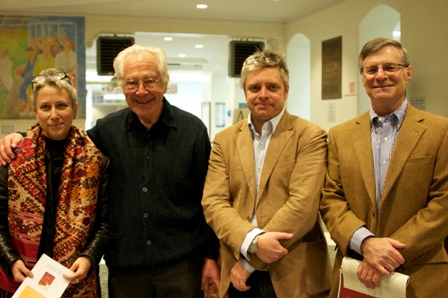
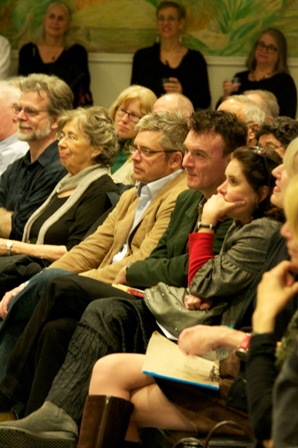
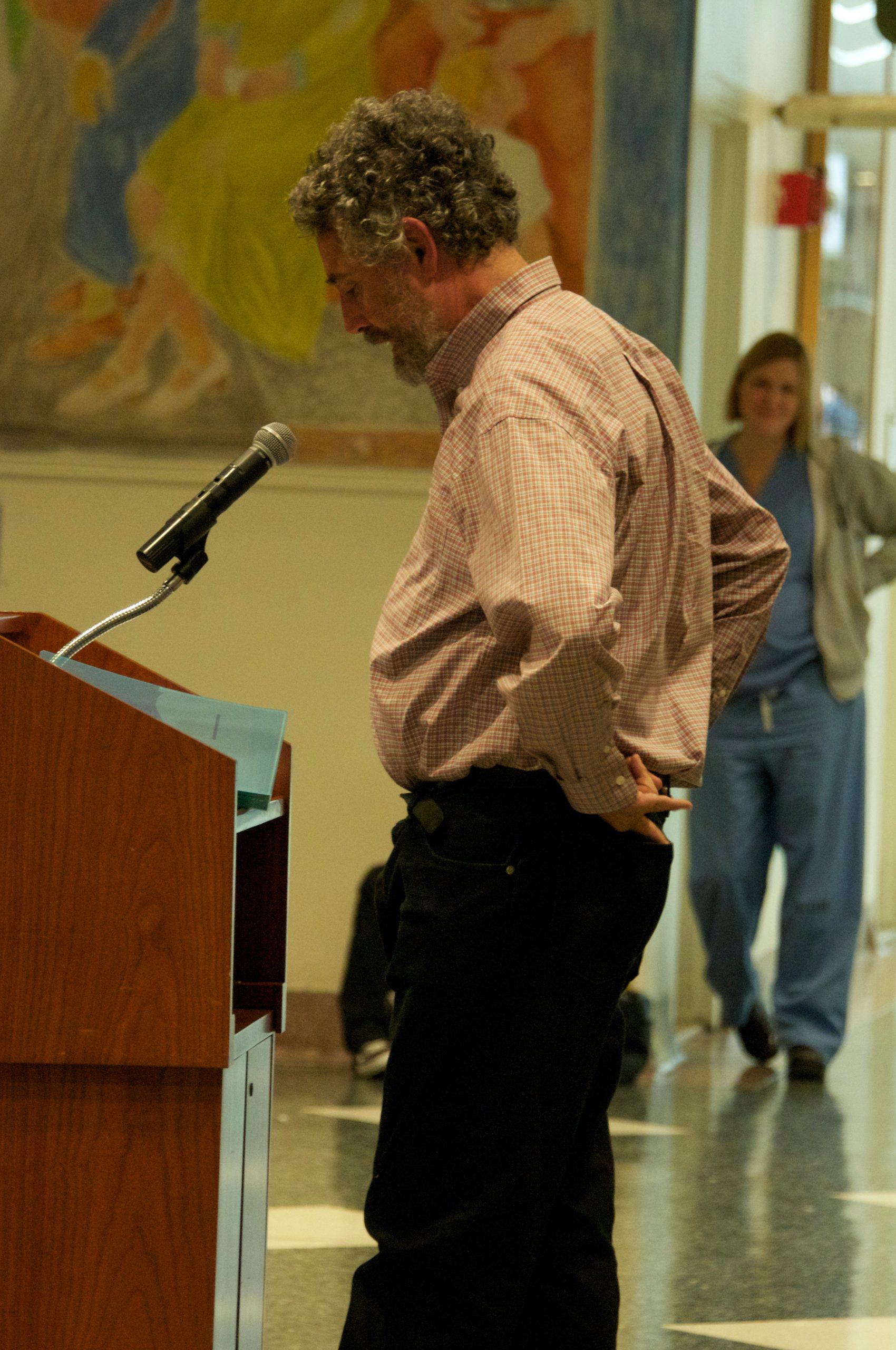
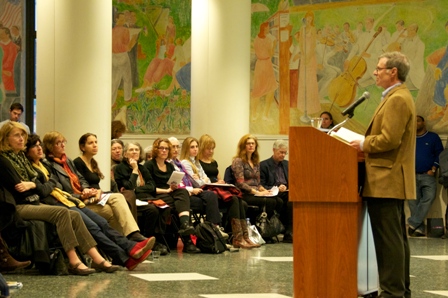
L-R: Erika Goldman, publisher of Bellevue Literary Press; Dr. Jerome Lowenstein, BLR’s founding nonfiction editor; and authors Paul Harding and David Oshinsky at BLR’s 10th anniversary reading in 2011 (photo by Troi Santos) Event attendees listen to readings at BLR’s 10th anniversary celebration Poet Hal Sirowitz reads his work as a healthcare worker looks on David Oshinsky reads his essay from the anniversary issue