

For 25 years, Bellevue Literary Review has been publishing stories, essays, and poems that take readers into the shared space where art and medicine meet. Throughout our anniversary year, we’re marking this incredible milestone by inviting you on a journey through the BLR archive, from the beginning through the present.
Join us each week as we curate special highlights — stories, poems, photos, and more — from each of our issues.

About the Issue
Great art often pairs universal themes with compelling narrative. Issue 23 touches on themes of family and fragility, with a handful of stories, essays, and poems meditating on the complexities of familial relationships: Dealing with a “wild” son in a rural setting. A father and daughter making choices in the midst of their grief journeys. A family’s life upended by the events of war.
These pieces of writing affect us deeply because it’s easy to see ourselves reflected in these characters and the choices they wrestle with. That is the unmatched power of storytelling. It serves as a mirror to our souls, reveals the feelings we bury, and frames the aspirations we endeavor toward.
From the Foreword
As managing editor, my first read of the work collected for a new issue of the Bellevue Literary Review is with a critical editorial eye, attuned to plot, theme, flow, and sentence structure. Each piece is then examined more technically as the layout of the issue comes together: proofreading, formatting, running headers, paragraph balance, facing pages, white space, table of contents, and then, proofreading again.
It’s lovely, then, to go back and read the published issue for pleasure, without thinking about punctuation or font size (though those thoughts must sometimes be banished forcibly). After having been immersed in the issue as a single entity—a computer file of glyphs and margins—indulging in each individual piece as its own work of literature is deeply satisfying and often surprising. I am “discovering” these wonderful poems, stories, and essays— familiar but suddenly fresh and invigorating—and then find myself returning to them time and again. Now it is my pleasure to introduce these pieces to you, the readers.
– Stacy Bodziak, Managing Editor
Read Highlights from Issue 23
Each week, we’ll be highlighting one outstanding story, poem, and essay from the featured issue. We encourage you to explore more from the issue on our website or, better yet, to pick up a copy!
Apnea
by Laura Adamczyk
They are all of them adults, but even so they will bring stuffed animals, pillows shaped like hearts, and scraps of blanket with satin borders hanging on by threads. The technician will, one at a time, hook them up, turn out the lights, and through a Plexiglas window watch them sleep. It is dark but for the blue from a streetlamp outside, the tiny lights of the polysomnograph beside the bed, electrodes running out like arteries from their chests and forearms. A different man or woman each night but the same restless sleep; they thrash and shift over the machine wires. He makes sure they stay connected.
Diagnosis
They are inevitably all diagnosed with the same condition. Simply, that while asleep, they stop breathing. In doing so, their bodies wake them. It happens dozens of times per night, though they do not remember most awakenings, if any.
Their bed partners tell them they snore. How the snoring churns, churns louder, and then seems to catch. A popping, struggling motor. A piece of string pulled smoothly from a knot, then stopping, knotting again. The catching is the awakening and the awakening is the apnea and this is the diagnosis.
On Not Seeing Whales
by Nikki Schulak
My mother wanted to see a whale before she died. In a boat off Montauk, Long Island, we puked over the side railings for the entire four-hour tour. No whales. We went on an Alaskan cruise—absolutely guaranteed to see whales—but we only saw harbor seals and a few scattered eagles. Then my mother died, without seeing her whale, which left me bitter.
Whales. They’re so evasive with their beady little eyes. They sing and get all this attention. Every time one of them is stranded on a beach, there’s another story in the press. Please.
For my mother’s honor, however, I’ve continued to look for whales. I’ve even made a proclamation: I will see a whale before I die! At first, I didn’t try very hard. Swimming with dolphins in the Florida Keys didn’t count. The water was murky, and our time with them was choreographed and trite. You could tell they didn’t care about the money we’d spent. But when we moved to the West Coast and found everybody hiking around in vintage sportswear drinking kombucha, casually talking about whale sightings, I knew that someday soon I would be able to die fulfilled.
A Suspicion
by Ricardo Pau-Llosa
of ailment breeds
a new season in flesh.
As if snow were suddenly
caking subtropical thatch roofs,
or the desert sogged up
with bitter rain. Something
hope wishes to keep nameless
might well be welling up
in what now seems a body
with an alien will,
a yearning to surrender
despite the call to arms,
to fold when the cards sirened
ambition. And one sits
through the embroidered
language of comfort
tearing the Latinate of science,
hoping there is no name
for what, therefore,
cannot threaten.
Issue 23: The Cover
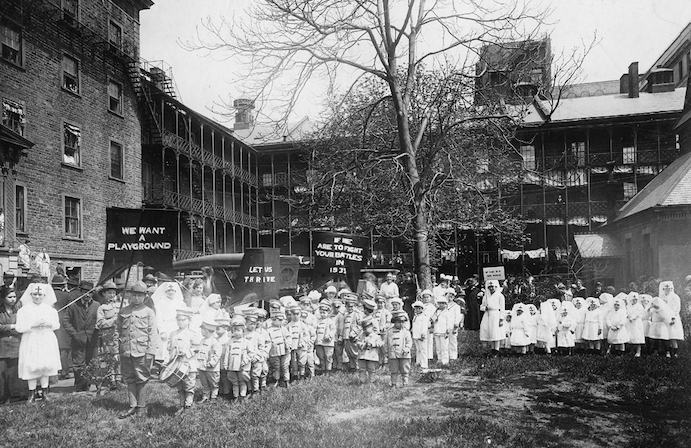
The Children’s Parade, circa 1917
Open spaces for children to play were in short supply in New York City. Here the pediatric patients from the Chest Service have galvanized to demonstrate the need for playgrounds. The children are dressed as doughboys and field nurses—images that were popular in World War I liberty posters, as well as tuberculosis posters.
The Bellevue Auxiliary established a play area on the hospital grounds in a yard set off by the Erysipelas Pavilion, the Sturgis (surgical) Pavilion, and the Psychopathic Pavilion. Pediatric patients, as well as neighborhood children and their families, were invited to use the playground. The Auxiliary sponsored Maypole dances, ice cream socials, and evening shows illuminated by “magic lanterns.”
Photo courtesy of Bellevue Hospital Center Archives, from the Chest Collection