


For 25 years, Bellevue Literary Review has been publishing stories, essays, and poems that take readers into the shared space where art and medicine meet. Throughout our anniversary year, we’re marking this incredible milestone by inviting you on a journey through the BLR archive, from the beginning through the present.
Join us each week as we curate special highlights — stories, poems, photos, and more — from each of our issues.

About the Issue
Life has its storms—in some cases, literally. Issue 24 of BLR, featuring winners of our annual contest, was published in the aftermath of Hurricane Sandy, which marked the first time Bellevue Hospital’s doors were forced to close in 276 years. The hospital would reopen approximately a hundred days after the devastation.
A special series of recollections included in this issue focus on the emotional effects of the storm from frontline students and resident doctors who assisted in the evacuation. There is also a wonderful mix of poetry and prose, including some from debut authors.
From the Foreword
At 6:30 p.m. on November 3, 2012, it was suddenly all very different. For the first time since March 31, 1736, Bellevue Hospital stood empty. The last of 700 patients had been safely evacuated and now the hospital hallways echoed with a preternatural stillness. Hurricane Sandy marked the first time Bellevue’s doors were forced closed in 276 years.
The hurricane and its overwhelming ramifications have been well-documented in the media. In our small corner of the world, all three of our teaching hospitals—NYU, Bellevue, and the Manhattan VA—had to close. Hundreds of patients and thousands of staff members were dispersed to other hospitals. Research laboratories and clinical trial units suffered irreparable losses…
The cumulative human experience itself can reach hurricane levels. The emotional winds can take far longer to calm. In this issue of the Bellevue Literary Review, we present a few snapshots of the experience of the hurricane, from the frontline students and resident doctors who assisted in the evacuation. This is obviously only one of many perspectives, but we hope it gives you a sense of one moment in our history.
– Danielle Ofri, Editor-in-Chief
Read Highlights from Issue 24
Each week, we’ll be highlighting one outstanding story, poem, and essay from the featured issue. We encourage you to explore more from the issue on our website or, better yet, to pick up a copy!
You Will Make Several Relaxing Cuts
2013 Honorable Mention, Goldenberg Prize for Fiction
by Ashley Chambers
The grieving family members haven’t left the patient’s room by the time you arrive at the hospital. The woman in admitting tells you they’re still grieving, and she remembers you. You are a contracted hospital regular. Your sneakers squeak as you walk to the intensive care unit, where you sit down in the waiting room. You play Plants vs. Zombies on your cell phone and avoid eye contact with the unit secretary. The waiting room and its keepers dematerialize as you strategically place puff-shrooms and scaredy-shrooms with your thumbs on your cell phone’s touchscreen in preparation for this morning’s first wave of zombies. What this means is you’re being paid seventeen dollars an hour to play Plants vs. Zombies while you wait to cut the eyes out of another dead person’s head.
Dust, Light, Life
2013 Winner, BLR Prize for Nonfiction
by Jacqueline Kolosov
“Why are there so many moths near the lamp, Mama?” my five-year-old daughter Sophie asked, as we sat at our patio table a few weeks ago, the purple-rose of twilight of late April having by now given way to night.
“They’re attracted to the light,” I said, registering the dozen moths circling the porch lamp. Moths are common enough here, especially at this time of year; still I would have expected two, four at most.
“I think they like Tiva’s locust tree,” my husband Bill said, and sure enough, a zigzagging flurry of dun bodies could be seen against the sky near that tree.
We ate our ice cream at the patio table as moths fluttered against the glass casing housing the lantern.
“What will happen if they touch the fire?” Sophie asked.
The Learn’d Astronomer on the Radio
2013 Winner, BLR Prize for Poetry
by Laura Passin
Given an infinite universe,
given a finite body,
given the bounding constellations
of atoms that trace the flesh,
we must accept, the cosmologist says,
that we are twinned: inside
of infinity, the theory goes,
any finite pattern must
repeat. Even our doubles
are doubled, uncanny almost-selves
with one atom changed, one more
gray hair, one breath not taken.
Issue 23: The Cover
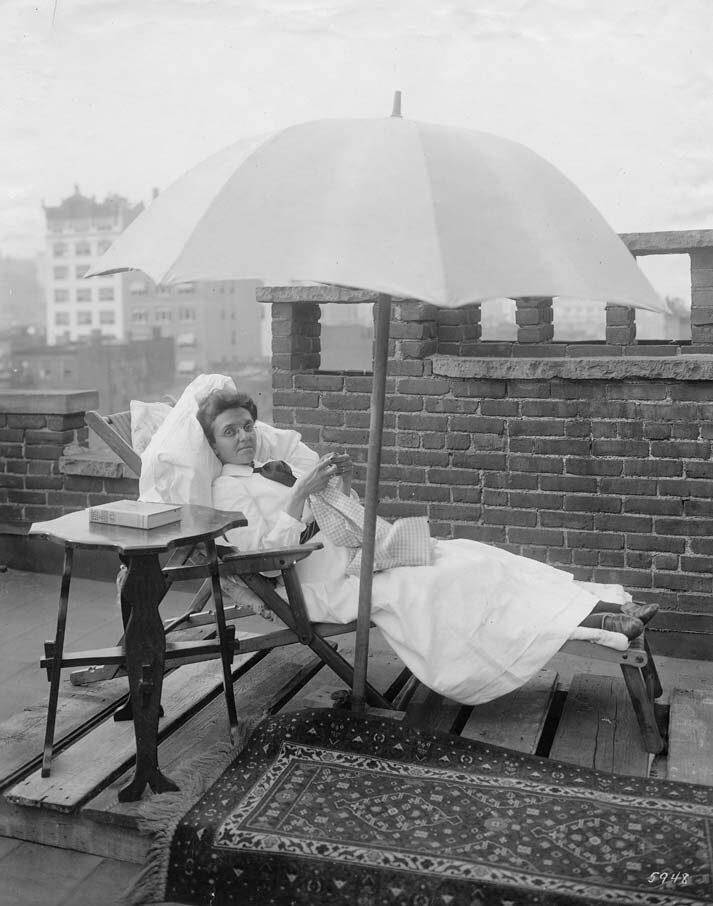
Home treatment of tuberculosis, circa 1909
Sunshine and fresh air were the only treatments for tuberculosis until the advent of antibiotic treatment with isoniazid in the early 1950s. While some patients traveled to sanitariums in the countryside such as Saranac Lake in the Adirondacks, many could not afford this. New York City residents took to their tenement rooftops to treat their consumption. Many slept on their rooftops, even in the wintertime.
This photograph was taken by Jessie Tarbox Beals (1870-1942), the first woman photojournalist in America. A self-taught photographer, she was known for “catching the soul” of New York City. From 1906-1938 she chronicled Bellevue Hospital and its patients. She was commercially successful, but illness and the Great Depression took their toll. She died penniless, ironically in a charity ward at Bellevue, possibly of tuberculosis.
Photo courtesy of Bellevue Hospital Center Archives, from the Chest Collection