

For 25 years, Bellevue Literary Review has been publishing stories, essays, and poems that take readers into the shared space where art and medicine meet. Throughout our anniversary year, we’re marking this incredible milestone by inviting you on a journey through the BLR archive, from the beginning through the present.
Join us each week as we curate special highlights — stories, poems, photos, and more — from each of our issues.

About the Issue
Issue 34—featuring the 2018 BLR Prizewinners, judged by Geraldine Brooks, Rivka Galchen, and Rachel Hadas—was the last issue to feature our original layout and style. Stay tuned for next week’s highlight to see BLR‘s brand-new look and learn how this redesign came to be!
From the Foreword
Every issue of a literary journal is a literary salad of sorts. You never know what ingredients will be available each time, so you can never predict the final product. We begin with nearly 2,000 submissions that run the gamut in style, theme, perspective, length, and form. And for the BLR prizes, there’s the additional wild card of which contest submissions will appeal to the judges’ unique tastes…
Once the editors pull the issue together, we are always delighted to see what surprises turn up. Sometimes it’s first-time publications such as that of our fiction winner, as well as Brendan Missett’s striking story, “Labor.” And sometimes, it’s familiar faces, such as poets Janet Chalmers, Muriel Nelson, Kaitlin LaMoine Martin, and Noah Stetzer. We also welcome back fiction writers Jennifer Lee, Alok Khorana, and Ivan Prashker. It turns out that Alok’s and Ivan’s debut BLR stories also appeared in the same issue, just over a decade ago, in the Fall 2007 issue…
We hope you find this issue’s salad to your taste.
– Danielle Ofri, Editor-in-Chief
Read Highlights from Issue 34
Each week, we’ll be highlighting one outstanding story, poem, and essay from the featured issue. We encourage you to explore more from the issue on our website or, better yet, to pick up a copy!
Atrophy
2018 Winner, Goldenberg Prize for Fiction
by Lauren Erin O’Brien
I see him on a Sunday, looking like tumbleweed on a dirt patch near the farmer’s market. He’s holding a sign that reads:
REAL LIFE CROCODILE EGGS. NOT PAPER MACHE. DO NOT TOUCH, ONLY PET
His jeans are large and slip down his waist and he’s too old for that look—or perhaps not. It can be hard to tell his age sometimes since he’s usually covered in dirt, some pale lines running past his cheekbones from sweat or something else—and a name like Yarrow doesn’t say much aside from being strange but that’s less him and more his parents, if he even has those. He doesn’t seem like the type to come from a womb.
Sometimes I take his presence as an omen, can picture pale skin, concave and cracking under pressure. Sometimes his footsteps echo the timbre of wheezing.
Drawing Blood
2018 Honorable Mention, Felice Buckvar Prize for Nonfiction
by Laura Johnsrude
I spent a lot of time thinking about blood during my training years—hoping I could get enough of it, wondering which vein would yield the best supply of it, wishing the patients had more of it, calling the blood bank for a bag of it. I cushioned samples of it in my sweaty palm, palpated arteries for the pulse of it, auscultated hearts for the beat of it.
In medical school in the mid-eighties, I learned to draw blood during my third and fourth years. No need to know during the first two years, since our anatomy cadavers had been relieved of their 1.5 gallons, and their veins and arteries washed clean. The books, of course, were bloodless.
Not until our later clinical years did we touch live people, ones with actual blood pulsing through their bodies—arterial, bright cherry-red; and venous, deep purple like a plum. All their vessels flushed with blood, full of oxygen and immune-fighting cells, delivering medicine and keeping fingers and toes warm. Vessels with volume enough to hold us upright and keep our kidneys perfused so we aren’t poisoned by our own waste. Blood traveling so far north that we are able to compute the numbers on our grocery receipt. All humming along, silently, until something goes wrong—a clot forms to block the path; or a vessel balloons and then ruptures; or a wound diverts the flow; or the bone marrow forgets how to crank out normal cells.
Intimate Contact
by Elisavet Makridis
To straighten her spinal column,
Frida suspends nearly vertical
with sacks of sand tied to her feet.
For three upright months, she thinks:
If the heart has a forest, it is a dream-
stomping carousel made of jewels and silence.
In some underbrush the deer dip
their candescent mouths above blue stumps,
each with a spur to devour the twinkling
world…
Issue 34: The Cover
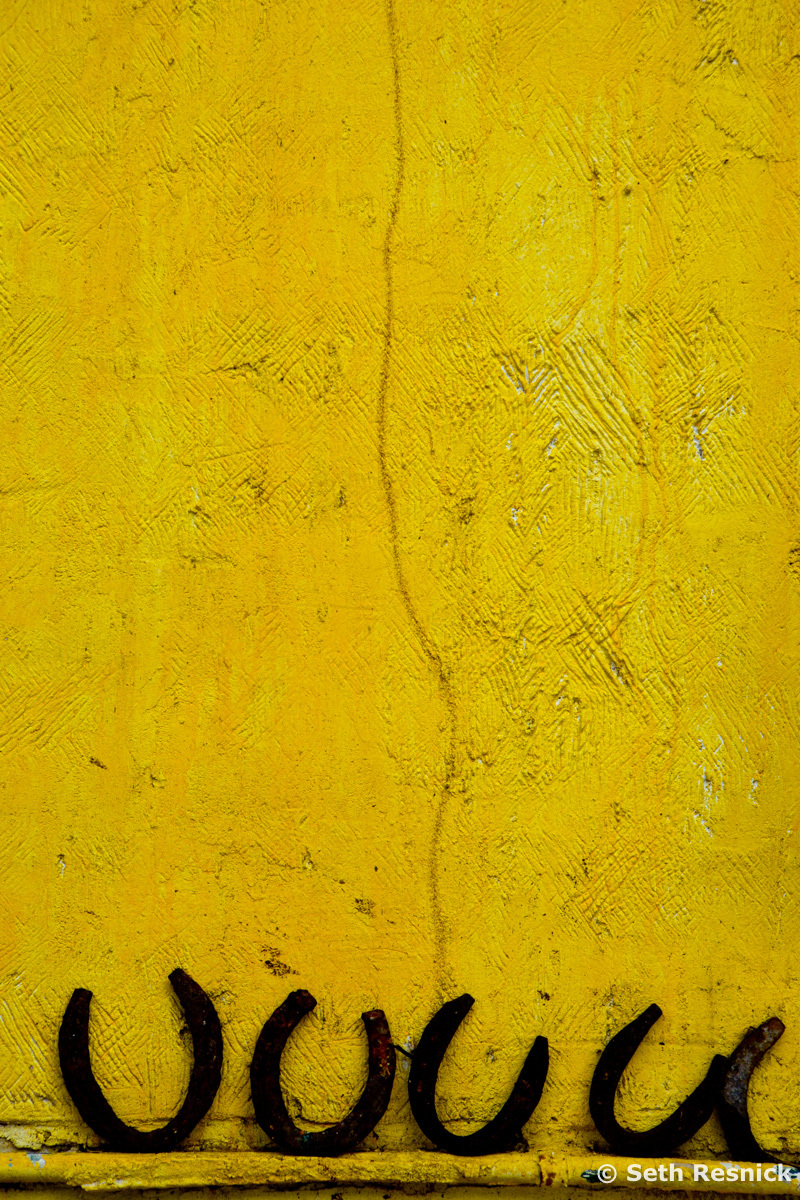
This issue of BLR featured artwork by Seth Resnick. Seth’s “Hope (Puerto Vallarta, Mexico, 2011),” shown here, graced the front cover. His other piece, “Self Awareness (Ouarzazate, Morocco, 2014)”, shown below, appeared on the back cover.
The quotes that follow were featured in an artist statement in Issue 34 of BLR.
“I don’t select objects or themes. Rather, I let my subjects lead me. I love writing down parts of dreams or free-association thoughts in the night and then going out to try to capture those thoughts and feelings. One reoccurring theme that enters into my work time and time again is optical illusion. I was a big fan of M.C. Escher as a kid and continually find that influence in my work. The rock in the image below appears to be floating in space. I love when your mind can take something as concrete as a photograph and transform it so many ways. I am also very attracted to layers and compacted space that create a certain sensuality in nature. I realize I am exploring the fantasy of nature.”
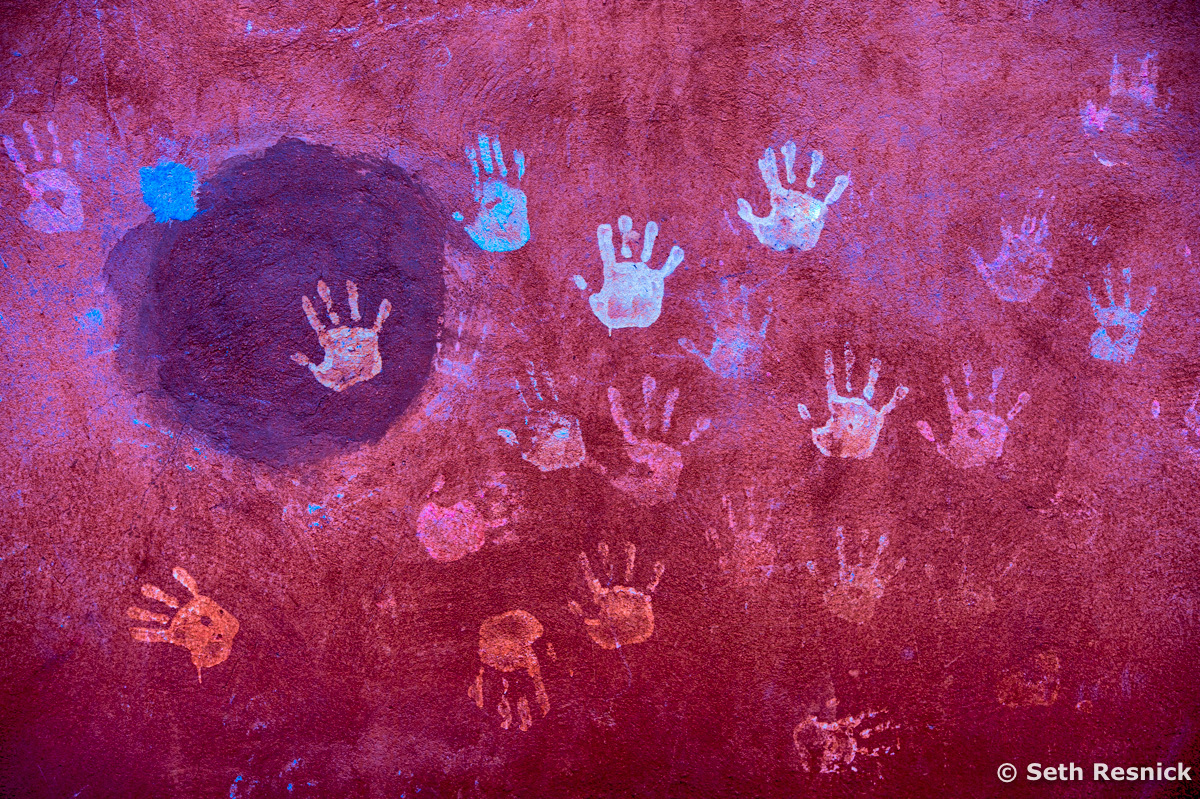
“The camera is a bridge to the energy I feel from the subject. I don’t want to displace that energy, but rather try to capture that very energy I feel in the moment. Hopefully the photograph can elicit that same sensation in others. A camera freezes time, but I like to think that moment isn’t frozen at all but very much alive, almost akin to suspended animation.“
All images used by permission of the artist