

For 25 years, Bellevue Literary Review has been publishing stories, essays, and poems that take readers into the shared space where art and medicine meet. Throughout our anniversary year, we’re marking this incredible milestone by inviting you on a journey through the BLR archive, from the beginning through the present.
Join us each week as we curate special highlights — stories, poems, photos, and more — from each of our issues.

About the Issue
When Jerry Lowenstein — BLR‘s founding nonfiction editor — first suggested “A Good Life” as the theme for Issue 37, we were a bit hesitant. But Jerry persisted, reminding us of how much our health and well-being depend on having a good life. We still miss Jerry terribly, but are so glad that he enabled us to bring you a selection of poetry and prose that look deeply at the joys and complications of our individual worlds.
From the Foreword
Because of the recent upheaval in my own comfortable little world, I’ve been thinking a lot about the tantalizing theme of this issue of the Bellevue Literary Review: a good life. Poking around the leavings of my newly emptied nest, I have been both buoyed and mocked by the impish ghosts that still live here with me, inciting emotional havoc. I discover a scrap of poetry in the tumult of books and college dorm bedding, a kind of aside, suggesting something about sea changes and remnants of past lives: “and there was a new voice / which you slowly / recognized as your own, / that kept you company….” Please, Mary Oliver*, I only want my child keeping me company, her voice quickening the air, showing me through the shared minutiae of our days that my own life is settled and good…
The authors in this issue of the BLR remind us that if figuring out who we are and where we belong is endlessly complicated, there is solace in our shared struggle, in our relationships to others through story. As I worry over the shifting relationship with my child, I am truly fortunate to still have recourse to my ninety-two-year-old mother’s self-reflective wisdom about her dealings with chronos and kairos, or more generally, time itself: “I’ve worked for eighty years, mostly for other people so I’m giving myself the gift of just being. I thank God every day for giving me these extra years—not everybody is so lucky. I remember Papa [her father] just sitting and looking up at the stars and that’s what I’m doing—watching everything—things I never had time to see. And believe it or not I’m learning something new every day because I have time to. I’m just taking up space but I’m loving every minute. Now if I just could get rid of the worries about my children. Oh well—can’t have everything.”
And that has to be good enough.
– Kate Falvey, Associate Editor
*from Mary Oliver’s “The Journey” in her 1986 collection, DreamWork.
Read Highlights from Issue 37
Each week, we’ll be highlighting one outstanding story, poem, and essay from the featured issue. We encourage you to explore more from the issue on our website or, better yet, to pick up a copy!
You’re Home Now
by Rachel Rose
Elvira’s English was good, with only a trace of an accent, but she got a few expressions off the tracks herself. Earl and I used to help the Suns out with phone calls and such when they first arrived in America and had to depend on Minnie to translate everything. I felt charitable towards them back in the day. And then I just started getting more and more attached to them. Elvira had a puffy face, sparse eyebrows, badly applied eyeliner, cheap clothes, hair she washed only once a week so that I noticed drifts of dandruff on her sweaters. But she was the mother of my daughter’s best friend. She and Mr. Sun came every week after we lost Linda and then every day for a while when Earl died.
“I don’t want to hear it, Elvira. But if you want some peaches, help yourself.”
Linda’s paws tap-tapped as she came across the kitchen linoleum to the sofa. Elvira found it disturbing that I called her Linda. She thought I was memorializing my daughter in some strange way. If she knew the truth, she’d be even more disturbed. I get it. It wasn’t easy for me to wrap my head around it either.
Our Psychedelic Minibreak
by Sunny Teich
My sister and I are resting in our cabin on the Botel. We got excited when we saw the reviews on TripAdvisor. People did not mince words: it was a hotel inside of a boat, and the price was right. Erin is cheap. I am less cheap, but perfectly willing. We keep saying that we are “Botel people now.” Our devotion relates to how difficult it turned out to be to get to it. It is not in Amsterdam proper; it is docked on the north side of the harbor. The inconvenient side that you can only get to via a weird, infrequent ferry that is crammed with Dutch people on bicycles who would love nothing more than to run you down as soon as they get a chance. You have to really, really want the Botel.
Before Another CT Scan
by Deborah Golub
Wood smoke.
Something arboreal.
Think your lungs a forest cleared.
Your breath winged
as if it had a better place to go
or just discovered that all this
time the outside door to the basement
has been unbolted and
here you are.
Think your body an amulet on the doorpost.
The body still loyal to the marriage
although it seems at times to want
to run away with someone younger
or hopes that giving you so much
trouble you’ll be the first to leave.
Think a waterspout up the spine.
WATCH: When this issue was published, BLR held an Off the Page event in which actors Erin Cherry and Deven Kolluri brought some of the works to life through dramatic readings. Watch here.
Issue 37: The Cover
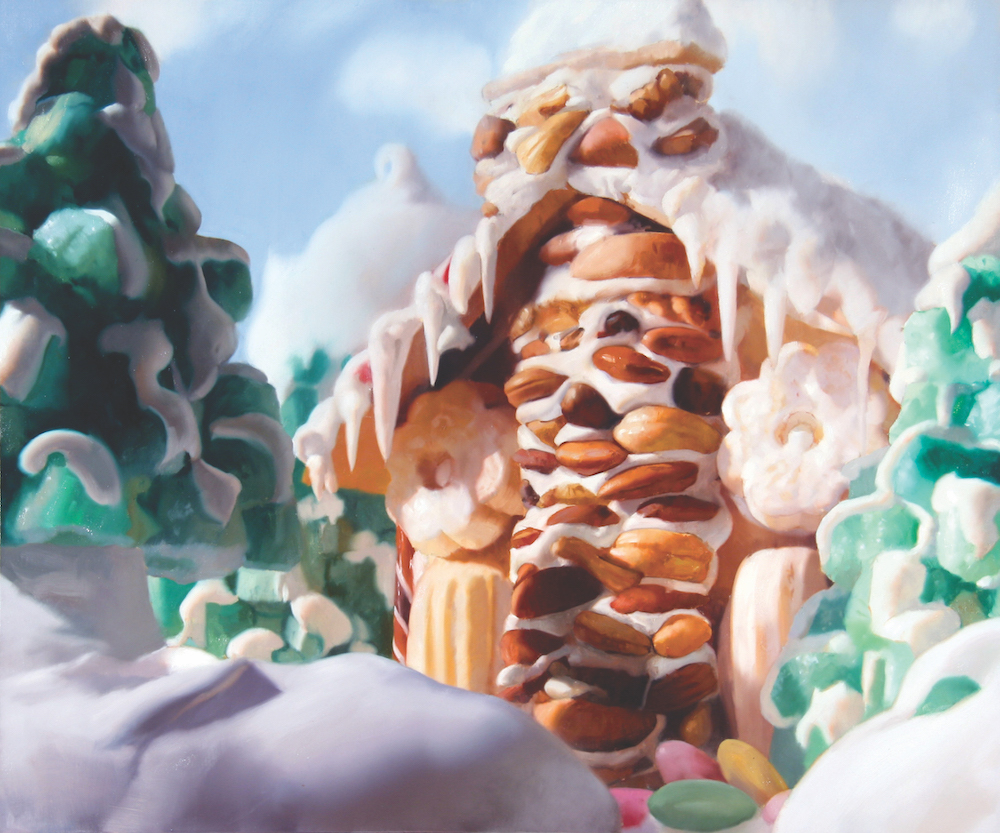
This issue of BLR featured Will Cotton’s “Nut House,” which graced the front cover.
About the artist:
Will Cotton’s artwork explores beauty, desire, and insatiability. His utopian landscape paintings are often composed of sugary desserts which are painted from large dioramas and sets that Cotton, an accomplished pastry chef, constructs in the studio from actual sweets. Cotton served as the artistic director of the “California Gurls” music video for pop singer Katy Perry and was commissioned by the Guggenheim Museum in 2012 to create the set for their annual performance of Peter and the Wolf. His work is included in the collections of the Seattle Art Museum, Columbus Museum of Art, National Portrait Gallery and the Smithsonian American Museum of Art. Cotton has been represented by Mary Boone Gallery in New York City since 1999. (www.willcotton.com or Instagram @willcottonnyc)
Image used by permission of the artist