

For 25 years, Bellevue Literary Review has been publishing stories, essays, and poems that take readers into the shared space where art and medicine meet. Throughout our anniversary year, we’re marking this incredible milestone by inviting you on a journey through the BLR archive, from the beginning through the present.
Join us each week as we curate special highlights — stories, poems, photos, and more — from each of our issues.

About the Issue
In 2020—a year that immediately conjures memories and emotions in us all—BLR became an independent nonprofit organization. After nearly twenty years at an academic medical center, the journal suddenly was starting from the ground up in many respects.
An editor’s note in this issue was originally meant to address BLR’s transition to independence, but instead captured a larger snapshot of this tumultuous period of time during the Covid pandemic: “Everyone has been affected in some way—medically, economically, politically, psychologically. There’s exhaustion and much grief. There’s also a churn of reassessing…”
Issue 39 was the first issue of BLR to be published independently. The themed issue centers on the body and the ways it speaks to us, and includes art by Laura Ferguson, who has made her own body the subject of her work.
From the Foreword
Our bodies are our first responders. Before cognition or language, our bodies sense. They communicate. Gestures — a shrug, a widening eye, a turning toward or away — speak as loudly as words. Our bodies carry our history. Trauma lodges in a held muscle, a tic of clearing the throat. Hunger and lust recall the pleasure of eating and sex.
Language reflects our common sense that our bodies portray emotional stances, including the phrase “common sense.” We bone up, back out, stand on our own two feet, and put our best foot forward. We keep a stiff upper lip when we face adversity and we have guts when we confront it.
The phrase native tongue speaks powerfully of one’s original language, calling up the bodily part that we must use to speak any language at all. The act of writing or reading can quicken the breath or bring tears, even though not yet fully comprehended by the mind. We touch someone, by our moving stories, poems, essays.
For this issue of the Bellevue Literary Review, “Reading the Body,” we requested writing in which the body speaks its eloquent, often unconscious song. The recent coronavirus pandemic has heightened awareness of our bodies’ vulnerability to an acute level for everyone, worldwide. Although submitted before the virus surfaced, the themes and metaphors presented in these pieces feel strikingly timely.
– Suzanne McConnell, past Fiction Editor
Read Highlights from Issue 39
Each week, we’ll be highlighting one outstanding story, poem, and essay from the featured issue. We encourage you to explore more from the issue on our website or, better yet, to pick up a copy!
Bound
by Sam Schieren
There is a cat sitting by the shed. The son can just make it out though the window. A grey cat at sundown. Eyes glinting. The cat licks its paw, scratches its ear. “Grooming,” the son says, as if it were an alien word. He often found himself whispering to himself. He says it again, “Grooming.”
Night begins its occupation. Through the window the son observes the faint and final remnants of the mother’s garden. There are plants in the garden that are still healthy. Months ago she’d asked him to prune, aggressively. “Down to the roots,” she’d said. “Only keep what’s essential.”
A lamp on the desk at the far end of the room gives off just enough light to see her face. Time has chosen this face, this fearful expression of hers, amidst folds and wrinkles, pinks spots, a basal cell scar. All the equipment in the mother’s room has been removed except one monitor. The son has taped socks over the monitor’s speaker to mute the tones that echo her heart. Less is more. He’s always hated this mantra. Still, as darkness takes the room, socks mute the sound and her eyes close for the first time in hours.
Dispatch From Bewilderness
by Judith Hannah Weiss
Probes puncture my scalp, surveying my mind. Temporal lobe, occipital lobe, you name it; there’s a probe for the lobe. The part of the brain that allows you to speak is the size of a penny. Other spots allow you to recognize your child, your mom, your home. Or not. Tests can’t measure what was lost. Just what remains.
Twelve years ago, a drunk driver stole a truck, jumped a curb, and mangled a parked car, where I’d been alone in the passenger seat. The good news was I survived. The bad news was brain damage.
Some things happen over years. Others occur in seconds—and replace who you were with someone you never met. She is strapped on a gurney with my name on her wrist, watching an angel wearing scrubs who is floating overhead.
Watch
Check out this special recording of Judith reading an excerpt from “Dispatch From Bewilderness.” Watch here.
OCD
by Sarah Giragosian
To survive this exile, you will need
to hold court with the moon, store the memory
of its light in a mason jar for later.
Understand: there’s no field guide for this,
for what you will encounter, for when the sluice
gate of your mind opens, for the whetstone
of your doubts or the homespun loop of Whys?
Even when your mind seems to have nothing left
to plunder, What if, in a certain key,
snags at your heart again.
Watch
When this issue was published, BLR held an Off the Page event in which Erin Cherry and Nkosi Nkululeko brought some of the works to life through dramatic readings. Watch here.
Issue 39: The Cover
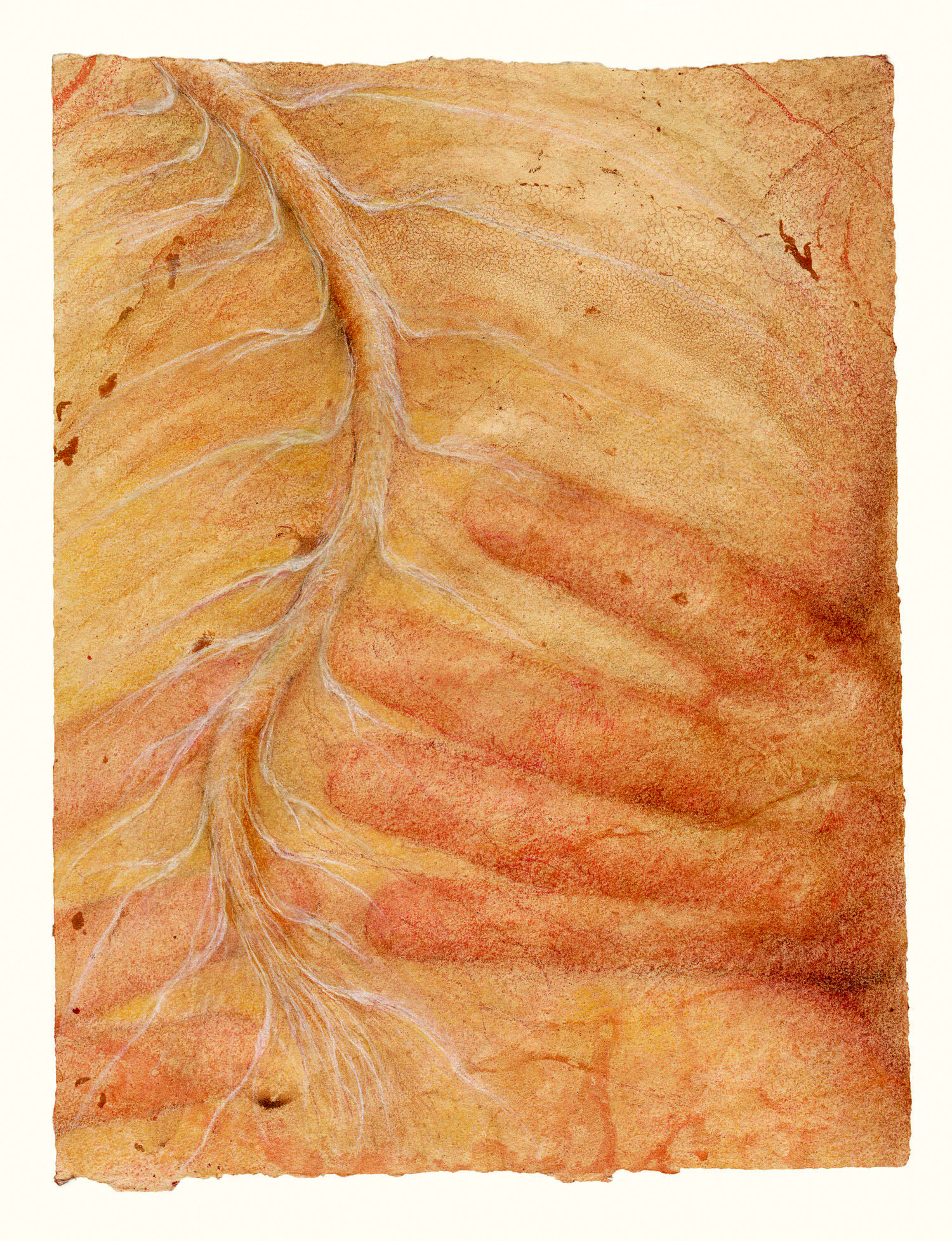
The cover of this issue of BLR featured “His hands, with spinal cord & nerves” by Laura Ferguson, which is from her “Consciousness of the Body” series.
In an artist statement, Ferguson noted:
“My drawings form a visual autobiography: drawing as storytelling, without the need for words. A life-changing experience at age thirteen—a spinal fusion for scoliosis and a year in a full-body plaster cast—heightened my connection to my body and my awareness of all that is hidden under the surface of our visible selves. When disability made it hard for me to be out moving through the world, I made my body’s life the subject of my art, finding beauty in a curving spine and exploring the connections between pain, consciousness, and creativity.”
Image used by permission of the artist