


For 25 years, Bellevue Literary Review has been publishing stories, essays, and poems that take readers into the shared space where art and medicine meet. Throughout our anniversary year, we’re marking this incredible milestone by inviting you on a journey through the BLR archive, from the beginning through the present.
Join us each week as we curate special highlights — stories, poems, photos, and more — from each of our issues.

About the Issue
Issue 41 was a celebratory issue that marked the 20th Anniversary of BLR. An expanded issue, it included an editorial roundtable with the BLR team and new writing by over 50 authors. These authors included Alanna Weissman (with the essay “Blood/Shed”) and Linda Harris Dolan (with the poem “Where Do Genetic Mutations Come From?”), who have since become BLR editors.
From the Foreword
As I slogged my way through medical school and residency, I was weighed down by career choices. Would I pursue clinical medicine or would I ensconce myself in a lab doing research? Would I train in neurology or stick with internal medicine? Would I stay in the public hospital system or seek the tonier private world? Academic medicine or private practice? New York or Boston? The choices were endless, and endlessly taxing. But suffice it to say, reading poetry and editing fiction were not among the options playing through my mind. As I paid off my student loans from my intern salary, I did not ever imagine that I might spend two decades of my medical career immersed in literature.
If nothing else, this experience has taught me to embrace serendipity. As a medical resident, I overheard a fellow trainee talking aboutlocum tenens, temp work for doctors. Exhausted from an AIDS-saturated residency, I took off on an 18-month sojourn. Between temp jobs, I had my first opportunity to reflect on the intensity of medical training, and began to write down some of the stories.
I returned to Bellevue as an attending physician and wanted to incorporate this experience into my teaching. When my students handed in the clinical histories of their patients, I requested that they ask their patients instead what it’s like to be sick, to just tell each patient’s story. At that time, Dr. Martin Blaser had returned to NYU as the new chair of medicine. He was also asking his students to write short essays inspired by their patient experiences. An astute colleague suggested we meet.
We initially considered assembling a student journal, but then thought that there might be a broader interest in these topics. We came up with the idea of Bellevue Literary Review and took out a two-line call for submissions in a writing magazine. When we were flooded with nearly a thousand submissions, we realized that we’d touched a nerve.
– Danielle Ofri, Editor-in-Chief
Read Highlights from Issue 41
Each week, we’ll be highlighting one outstanding story, poem, and essay from the featured issue. We encourage you to explore more from the issue on our website or, better yet, to pick up a copy!
Old Poles
by Tim Erwin
Throughout most of my childhood, my uncle Ludwik lived in the guest room at the back of our house on Danforth Street. I don’t know if he was really my uncle in a literal sense—I come from a large Polish family, and all my life people I’d never met before were being introduced to me as blood relatives—but he had no wife and no children, and he thought it was a sin to live alone, so my mother let him live with us.
I was uncomfortable around Uncle Ludwik. People told me I looked like him, and I resented the comparison. He had a face that belonged in a Soviet bread line, waxen and expressionless, with skin tags and papules sprouting up from beneath the rough surface. Life had mangled his body into the shape of a question mark, and he walked around leaning on an old blackthorn shillelagh, laughing spitefully under his breath and muttering Polish words that could only have been obscenities. He wore thick-soled orthopedic clodhoppers and trousers with the warp and weft of burlap, which he mended himself with a little pink sewing kit. In actuality, Uncle Ludwik could not have been more than sixty-five years old, but in my mind, he was as ancient as Europe itself, and I was convinced that, despite his many ailments, he would outlive us all.
Our Eyes Were Watching Marcia
by Samuel A. Autman
Television had always been a perfect distraction from our family’s drama and trauma, soothing us more than our Baptist faith. TV was ubiquitous and extremely effective at programming us. Back in the 1970s and 1980s, network television offered us—kids from backgrounds deemed as marginalized—aspirational, unattainable families that looked nothing like ours.
Chung and I were born two years apart almost to the day in early September 1966 and 1968. Mama always joked she planned it that way so she’d only have to throw one joint birthday party each year. Before our parents split, we lived in Hillsdale, a northwestern suburb. TV served as an easy babysitter between Mama’s shift as a public-school teacher and Daddy’s evening hours at the General Motors plant. While our mother read books to us at night, it was the television that lit up our imaginations. We’d watch the clownish antics of a local program called Mr. Patches and hoped against hope that the nice white lady on Romper Room would say she saw Anthony and Chung as she gazed into her magic mirror. She never said our names.
Shows like Family Affair, The Courtship of Eddie’s Father, and My Three Sons sustained the myth of perfect American nuclear families—all of them white. Family Affair was the one Chung and I loved the most. In the first episode, which we watched in reruns, Buffy was reunited with her twin brother after years and ran to embrace him, screaming, “Jody!” He responded, “Buffy!” Chung and I re-enacted that scene over and over. We didn’t see rich white kids on the Upper East Side of Manhattan, just kids. Something in us craved connection to television families that did not reflect us at all. We projected ourselves into their narratives.
Temporary Separation
by Margot Wizansky
I’m inside this body that doesn’t work
the way it did before, as if all my angles
were filed down. Fear of falling makes me
consider where I sit, where I step.
Love is pulling me up. Every day
the children call. A gift of sequined silk
and flowers from my brother. You drive me
everywhere, carry and lift. Nights are long,
streetlights shining in through the curtains,
in the drizzle, the neighborhood
turned nineteenth century romantic,
but the surgeon has separated us as though
I’m covered in Post Office labels:
Fragile, Special Handling.
Read
This special anniversary issue of BLR included an Editorial Roundtable. Past and present editors, plus our founding publisher, were invited to offer reflections on the BLR’s founding and its evolution over two decades of publishing. Read it here.
Issue 41: The Cover
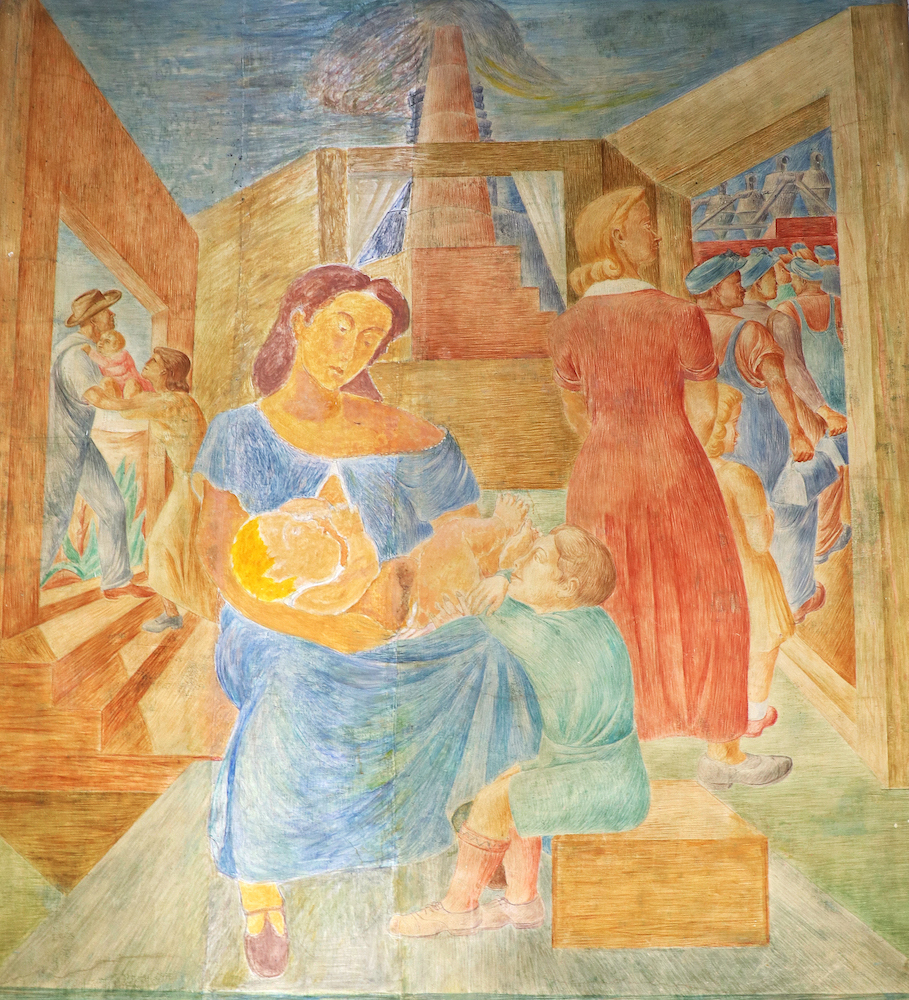
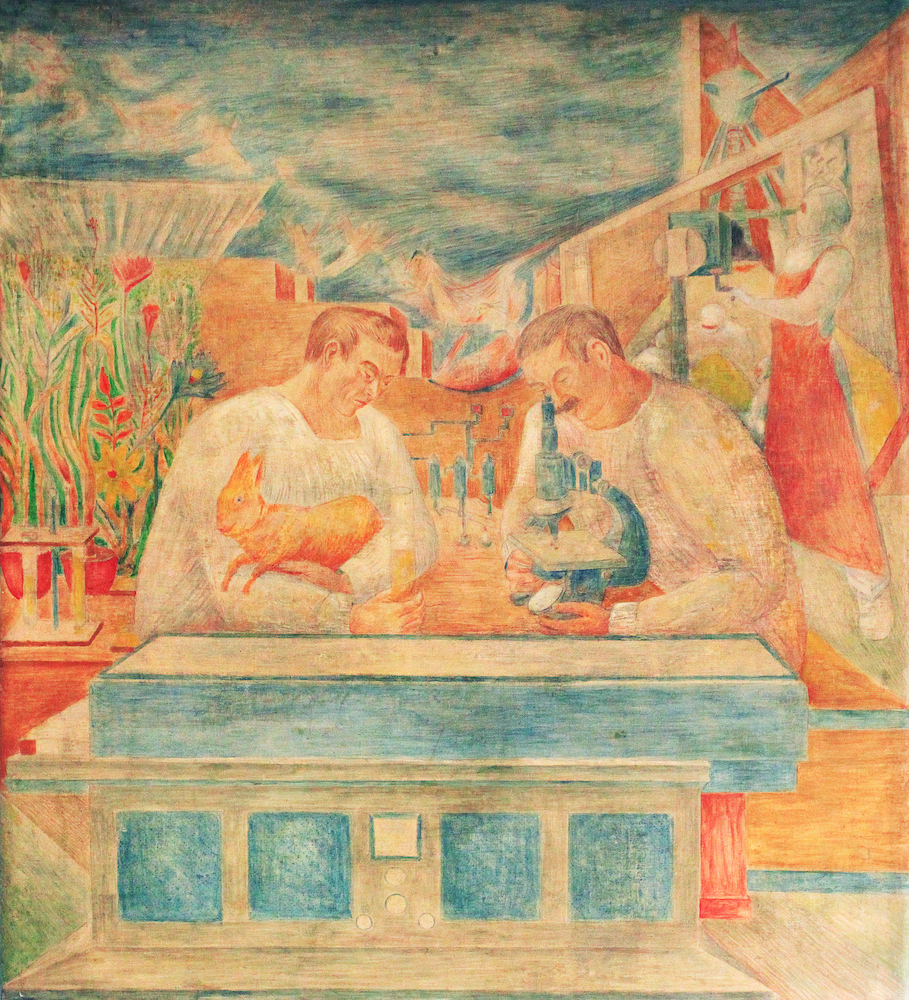
The cover of this issue of BLR featured ”Construction” on the front and “Research” on the back, both by David Margolis.
As stated in the issue cover note:
“From 1937 to 1941, Margolis spent nights and weekends painting in the various pavilions of Bellevue Hospital. The paintings fronting this issue of BLR are part of a nine-panel mural series covering 900 square feet of curved walls of the Bellevue atrium. Margolis later told a New York Times reporter that he was ‘painting murals that told the story of human progress.'”
Image used by permission of NYC Health + Hospitals/Bellevue, where Margolis’s iconic murals are located in the equally iconic Bellevue Rotunda.

David Margolis joined BLR for the launch of its inaugural issue in 2001. Here, he poses next to his murals in the Rotunda of Bellevue Hospital.