
For 25 years, Bellevue Literary Review has been publishing stories, essays, and poems that take readers into the shared space where art and medicine meet. Throughout our anniversary year, we’re marking this incredible milestone by inviting you on a journey through the BLR archive, from the beginning through the present.
Join us each week as we curate special highlights — stories, poems, photos, and more — from each of our issues.

About the Issue
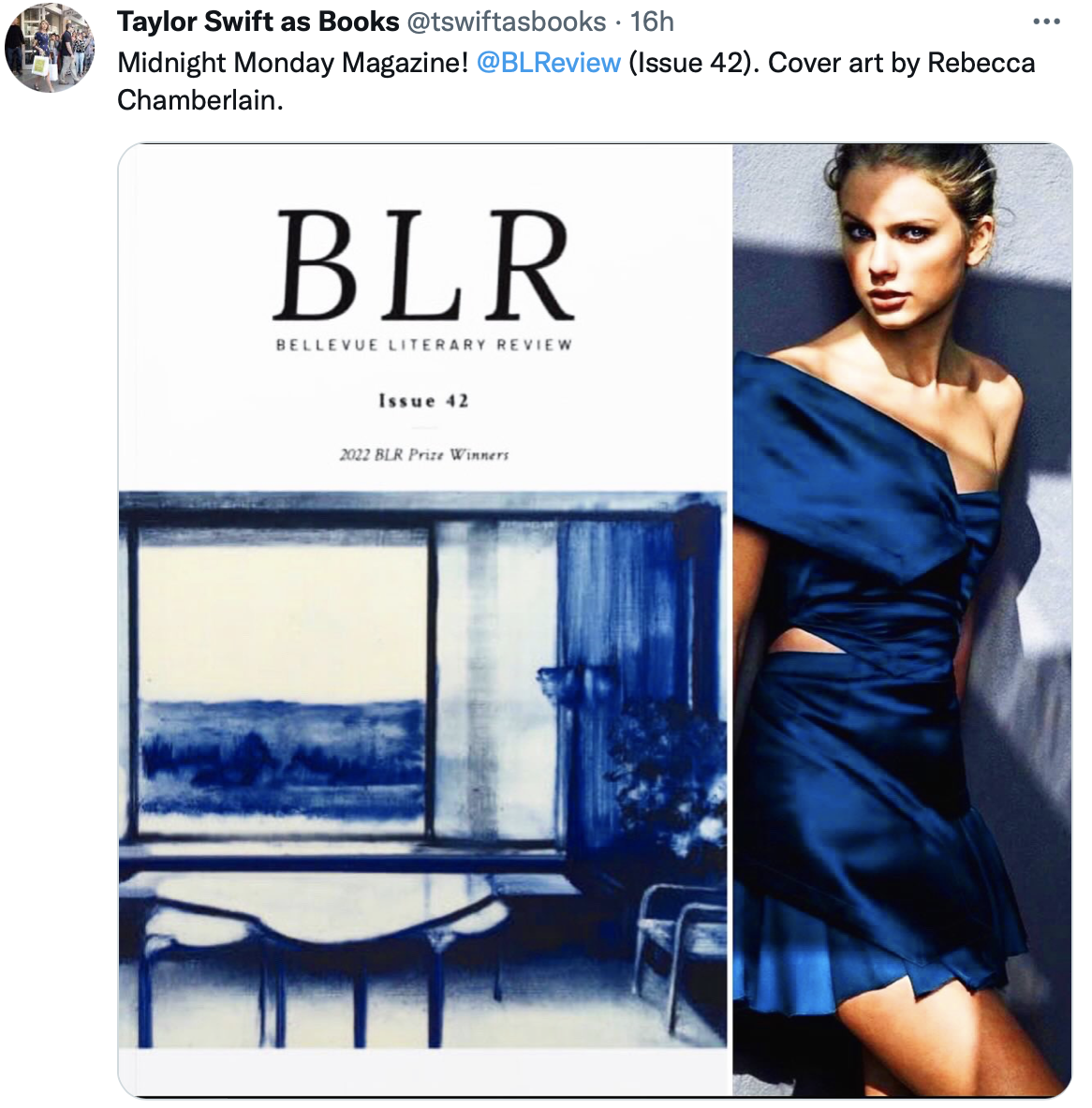
Issue 42 featured the 2022 BLR Prizewinners, selected by judges Michele Harper, Amy Hempel, and Crystal Valentine. These winners are highlighted in this email, along with the unique attention this issue’s cover art received online.
From the Foreword
This issue of Bellevue Literary Review goes to press just as the Covid pandemic rounds out its second full year. For BLR, this period has been one of upheaval, as for everyone. But there have been some unanticipated bright spots. The shift to virtual events, for example, has allowed us to diversify our offerings and create events that continue to live on. BLR’s website and YouTube channel feature our programs on poetry and Parkinson’s, how writing confronts racism, the life of Oliver Sacks, writing during the Covid pandemic plus our original film, “Reading the Body,” that intertwines dance, disability, and poetry.
On a less tangible, but no less significant note, the pandemic has reinvigorated our sense of purpose. Grappling with illness has become universal, or at least now universally acknowledged. The themes that BLR writers have mined for twenty years are now recognized as fundamental themes of the human experience.
– Danielle Ofri, Editor-in-Chief
Read Highlights from Issue 42
Each week, we’ll be highlighting one outstanding story, poem, and essay from the featured issue. We encourage you to explore more from the issue on our website or, better yet, to pick up a copy!
Step-Down
2022 Winner, Goldenberg Prize for Fiction
by Nitin K. Ahuja
I don’t mind the night shift. I’m still new here, granted, so it doesn’t really matter whether or not I mind it. I suspect I’d have a harder time on the general wards, where nights are really just a babysitting gig. But not in the step-down unit, where the patients are all sick in a steady but uncertain way, suspended between the floors and the ICU, waiting for the course of an illness to reveal itself. The lights are dimmed through the early morning hours, and the cardiac monitors keep softly beeping. I spend most of my time with a pleasant sense of calm and capability, holding in my haunches the energy of a weighted spring.
The best compliments I receive from my colleagues are in this spirit. “You’re so levelheaded, Russell,” or, “If I was ever in here, Russ, I’d want you to take care of me.” I try to accept this praise with an ample dose of self-deprecation, or else false swagger that serves the same basic purpose: “God help you, Marge,” or, “You should be so lucky, Marie.”
It isn’t lost on me that I stand out in other ways. Male nurses at this hospital are few and far between. They skew either young and effeminate or old and foreign. Visitors who stop me for directions in the lobby usually mistake me for a doctor. With my back half-turned toward a cabinet or computer, I sometimes feel my coworkers’ eyes on me, lingering with the sort of idle curiosity that I assume drives zoo patrons through the lesser exhibits, where the animals aren’t beautiful or dangerous, just rare enough to be interesting.
In My Head
2022 Winner, Felice Buckvar Prize for Nonfiction
by Avra Aron
You are twelve years old and your mind is like a game of hot potato. Your thoughts are quick and jerky, and you need to get past them before you get burned. Close a cupboard, turn the page of a book, put on a jacket. Hop into bed, open the refrigerator, flick on the light. Stay too long on something and that’s it, BOOM, you need to open and close the door six times before you can continue on with your life. Why? Because if you don’t, your mother will die.
Intellectually, you know that closing a door has nothing to do with your mother dying, but that’s not the point. Your mother is going to die; the only question is how, and your brain dares you to pick the most disturbing manner. Maybe your mother will get hit on the head, the way she did when you were eight years old, when she opened the freezer and a frozen chicken carcass came flying down and bonked her skull so badly that she started to bleed and you had to call the nearest neighbor for help and then later at the hospital your father was laughing to the point of being hysterical. A flying chicken, he kept repeating. A flying chicken!
Drought Pastoral
2022 Winner, Allman Prize for Poetry
by Michael M. Weinstein
I wanted you, desert
you red incorruptible
parchedness perched on
the earth’s bone shoulder
songless as the hot
wind soughs through you
and the dump truck windows
gleam like opened blisters
at high noon. Today I
heard the grass growing
whispering its one shared word
blade to blade until the whole
green lawn knew it.
Issue 42: The Cover
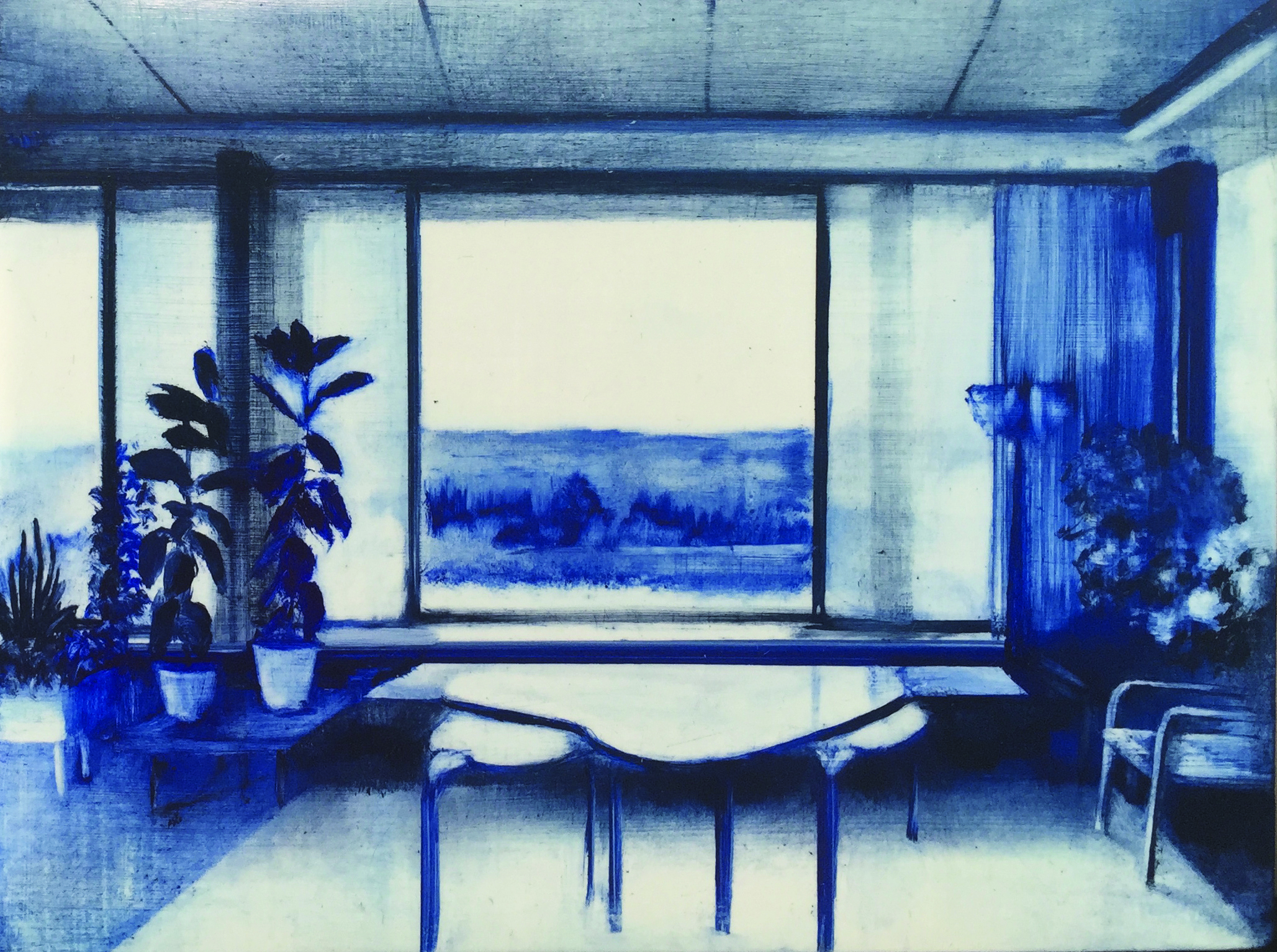
Image used by permission of the artist
The cover of this issue of BLR featured was created by Rebecca Chamberlain, and titled “Homatorium Series, Aalto, Public-Private.”
As stated in the issue cover note:
“Drawing from early Modernist architecture and abstraction from the interwar period and its embodiment of humanist ideals, Rebecca Chamberlain’s works are meditations on dwelling and being. Her monochromatic paintings utilize photographs (her own and archival) plus additional materials such as ballpoint and lithography inks, lead crystal, and vintage architectural tracing cloth.”
A fun fact about this issue’s cover: it was featured by “Taylor Swift as Books,” a social media account that matches Taylor Swift’s outfits and aesthetic to book covers!