

Issue 51 Foreword
Danielle Ofri
As I write this foreword, I’m keenly aware that I was doing the exact same thing, twenty-five years ago, for the inaugural issue of Bellevue Literary Review. Of course, it was all terra incognita at the time—everything from choosing the fonts and finding a printer to reading through the bounty of submissions and curating a balance of poetry, fiction, and nonfiction.
But a foreword—despite its name—is always something of an afterthought. After the months-long sprint and the balls-in-the-air juggle of pulling the issue together, you just want to collapse in your seat and draw in what feels like the first full breath in ages. And then it suddenly dawns: oh wait, there’s still one more thing. The issue needs some sort of welcome for the reader.
I wrote the foreword to BLR Issue 1 while sitting in my clinic office at Bellevue Hospital. The poems, stories, and essays were laid out on the exam table. (Submissions were all paper then, and the rectangular shape of my exam table was ideal for visualizing the breadth of literary work that comprised the issue.)
At its founding, BLR was a project within NYU’s Department of Medicine, but our physical—and spiritual—home was at Bellevue, the oldest public hospital in the US. It’s where I’d done my training, and where I was laying down roots for what would turn out to be the site of my entire medical career. The inspiration for that first foreword, then, came directly from this hospital where I was sitting.
“If great literature arises from an unflinching examination of the tender underbelly of human existence, then a literary journal is a natural development for an institution such as Bellevue,” I wrote. “Its halls have witnessed two and a half centuries of human drama. Bellevue Literary Review was created as a forum for examining the human condition through the prism of health, illness, and healing.”
These words still ring true to me today, a quarter of a century later. Even though BLR became an independent nonprofit during the tumult of the Covid pandemic in 2020, our creative roots remain connected to Bellevue. I still work in the clinic, and every day I witness how the struggles with illness and healing impact our everyday existence. Long after our submission process became digital, we still printed out the first page of every story, essay, and poem; laying the pages out on my exam table still felt like the only way to order the contents of each issue. We were seeking to balance theme, style, perspective, voice, and emotional charge, but it was inescapable that every page in hand was the physical manifestation of a human story.
As we celebrate BLR’s 25th anniversary, we still view our mission as a forum for examining the human condition through the prism of health, illness, and healing. Over the years we’ve received and read some 75,000 submissions, each one a window into a unique world. In the first 50 issues of BLR, we’ve published 250 essays, more than 500 stories, and over 1,000 poems, including more than 125 literary prizes. That’s roughly 10,000 pages of creative writing from over 1,500 authors!
It is a true delight, then, to welcome you to the 51st issue of BLR, an expanded 25th anniversary edition of the journal. There is a bounty of creative writing within these pages, and I encourage you to savor it all.
The fiction in this issue does what fiction does best. It takes us around the world—to Nigeria, Afghanistan, the Philippines, Cuba, China, Turkey, and the Jersey Shore—and to all manner of situation. The protagonist of “Our Lady of Slaughter” by Scarlett Diaz Power is a self-possessed nine-year-old who discovers newfound authority after surviving illness. In his first published work of fiction—“Asymptote to Silence”—Pitoyo Hartono writes of a math professor adjusting to novel and strange surroundings. Sarah Juma, in “How to Sell a Deathbed,” describes the uncanny sales pitch made by a nursing-home owner to prospective residents.
This issue’s nonfiction brings us into the lives of real people, and how they navigate their unique circumstances. In the essay “Divide,” medical student Novi Zheng explores how the Chinese language and mathematical metaphors of their parents provide context for otherwise invisible ADHD and gender dysphoria. Paul V. Brock, in “The Sound Offensive,” illuminates the unsettling experience of reentering the world of the hearing when he dons hearing aids. In “Winking at the Sun,” Mahru Elahi grapples with a rebellious thyroid, while the monarch butterflies around her fight to survive.
The poetry in these pages conveys emotion and narrative with an economy of phrase. Peggy Ann Tartt’s poem “Bilingual” opens with the couplet: “My father’s second language /was silence, and he was fluent.” Mubanga Kalimamukwento, in the poem “Birth,” recalls losing her mother when she was a young child: “The morning after my mother succumbs to her illness, / I wake up forgetting, waiting for her Good morning to come…”” In the poem “I’m Not Bothering Anybody With My Blues,” R. Nikolas Macioci wonders if he “like William Stafford, / will write a poem on the last day of my life,/ or will I grab a handful of sun and try to hang on?”
Because Issue 51 is an expanded anniversary issue, the additional pages offer us room to bring you some delightful extras. Poet Meghan O’Rourke shares the wealth of poems that sustained her through her own illness, in an inspiring essay that will appear inher forthcoming anthology, The Story of the Body. Book review editor Kate Falvey has assembled recommendations from eight of BLR’s stalwart book reviewers, who offer you bucket lists of books, poems, and even single lines to turn to when you need solace or support.
BLR has also invited a selection of eminent authors to share thoughts about how writing intersects with health, illness, and healing. You’ll enjoy wisdom imparted by Edward Hirsch, Sarah Ruhl, Susannah Cahalan, Porochista Khakpour, Theresa Brown, and Damon Tweedy.
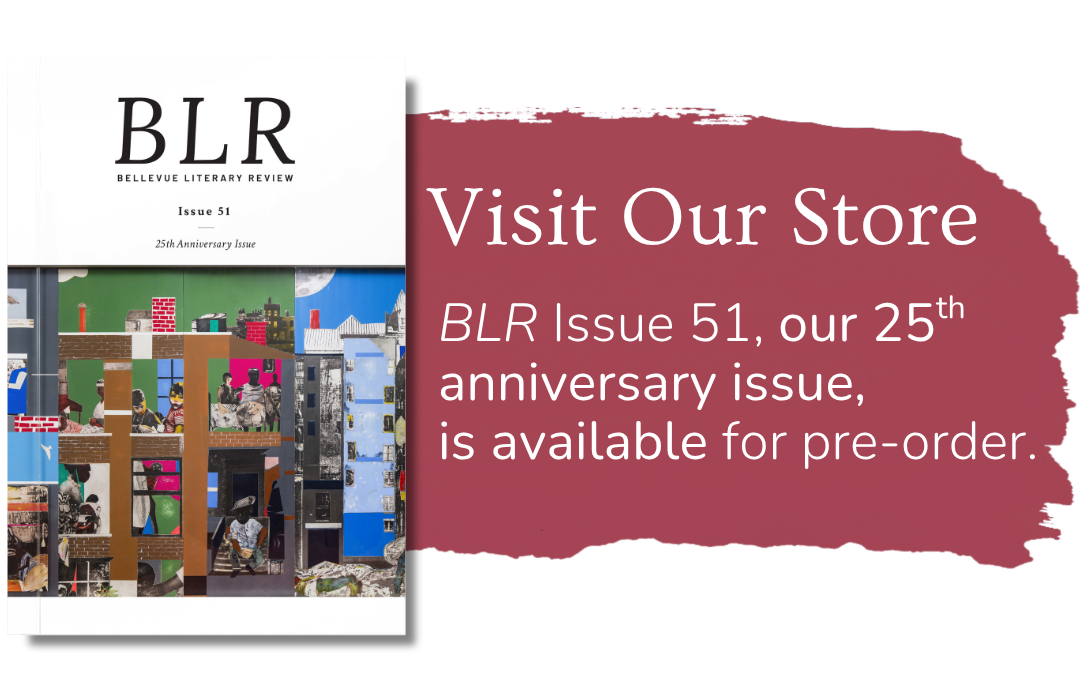
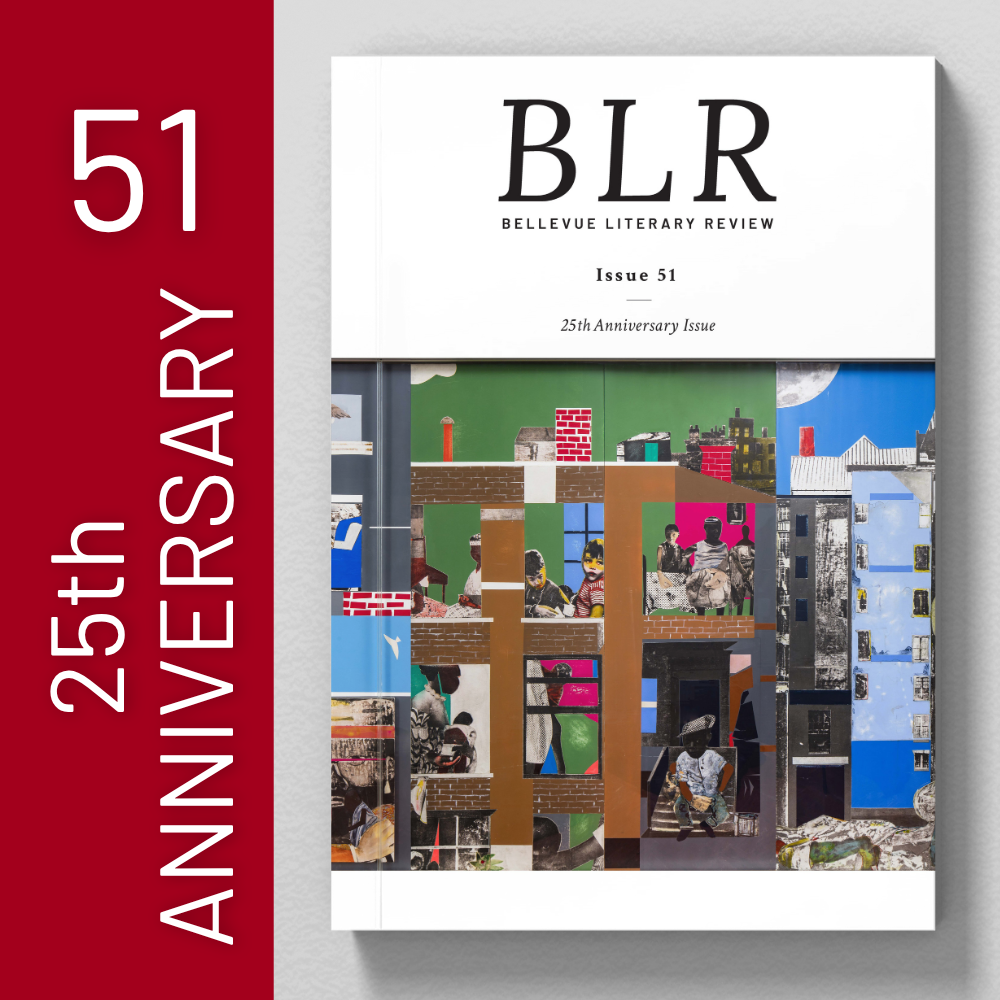
And because art is so interconnected with healing, we are especially delighted to share a special feature showcasing art from New York City’s public hospital systems. The cover of this issue is a detail from a striking collage by Romare Beardon that hangs in Bellevue Hospital. Further on in our pages is a gorgeous insert with some highlights from the more than 8,000 works in the NYC Health + Hospitals art collection.
No creative entity can be static, and BLR has grown and evolved over the years into a full-fledged literary arts organization. The journal remains both the cornerstone and the north star of our creative endeavors, but it’s been enriching to experiment with a variety of ways to connect with our community. At our start, we held precisely two events per year, a reading to launch the new issue each spring and fall. Now we’ve been able to supplement these launch celebrations with in-depth author interviews, BookTalk events, and the BLR Book Club to read together. The “Reading the Body” initiative yielded a series of short films featuring dancers interpreting BLR poems, which won numerous awards at national and international film festivals. Our live storytelling events bring stories to the stage in off-Broadway theaters. The Writing Illness onto the Page workshops connect aspiring writers with BLR editors to explore the craft of fiction, nonfiction, and poetry. BLR’s Studio Visits provide a window into the creative process of the artists whose work graces our covers. BLR’s Conversations on Creative Writing in Healthcare series brings together preeminent authors for fascinating discussions. The Art in Medicine program offers clinical trainees the opportunity to hone close-observation skills using BLR writings and cover art.
I gaze at this list and remain astounded at the generativeness of this community and of the intense creative passion of BLR authors, editors, reviewers, board members, volunteers, subscribers, readers, viewers, and audience members. At a moment when societal vulnerability feels almost akin to the vulnerability experienced during illness, a community that is thriving, passionate, and welcoming is indeed a balm. Thank you all for being part of this very necessary prescription.
And a very special thanks to all of the people and institutions that have enabled BLR to thrive—the many generous individual donors, the New York State Council on the Arts, the National Endowment for the Arts, the Brandt Jackson Foundation, the Laurie M. Tisch Illumination Fund, the Arts in Medicine program at NYC Health + Hospitals, the Leslin Healthcare Leadership Foundation, the Goldenberg and Buckvar families, and so many other supporters. These votes of confidence have been foundational to BLR’s ability to support our writers and artists, and serve our community.
We are excited to find out what the next 25 years will bring. We can’t wait to discover what poems, stories, and essays are churning in writers’ minds that will fill the pages of the journal. We are eager to see how the conversations and connections flow within the BLR community. The next chapter is unfolding and we are so grateful that you are part of this story.