Issue 30 Foreword
by Ronna Wineberg
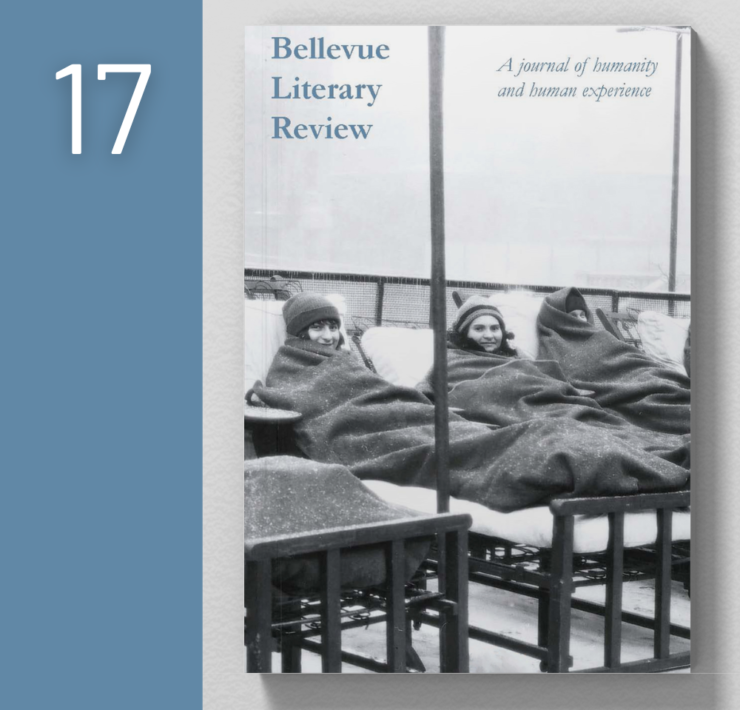
Welcome to the thirtieth issue of the Bellevue Literary Review. In 2000, when we sat in Bellevue Hospital, creating this literary journal, the world seemed like a stable place. The third millennium had begun. Life felt relatively peaceful; violence and war occurred in countries far from us. We assumed this stability would extend for decades. The first batch of BLR submissions explored illness, death, the practice of medicine, and families, and were set mostly in the United States.
The world is fluid, though, and just as our first issue was going to press, the attacks of 9/11 took place. We now live in an era in which terrorism has, unfortunately, become part of our daily vocabulary. The Internet and the ease of travel of people and ideas have made us—for better or for worse—citizens of one global community. Medicine, too, has been transformed; we can sit at the computer and search for cures, or choose 5-star hospitals and the best doctors based on the ratings of strangers. The themes of the stories, poems, and essays that come to the BLR reflect the concerns of our changing world.
One of the pleasures of reading BLR submissions is that we learn what subjects demand a writer’s attention. Writing, after all, is a way to capture moments in time, ones that will never be duplicated again, events that actually happened or that occurred only in the writer’s imagination. Literature can provide comfort or clarity, entertain us, educate us, offer dissonance, or startle our emotions awake. A good piece of writing opens up new worlds to the reader.
In this issue of the BLR, the writers explore a range of emotions and also the concerns that exist in different parts of our global community. “The Foreign Cinema,” by Lauren Alwan, won the Goldenberg Prize for Fiction. This charming story invites the reader to travel from Istanbul to Los Angeles. The protagonist, who has been having an affair with her bookstore employer, learns about America and heartbreak from the movies, especially from her favorite film, Casablanca. “Are You Having Suicidal Thoughts?” by John Noonan—one of the Honorable Mention stories—captures the despair of depression with honesty and poignancy. The second Honorable Mention, “First Child, Second Place” by Marylin Warner, is set in rural Kansas. The eleven-year-old narrator, Della Lee Weems, relates the events that changed her family’s life, and she inserts wisdom into her tale: “A teacher once told my class that it is the capacity to hate that robs us of our innocence.”
Esther K. Willison’s “Askew,” the winner of the Felice Buckvar Prize for Nonfiction, is a devastatingly beautiful essay about a daughter’s transformation from a vibrant child into a troubled adult who commits suicide. “A Member of the Family” by Morgan Smith won the Honorable Mention. The author, a retired lawyer turned photographer, leads us inside a mental asylum in the Mexican desert near Juarez, where patients are treated in ways that may be more humane than in the United States.
“The Problem with Anatomical Thinking” by Meridian Johnson won the Marica and Jan Vilcek Prize for Poetry and is written with exquisite economy, reminding the reader of the corpse’s place in nature and the cycle of life. The Honorable Mention, “The Interview” by Kathryn Starbuck, playfully and insightfully reframes the author’s inner thoughts into an interview she is conducting with herself.
Susanna Nguy is the winner of the Daniel Liebowitz Prize for Student Writing, which is awarded annually to an NYU medical student. Her story, “The Lump,” imagines the perspective of a patient with mental illness who must simultaneously cope with a new physical illness.
We’re grateful to this year’s contest judges: Paul Harding for fiction, Mark Vonnegut for nonfiction, and Ada Limón for poetry. Our deepest thanks to the Goldenberg, Buckvar, Vilcek and Oratz/Knapp families for sponsoring the BLR Literary Prizes, which discover and showcase great literature.
Other work included in this issue of the BLR also explores a spectrum of emotions and our global community. “The Vegetable Seller,” a striking story by Sonni Aun, takes us to Seoul, Korea where an accident in a local market has dramatic repercussions that stretch from the past to the present. In “Nothing Shaking” by Michael Caleb Tasker, a man attempts to reconcile with his estranged father, and their relationship creates unexpected tensions in the son’s marriage. “Canine Cardiology,” a nonfiction piece by Deborah Thompson, describes the experience of a woman who has lost her life partner to cancer and now must take care of her beloved, ailing dog.
The poetry selections give us fresh perspectives on both ordinary and extraordinary experiences. The poet Owen McLeod in “Adelia” writes: “People have tricks for falling asleep,” and he guides the reader on an insomniac’s journey toward sleep. “Ground Zero” by Gaetan Sgro unflinchingly explores terror in Sierra Leone, and “Reprieve” by Jeffrey Harrison describes the time during a remission of cancer: “Still, it seemed a miracle almost, this reprieve…” In “The Fall,” Molly Peacock navigates an injury in surprisingly wonderful ways: “My fall itself fell, rising up, both cliff and pit…”
We hope the pages of this issue capture the current moments in our history and also introduce new worlds. We’re grateful to you, our readers, for joining us on this journey and sharing our joy in the written word.
Danielle Ofri
When I read the slush pile of submissions to the Bellevue Literary Review, one of the things that most catches my eye is the set-up: where the characters find themselves, what personality quirks undercut them, how they are pressed up against each other by circumstance, and what sort of challenges from left field will wreak havoc. The Spring 2015 issue of the BLR offers a literary jaunt through unusual locales and intriguing set-ups.
Carly Nugent’s story, “The Last of Its Kind,” is what we might see from Carl Hiaasen if he lived in Australia. An unassuming Mr. Nevus is fed up with the dietary restrictions forced upon him by his diabetes and decides to go down happy in a blaze of cheeseburgers. Just then…an unidentifiable mammal wanders into town from the outback.
In “Lost and Found” by Jon Mozes, a Brooklynite visits his curmudgeonly great-uncle Bolek in Tel Aviv to tentatively introduce his former therapist, now his gay lover. All are crammed into the living room of a crumbling Bauhaus apartment along with Bolek’s oxygen tank, his Filipina caregiver, and his elderly wife who unleashes expletives at her online bridge partner in Belgium.
In Michael O’Connor’s story “Dissolution,” a woman exits the subway, struggling with her Parkinson’s and her iPod earphones. At the far end of the platform stands a man clad in a bright-blue superhero cape and nothing else. He has evidently made the clinical diagnosis and confidently shouts to her: “I can cure you!”
In this issue we proudly bring you the winners of the annual BLR literary prizes, all of which offer curious and compelling set-ups. The winner of the Goldenberg Prize for Fiction, judged by Chang-rae Lee, is Carla Hartenberger. Her story “Autobiography” follows a set of Canadian conjoined twins who must wrestle with the physiology and psychology that both keep them together and wrench them apart. Honorable Mention goes to Jen Bergmark for her story “Bystander,” in which a Vietnam veteran photographer on a hike accidentally witnesses a murder.
The Felice Buckvar Prize for Nonfiction, judged by Anne Fadiman, is awarded to Adina Talve-Goodman for her essay “I Must Have Been That Man.” Talve-Goodman navigates college- age independence, her recent heart transplant, and the challenges of compassion when she comes upon a man lying on the side of the road on a rain-drenched night. Leslie Absher’s honorable mention essay, “Torso,” recounts her trip to Greece to figure out the CIA’s—and possibly her father’s—role in the 1967 coup.
Major Jackson judged this year’s Marica and Jan Vilcek Prize for Poetry and selected Hannah Baggott’s vivid poem “Dysesthesia” as the winner: “I want to know why I am always wanting,” Baggott writes, “why my body is never quiet—” And then we are brought into the sensory mayhem of dysesthesia. Honorable Mention is awarded to “Damaged” by Colby Cedar Smith: “It is possible/ to not remember/ until your body/ reveals it one photograph/at a time.” The images revealed are taut, harrowing, and memorable.
The Bellevue Literary Review is delighted to announce our newest literary prize, the Daniel Liebowitz Prize for Student Writing. Generously endowed by BLR board member Dr. Ruth Oratz and Dr. Albert B. Knapp, the annual Liebowitz prize will recognize one outstanding literary submission from the Medicine Clerkship at the NYU School of Medicine. Reflective writing has been part of the Department of Medicine’s focus on medical humanities and medical professionalism for more than a decade now. We are pleased that the Liebowitz Prize will formally recognize the literary talents of our future doctors. This year’s prize is awarded to Philip Cawkwell for his haunting poem “The Dinosaur Exhibit.”
We are deeply grateful to the Goldenberg, Buckvar, Vilcek, and Oratz-Knapp families for their steadfast support of this nexus of literary and medical arts. Their generosity and commitment send a powerful signal about the critical importance of literature as we grapple with illness, health, and healing at all levels. We hope you find the offerings in this issue stimulating, thought-provoking, and satisfying. This constitutes the best literary set-up.
Stacy Bodziak
As managing editor, my first read of the work collected for a new issue of the Bellevue Literary Review is with a critical editorial eye, attuned to plot, theme, flow, and sentence structure. Each piece is then examined more technically as the layout of the issue comes together: proofreading, formatting, running headers, paragraph balance, facing pages, white space, table of contents, and then, proofreading again.
It’s lovely, then, to go back and read the published issue for pleasure, without thinking about punctuation or font size (though those thoughts must sometimes be banished forcibly). After having been immersed in the issue as a single entity—a computer file of glyphs and margins—indulging in each individual piece as its own work of literature is deeply satisfying and often surprising. I am “discovering” these wonderful poems, stories, and essays— familiar but suddenly fresh and invigorating—and then find myself returning to them time and again. Now it is my pleasure to introduce these pieces to you, the readers.
Family is a deep well for writers, and much of the fiction in the Fall 2012 issue focuses on these complex, tender, and fractious relationships. Edward Hamlin’s “Boy, Unleashed” takes a raw look at a rural family dealing with their “wild” son in the best way they know, set against the havoc wrought by outside interference. Andrea Rochat’s “Yellow Fog” is narrated by the unique voice of a father and daughter, and traces the unnerving—and ultimately chilling—choices they make in their grief.
The young narrator of Catherine Lewis’s “Not to Scale” begins her story by stating, “One morning I woke up afraid.” She struggles to keep her own anxiety at bay in the face of her mother’s depression, embarking on a project that she hopes will help quiet her fluttering thoughts. Laura Adamczyk’s “Apnea” follows a sleep-lab technician, beautifully describing the sensation of “waterless drowning” felt by both his patients and himself, as the adult child of an alcoholic pulled back into his mother’s orbit.
Several stories in this issue feature families complicated by the backdrop of war. In “Below the Knee” by Laura Ender, a wounded soldier’s return home dislodges the uneasy balance between two sisters, one his pregnant wife. Jake Wolff’s “Repurpose” takes us to rural Maine during World War II, where the installation of a camp of German prisoners-of-war upends the lives of a boy and his mother, who suffers from a mysterious ailment they know only as “the insanity with two heads.”
The essays in this issue examine life’s fragility from different perspectives. Elizabeth Scarboro’s “No Man’s Land” is a poignant memoir about reorienting her life after the death of her husband, moving past guilt into acceptance, perhaps even towards happiness: “There is no way, after what we had together, that life can keep me from its possibilities.” Toni Mirosevich’s “The Deposit” looks at the death of a stranger and how people react to tragedy in unison, from shrines and remembrances to the urge to claim a part of the story as their own. And in her essay “On Not Seeing Whales,” Nikki Schulak turns a sharp eye and equally sharp sense of humor to the choices that each of us must make when faced with the weaknesses of our own body.
This issue marks the first “solo voyage” for our new poetry editor, Jason Schneiderman. We are excited to share the work Jason has culled from hundreds of poetry submissions. “A Suspicion” by Ricardo Pau-Llosa describes the possibility of illness as “an anonymous / citizen of a journey / unaltered but changed / all the same.” Jeffrey Morgan’s “The Anesthesiologist” contains lovely, surreal imagery that allows the reader to join the subject on the border between consciousness and sleep. And several poems gracefully complement the prose in their meditations on family and parent-child relationships, including Deb Baker’s “Intersections” and Wendy Wisner’s “Weaning: First Day of School.”
This is the 23rd issue of the Bellevue Literary Review, beginning our 12th year of publication—yet each issue remains a joy to put together and to share with our readers. We hope the work in this issue resonates with you and inspires you.
Corie Feiner
“I kept them all. The poems, I mean.”
So writes Eleonora Luongo in her poem “Conversation with a Dead Poet,” appearing in this issue of the Bellevue Literary Review. I ponder over these lines as I write this introduction to my last issue as Poetry Editor. Since 2004, I have read thousands of poems, thousands of little gems waiting to be unearthed. I have had the pleasure of bringing some of them to the page, but the inevitable, difficult job of turning so many away. But indeed, in some way, I have “kept them all.”
Our theme of “illness, health, and healing” calls to many people who are in the medical profession, such as one of our frequent contributors, Cortney Davis, and to those living with illness, such as Hal Sirowitz. When reading poems for the BLR, I am struck by the unique voices and perspectives, the lyrical capturings, the humor, and the words selected as carefully as each stone is selected for the building of a house.
Whether the poem makes us laugh or cry, or clutch the paper to our hearts, it has to move us to another place, a new reality, a new connection so that even when you are washing the dishes or turning the keys to your door, you are thinking of that poem, that line. As Mary Elizabeth Frandson writes in her poem “No Limits, Just Edges,” which also appears in this issue, “‘Painting has a life of its own,’ / said Pollock. ‘I try to let it live.’”
We would like to thank the sponsors of BLR’s annual literary prizes. Their generous gifts go to the talented writers whose work was selected from more than 800 submissions this year.
The winner of the Goldenberg Prize for Fiction, chosen by Francine Prose, was “Trotsky in the Bronx” by Harry W. Kopp. This charming story follows a Yiddish Writers Club and their brush with Bolshevik fame. Honorable mention went to Jennifer Lee, whose story “Terminal Device” focuses on a physical therapist caring for an Iraqi war veteran.
In “Portrait of My Parents Making Love as a Stomach Virus” by Lauren Schmidt, winner of the Marica and Jan Vilcek Prize for Poetry, selected by Cornelius Eady, the daughter in the poem is “witness-sick” as she watches her father collapse in the bathroom and calls, “Get Mom. / Get Mom.” This dirge-like poem written in rhythmic couplets takes us from the vulnerable gruesomeness of watching her father suffer to a transformational moment of her parents’ bellies swelling together to “kiss, and kiss again.”
“In Winter I See the Bridge and the Lights Are Like Keening” by Megan Leonard received an Honorable Mention. In her poem, full of caesura and breath, we are brought to a painfully surreal landscape of swallowing goldfinches, spoons that cuts the side of a mouth, and a place where, “everything, my love is burning in the backyard.”
The Burns Archive Prize for Nonfiction was judged by Susan Orlean. The winner—”The Crazy One” by Annita Sawyer—is an intense dinner-time conversation between two psychotherapists, each with a past. “Mustard Seed,” the Honorable Mention essay by Jessica Penner, chronicles the trials of faith in a young woman with a rare bone disease.
To me, every issue of the Bellevue Literary Review has been like a journey that I am honored to have taken. I want to thank all of our contributors over the years, all of the writers who have submitted their work, and all of you who have read through the pages of the BLR again and again.
In my leaving, I am glad to say that the new Poetry Editor, Jason Schneiderman, an accomplished poet himself, is diligent, community-oriented, and has a deep love of poetry and the written word. In her poem “Relic,” Stacy Nigliazzo writes, “I collect you like clover / in the green fleck of my eye—” Perhaps you, too, can relate to these words, how certain pieces we come across in the BLR become more than something we read. They become something we experience, a part of us.
Danielle Ofri
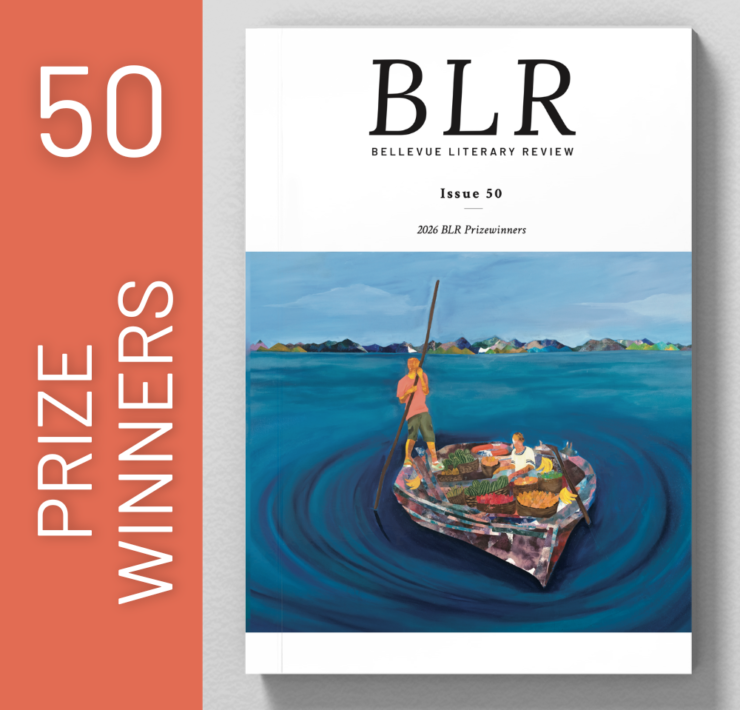
Welcome to the 50th issue of Bellevue Literary Review! It seems hard to believe, but BLR is celebrating its 25th anniversary this year. We certainly weren’t thinking in terms of a silver jubilee back when this all started, with a wisp of an idea about creative writing on health, illness, and healing. But these themes are universal, and using the arts to grapple with our shared vulnerabilities turned out to be a prescription that resonates with an ever-growing community.
We are excited to share this special year with our readers. All year long we’re digging back through our archives to highlight past issues of BLR in our weekly newsletters, featuring some of the most memorable poems, stories, and essays that have appeared in our pages. We’re launching a slate of new programs to invite the broader community to engage directly our themes, including Conversations on Creative Writing in Healthcare, Art in Medicine, Writing Illness onto the Page, as well as a book club and a writing studio.
The journal, however, remains at our core and shepherding a new crop of writings onto the page is one of the greatest pleasures of the editorial team. Even after fifty issues, the excitement of reading and selecting work for each issue hasn’t waned. And when these poems, essays, and stories come together in the finished issue—well, to an editor, there’s nothing better.
Issue 50 includes the winners of the annual BLR Literary Prizes, which attracted a wealth of impressive writing. Joan Silber, the judge for the Goldenberg Prize for Fiction, selected “The Senator” by Shannon Perri as the winner. In a story that manages to be unsentimental and even humorous at times, a mother lands upon an unusual metaphor for her brain tumor as she debates how to tell her toddler. In May Lee-Yang’s Honorable Mention story, “Hunting Game,” two young women participate in a college “game” that simulates the harrowing escape from Laos of their parents’ generation.
The nonfiction judge, Nicole Chung, chose “Running Deep,” by Won Lee, as the winner of the Felice Buckvar Prize for Nonfiction. A family navigates the unsettling waters of a mother with failing kidneys, never sure when the end might be near. Honorable Mention goes to “The Last Tableau,” by Ardis Garcia, which follows a woman who has returned to a home of conflicted memories to care for her dying father and ill mother.
The John and Eileen Allman Prize for Poetry was judged by Patricia Spears Jones. The winning poem, “Telling the Bees” by Dara Laine, moves fluidly from personal to familial to ecological: “Maybe they knew before we did. Maybe they felt it. When the line flattened. The air static. / Maybe grief hums at a pitch only bees can hear.” Honorable Mention was awarded to Miranda Saake’s “Stinson Beach,” a moving poem of parents bringing their son with leukemia to the beach: “I was trying / to recreate trips from before he was sick, / flinging himself into frigid water /on a beach so full of bleached driftwood /we believed in a kingdom of /bones.”
We recognize that BLR writings engage directly with experiences of illness, loss, suicide, and the realities of the body in ways that may be intense or affecting for some readers. We hope you will find meaning and resonance in the stories, essays, and poems contained herein.
Our thanks to the judges, the writers, and the dedicated BLR friends who sponsor our annual literary prizes—the Goldenberg family (fiction), the Buckvar family (nonfiction), and the Leslin Healthcare Leadership Foundation, which underwrites the Allman Poetry Prize. And of course the biggest thanks goes to you, our readers, who form the backbone of the BLR community. We are thrilled to share this 25th anniversary with you!
Danielle Ofri
Welcome to the Spring 2011 issue of the Bellevue Literary Review. We are pleased to bring you the winners of the annual BLR Literary Prizes. We offer our thanks to the Vilcek and Goldenberg families and to the Burns Archive for the opportunity to showcase so many remarkable writers. Of course, we are deeply indebted to our judges and reviewers.
This year’s Marica and Jan Vilcek Prize for Poetry was judged by Marie Ponsot. The winner is Janet Tracy Landman, whose poem “Sinkhole” is a delicate meditation on grief. Honorable Mention goes to Cynthia Neely for her poem, “Climacteric.”
The Burns Archive Prize for Nonfiction was judged by Jerome Groopman. “The Tag,” by Elizabeth Crowell, stood out “head and shoulders” for him. The essay is a harrowingly human story of parents facing the birth of a child with a life-threatening illness.
Andre Dubus III was the judge of this year’s Goldenberg Prize for Fiction. The winner, “But Now Am Found” by Patti Horvath, is a tender story—equal parts devotion and disillusionment—of a teenage boy in love with a girl who wears a brace for scoliosis.
The Honorable Mention for fiction goes to Jill Caputo. “Winston Speaks” is the vibrant story of Winston—severely disabled, mute—and how he navigates life from his wheelchair and with his aide upon whom he is dependent. When the editors sought to contact Jill about her story, we learned with sadness that she had recently passed away. Disabled by a stroke at the age of 11, Jill became a writer, completing her MFA at Florida State University. She was working at the university when her wheelchair was struck by a car as she crossed a street on August 10, 2010. She was 30 years old.
Much of the writing in the Bellevue Literary Review touches upon mortality and vulnerability. Writers often use fiction and poetry—“the great lies that tell the truth”—to mine the emotional depths of these issues. But sometimes the brutal facts of real life jolt us, and can make literature feel rather paltry.
In the waning weeks of August, through September and October, “Winston Speaks” was being passed from hand to hand, as reviewers and editors read, discussed, and debated this story, unaware that the author had been killed in a car accident just five weeks after submitting it. The story was very much alive for all of us, eddying in our minds as it survived cut after cut of the hundreds of contest submissions. By the time we called to congratulate her, all her listed phone numbers and email addresses were inactive. When we finally pieced together what had happened, and then tracked her family in Kansas, it felt as though we had lost a close friend.
We had never met Jill Caputo, but we’d experienced an intimate relationship with part of her, absorbed in the intricacies of her narrative voice, living with her story for months. “Winston Speaks” is very much alive, even though the author is not.
It is true that real-life tragedy can make artistic pursuits seem frivolous. There is a certain leap of faith and gulp of guilt that one registers after experiencing illness or adversity, and then reading a poem or writing a story. But literature has always offered succor to patients, families, and caregivers with an intensity that far supersedes the mere scratches of ink on the page. So perhaps it does makes sense, with some curious but compelling emotional logic, to engage literature at these painful moments.
Jill was just beginning her career as a writer, but she was able to use the medium of fiction to convey some of the most eye-opening truths. For those of us who’ve had the good fortune (some would say random luck) to have not experienced disability, Jill’s invented character and made-up story do a more faithful job in communicating the “facts” of disability than most textbooks. It is a gift that extends to the concentric rings of readers who will experience the story, and then pass it along to a friend or colleague or student.
It is with these thoughts that we dedicate this issue of the Bellevue Literary Review to Jill Caputo, and offer our thanks to her for graciously sharing her wisdom with us.
Danielle Ofri
Welcome to the 50th issue of Bellevue Literary Review! It seems hard to believe, but BLR is celebrating its 25th anniversary this year. We certainly weren’t thinking in terms of a silver jubilee back when this all started, with a wisp of an idea about creative writing on health, illness, and healing. But these themes are universal, and using the arts to grapple with our shared vulnerabilities turned out to be a prescription that resonates with an ever-growing community.
We are excited to share this special year with our readers. All year long we’re digging back through our archives to highlight past issues of BLR in our weekly newsletters, featuring some of the most memorable poems, stories, and essays that have appeared in our pages. We’re launching a slate of new programs to invite the broader community to engage directly our themes, including Conversations on Creative Writing in Healthcare, Art in Medicine, Writing Illness onto the Page, as well as a book club and a writing studio.
The journal, however, remains at our core and shepherding a new crop of writings onto the page is one of the greatest pleasures of the editorial team. Even after fifty issues, the excitement of reading and selecting work for each issue hasn’t waned. And when these poems, essays, and stories come together in the finished issue—well, to an editor, there’s nothing better.
Issue 50 includes the winners of the annual BLR Literary Prizes, which attracted a wealth of impressive writing. Joan Silber, the judge for the Goldenberg Prize for Fiction, selected “The Senator” by Shannon Perri as the winner. In a story that manages to be unsentimental and even humorous at times, a mother lands upon an unusual metaphor for her brain tumor as she debates how to tell her toddler. In May Lee-Yang’s Honorable Mention story, “Hunting Game,” two young women participate in a college “game” that simulates the harrowing escape from Laos of their parents’ generation.
The nonfiction judge, Nicole Chung, chose “Running Deep,” by Won Lee, as the winner of the Felice Buckvar Prize for Nonfiction. A family navigates the unsettling waters of a mother with failing kidneys, never sure when the end might be near. Honorable Mention goes to “The Last Tableau,” by Ardis Garcia, which follows a woman who has returned to a home of conflicted memories to care for her dying father and ill mother.
The John and Eileen Allman Prize for Poetry was judged by Patricia Spears Jones. The winning poem, “Telling the Bees” by Dara Laine, moves fluidly from personal to familial to ecological: “Maybe they knew before we did. Maybe they felt it. When the line flattened. The air static. / Maybe grief hums at a pitch only bees can hear.” Honorable Mention was awarded to Miranda Saake’s “Stinson Beach,” a moving poem of parents bringing their son with leukemia to the beach: “I was trying / to recreate trips from before he was sick, / flinging himself into frigid water /on a beach so full of bleached driftwood /we believed in a kingdom of /bones.”
We recognize that BLR writings engage directly with experiences of illness, loss, suicide, and the realities of the body in ways that may be intense or affecting for some readers. We hope you will find meaning and resonance in the stories, essays, and poems contained herein.
Our thanks to the judges, the writers, and the dedicated BLR friends who sponsor our annual literary prizes—the Goldenberg family (fiction), the Buckvar family (nonfiction), and the Leslin Healthcare Leadership Foundation, which underwrites the Allman Poetry Prize. And of course the biggest thanks goes to you, our readers, who form the backbone of the BLR community. We are thrilled to share this 25th anniversary with you!
Stacy Bodziak
“You opened this door…”
So begins Melissa Stein’s poem, “Hinges,” appearing in this issue of the Bellevue Literary Review. It is an apt description for much of the writing we receive. Our themes seem to inspire writers to dig a bit deeper, to enter the realms that are slivered open when illness invades. The ways in which we are broken and healed press these doors even further ajar, allowing us to consider the fragility of the human experience.
When asked to describe our themes, we often say that we are looking for writing on “illness, health, and healing.” However, this is a deceptively simple phrase. Yes, on the surface these are stories, essays, and poems about disease and healing, about the mind and body. But they are more than that. They take the reader into intimate spaces and help us find that common place—that human place—where we can slip into another person’s experience.
Several pieces in this issue are meditations on loss. In “A Distant Shore,” by Patrick Pfister, our narrator—on the cusp of moving from hospital to hospice—is charged with taking stock of his life in order to find some kind of peace before death. MaryLee McNeal’s “Smart Enough” approaches loss from a different angle, as a man who has spent his life under the thumb of his domineering mother is suddenly ‘free’ after her death. Nancy Naomi Carlson’s “What Bears Your Name” is a beautiful poem about honoring a child’s “one day of life.”
Other pieces in this issue also consider birth and childhood. Christopher Schacht’s “Shark Eyes” turns an unflinching eye to what constitutes living when twins are delivered prematurely. In “Martin, 1918,” Karina Borowicz describes a childhood cut short by “the epidemic standing sentinel/ at the border between twelve and thirteen.” The young narrator in Kelly Flanigan’s “To the River” also sees his childhood contract when he must cope with tragedy in his friend’s family and uncertainty in his own. In “Before the Jacaranda Trees Bloom,” by Sequoia Nagamatsu, two recent college graduates spend a summer at a hospice in South Africa, mourning the end of their relationship while helping a young boy grieve the impending loss of his mother to AIDS.
All of the essays in this volume contemplate family relationships: what we inherit, what is lost, and how lives are interwoven despite the fractures of time and place. P. Phillip Cheung’s “My Father’s Hands” focuses on the intangibles that his father has passed on to him, delicate talents that were not taught so much as absorbed. Itzhak Kronzon and Kurt Magsamen also pay tribute to fathers—in very different ways—in their essays. Hazel Kight Witham’s “The Storm Between Us” parallels the author’s struggle with mental illness with that of her grandmother, tracing her birthright back to the hospital where her grandmother endured treatment of a different sort in another era. And in “She Might Die,” Magda Montiel Davis reaches back to a time when her mother’s future was uncertain and her own capacity to understand was bound by the limitations of childhood.
Other pieces invite us to go along for the ride with their unique characters. In “The Hand You’re Dealt,” Jerry M. Burger takes us on a journey with a bipolar man searching for connection while in the throes of a manic gambling trip. Luther Magnussen’s “At War With General Franco” follows a gallivanting soldier in the Spanish Civil War, weaving his story back and forth through time. And in “This, of Course, Is Spiritual,” by Matt Lombardi, we spend time with a writing professor who has locked himself in the school bathroom, where he alternates between raving wildly and calmly teaching class to the students gathered outside the door.
We hope you enjoy ‘opening this door’ with us. Simply putting together an issue means nothing if it does not reach the hands of passionate readers. We are grateful to everyone who joins our community of subscribers, and to everyone who chooses a copy from the overflowing bookstore racks. We hope that the words in the BLR stimulate discussion and reflection, and that you’ll be inspired—to share the journal and to share your own stories.
Danielle Ofri
The Fall 2004 issue of the Bellevue Literary Review chronicles a range of bodily rebellions, the sometimes colorful and often agonizing varieties in which they are manifest, and the challenges of adapting to them. In “The Plagiarist,” Hollis Seamon creates an English professor, whose staid life is shaken by unexplained heart palpitations. This sudden loss of her body’s reliability causes her to view differently her troubled student and her aging dog. Dorothy Wall, in her essay “On Determination,” examines the triumph-over-adversity myths that often frustrate, rather than inspire, those with disabilities. With a disability that is not necessarily visible to most eyes, Wall is able to see how the ever-present threat of disability stirs the anxiety of the “temporarily able.”
One aspect of life with a disability that is rarely discussed is sexuality. While rehabilitation programs exist to provide therapy for many of the impairments incurred by illness, there is little guidance in the realm of sex. Catherine Bergart, in “Doing It,” writes candidly about the modern technologies and human realities of creating a sex life in the face of quadriplegia. Stephen Dixon, in the story “Pain,” follows a husband and wife and their efforts to maintain physical intimacy as their marriage incorporates illness and incapacity.
In the story “Working for the Doctor,” Amber Dorko Stopper uses the point of view of a receptionist to examine the relationships among doctors, patients, and office staff. With a wry voice that can be biting in its humor, the receptionist pokes at the doctor, innocuously at first, uncovering some of the absurdities of his life. “Happy Hour at the Children’s Museum,” by Jenni Lapidus, features a twenty- something narrator, also with a dry wit, who navigates the intersections of a difficult upbringing, a complicated love-life, the tribulations of being a writer, and the frightening possibilities of what can happen as life grows ever more complex.
Nahid Rachlin, in “Old Injuries,” brings us from to Tehran to Texas, where an Iranian woman experiences how the stronghold of the past can overpower the present. “A Staircase in the Fog”, an essay by Robin Fast, also explores the grip of the past, in this case, how a father’s dissolution into mental illness permeates the son’s life.
The poetry in this issue of the Bellevue Literary Review considers the emotional assaults on the human body during the course of a lifetime, sometimes even after. In John Grey’s “First Born,” the “marvel” of childbirth shares hospital space with the “marvels in reverse” of cancer, coma, and dementia. Paula Sergi, in the poem, “Power and Light,” uses concise and detailed imagery to follow the trajectory of grief in the wake of a husband’s death.
Linda Tomol Pennisi’s pair of poems focuses on her daughter’s beginning of anatomy class. “She Makes the First Cut” and “I Want to Tell My Daughter Not to Name the Cadaver” encompass mother, daughter, and cadaver, in an unusual, emotionally resonant, triangle.
In the prose poem “Having an MRI/Waiting for Laundry,” Jan Bottiglieri uses sensual connections to weave memories, and finds that these recollections often threaten to recast reality.
Illness, loss, disability, and death all are uninvited guests. Each saps a portion of a person, sometimes unforeseen, often insidiously. Meditating too long on these lurking possibilities stirs an existential angst that can paralyze. But at this moment it is worth appreciating all that is not malfunctioning. We are at least “temporarily able” to grasp words on the page, and it is in this spirit that we wish you an enjoyable journey into the Fall 2004 issue of the Bellevue Literary Review.